Poker All In Strategy: When to Call, Fold, or Jam
Poker All In Strategy: When to Call, Fold, or Jam
Poker All In Strategy is not about being fearless. It is about knowing when your last bet, call, or fold has positive expected value. Once the stacks go in, the decision becomes cleaner than most poker spots: calculate the price, estimate your equity against a range, add fold equity when you are the player jamming, and avoid risking your stack when the math says you are guessing.
Poker All In Strategy Starts With the Pot
Before you think about your hand, count the pot. Beginners often start with "I have ace-king" or "I have top pair." That skips the only part of the spot you can know with certainty: how much you must risk and how much you can win.
Use this call formula when someone jams into you:
Required equity = amount to call / final pot after your call
Suppose the pot is $100 and your opponent shoves $75. If you call, the final pot is $250: the $100 pot, the $75 shove, and your $75 call. Your required equity is:
$75 / $250 = 30%
If your hand wins more than 30% against villain's all-in range, calling is profitable in chip EV. If it wins less than 30%, folding is better, even if the hand looks pretty. That is the core of beginner all-in math.
The same idea works preflop, on the flop, on the turn, and on the river. All-in spots are easier than normal multi-street spots because future betting disappears. Once everyone is all in, you get to realize your equity. No one can bluff you off the river. No one can charge you again. Your hand either wins its share of the final pot or it does not.
That does not mean all-in decisions are always easy. The hard part is estimating villain's range. A 30% price is a snap-call against a wild range and a clear fold against a range of only sets and overpairs. The math gives you the line. Your range estimate tells you which side of the line you are on.
The Three All-In Questions: Call, Fold, or Jam?
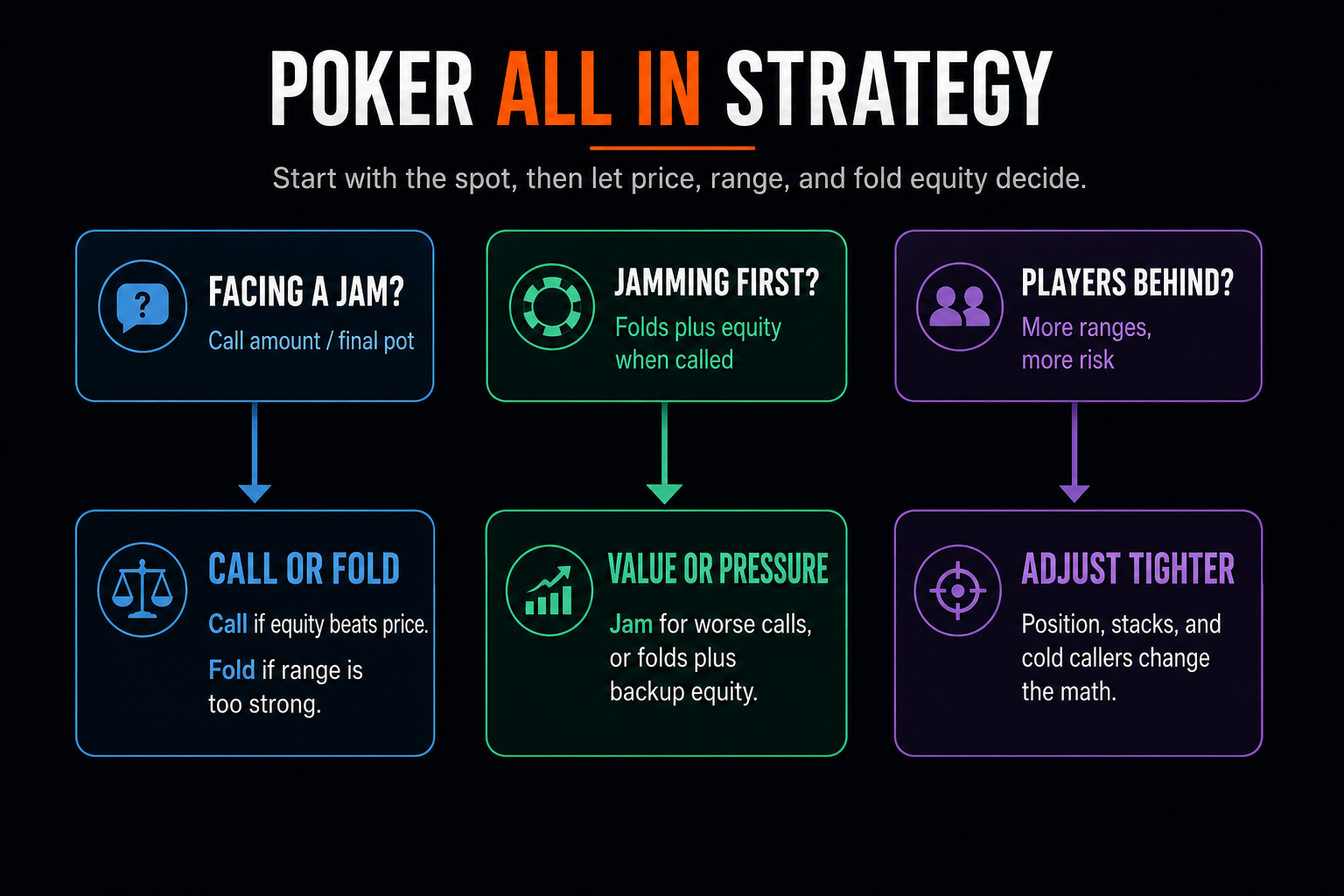
Every all-in decision starts with one of three jobs.
- If you face a shove, decide whether to call or fold.
- If action is on you and no one has jammed, decide whether jamming beats checking, calling, or making a smaller bet.
- If someone else may still act behind you, decide how their stack and range change your risk.
When you face a shove, you only have one way to win: show down the best hand often enough. You do not create fold equity by calling. The opponent has already committed the chips. Your job is to compare your price to your equity against their range.
When you jam first, you may have two ways to win. Everyone can fold, or you can get called and still win at showdown. That is why a hand like 7s 7d can be a strong 14 big blind tournament jam from the cutoff even though it is not a monster. It can win blinds and antes immediately, and when called it often has reasonable equity against broadways, suited aces, and smaller pairs.
When players remain behind, the spot becomes more sensitive. A button jam through the small blind and big blind is different from a hijack jam through four players. More players behind means more chances someone wakes up with a hand that can call. It also means tighter jamming ranges from early position.
Do not reduce every decision to "I like my hand" or "I am tired of folding." Label the spot first. Are you calling off? Are you open-jamming? Are you re-jamming over a raise? Each one uses the same EV logic, but the range assumptions are different. [INTERNAL: poker pot odds guide]
Calling an All-In: The Beginner Formula
Calling an all-in is the cleanest version of Poker All In Strategy because there is no fold equity for you. You are buying a share of the pot. If the share is worth more than the price, call. If it is worth less, fold.
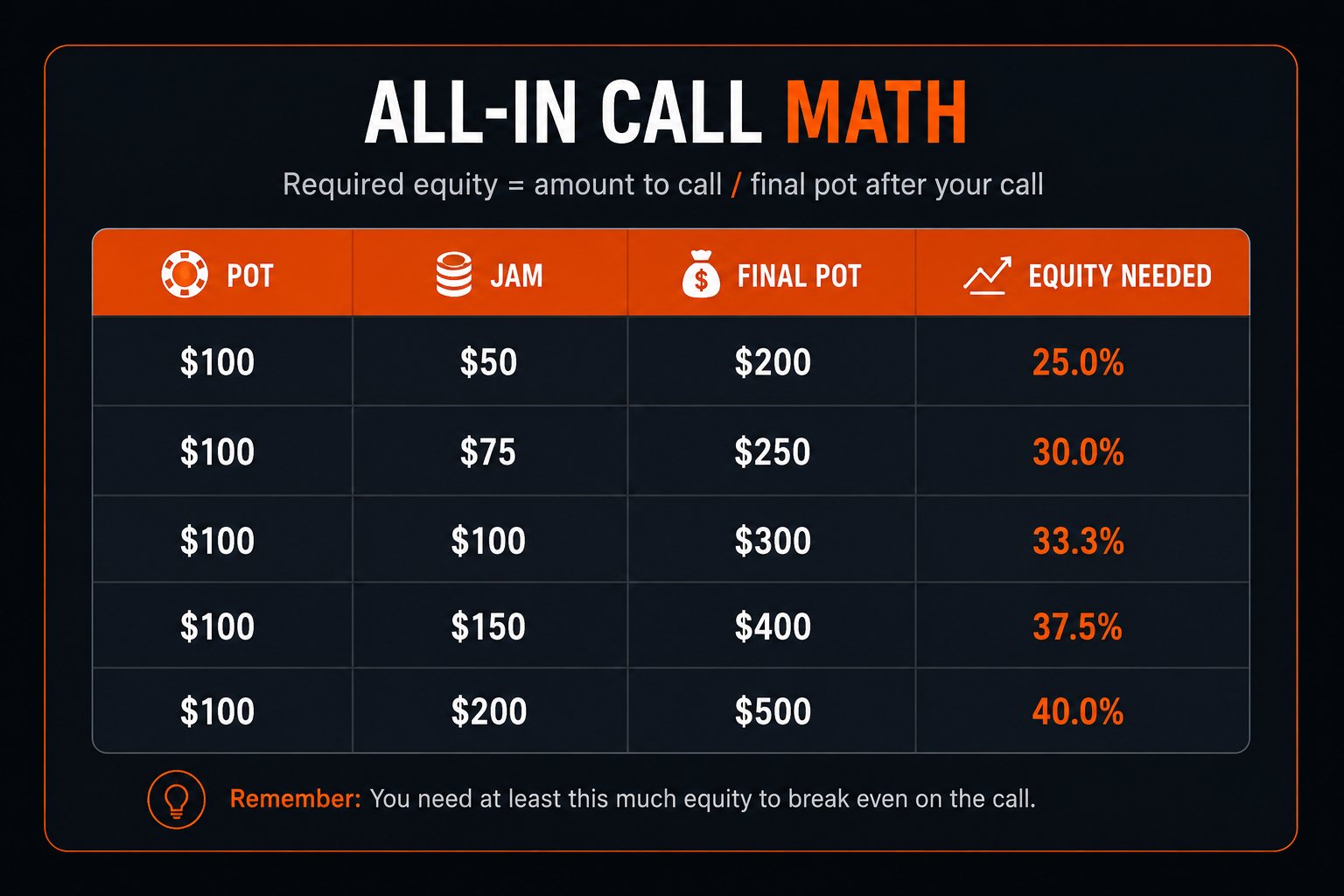
Here are common all-in call prices:
| Pot before shove | Villain shoves | You call | Final pot | Equity needed |
|---|---|---|---|---|
| $100 | $50 | $50 | $200 | 25.0% |
| $100 | $75 | $75 | $250 | 30.0% |
| $100 | $100 | $100 | $300 | 33.3% |
| $100 | $150 | $150 | $400 | 37.5% |
| $100 | $200 | $200 | $500 | 40.0% |
The bigger the jam relative to the pot, the more equity you need. But notice how even a huge $200 shove into $100 does not require you to be a favorite. You need 40%. That matters because many draws and pair-plus-draw hands are live enough to call against the right range.
A Flop Draw Example
You call preflop with Qc Jc. The flop is Tc 9c 2d. The pot is $80, and your opponent jams $120.
If you call, the final pot is:
$80 + $120 + $120 = $320
Your required equity is:
$120 / $320 = 37.5%
You have an open-ended straight draw and a flush draw. Against a single overpair such as As Ah, this hand is often around flipping territory on the flop. Against a set, it is still powerful but not as comfortable. Against a range that includes overpairs, top pair, nut flush draws, and sets, you need to estimate whether your actual equity clears 37.5%.
This is why range matters. If villain only jams sets and Ac Kc, you should not treat your draw like it is printing. If villain can jam overpairs, weaker draws, and top pair because they hate scary turns, the call becomes much better.
A River Bluff-Catcher Example
The river is different. There are no outs to come. You either beat enough bluffs or you do not.
Suppose the pot is $200 and villain jams $200 on the river. You need:
$200 / ($200 + $200 + $200) = 33.3%
Your one-pair hand does not need to win most of the time. It needs to win one time in three. If villain arrives with many missed draws and over-bluffs, call. If villain is a low-stakes player who almost never rips the river without a very strong hand, fold and keep the stack.
Folding Is a Profitable Poker All In Strategy
Folding feels passive, but folding is often the highest-EV action. A beginner leak is treating all-in decisions like personal tests. They are not. They are pricing decisions.
If you face a $150 shove into a $100 pot and your hand has 28% equity against the jamming range, calling loses money. Your required equity is 37.5%. Folding saves the $150 you were about to put into a bad investment. That saved money is profit in practical terms.
Folding gets especially valuable when the opponent's range is narrow. If a tight player cold 4-bet jams 100 big blinds and you hold AQs, you may be attached to the blockers and suitedness. But if their range is mostly QQ+, AK, your equity is not good enough at many prices. The ace blocker does not magically create a call.
Another common fold is the dominated draw. You have Kc 8c on Ac Jc 4d, and a tight opponent jams a big stack. You have a flush draw, but not the nut flush draw. Some club runouts make you a flush and still lose to better clubs. If villain's range includes many Ax of clubs and strong made hands, your "nine outs" are not all clean.
Fold Before the Pot Gets Emotional
The best time to fold is before the hand becomes about frustration. If you called preflop, called flop, and called turn, you may feel invested. That feeling is dangerous. The river all-in is a new decision with a new price and a new range.
Ask three questions before clicking call:
- What equity or bluff-catching frequency do I need?
- What hands does this opponent realistically jam?
- Does my hand beat enough of that range?
If the answer to the third question is no, fold. You are not surrendering. You are refusing a bad price. [INTERNAL: hand range review process]
Jamming First: Add Fold Equity to the Math
When you jam first, your EV includes fold equity. Fold equity is the chance your opponent folds to your bet or raise. That immediate win changes the value of hands that are not strong enough to call off but are strong enough to shove profitably.
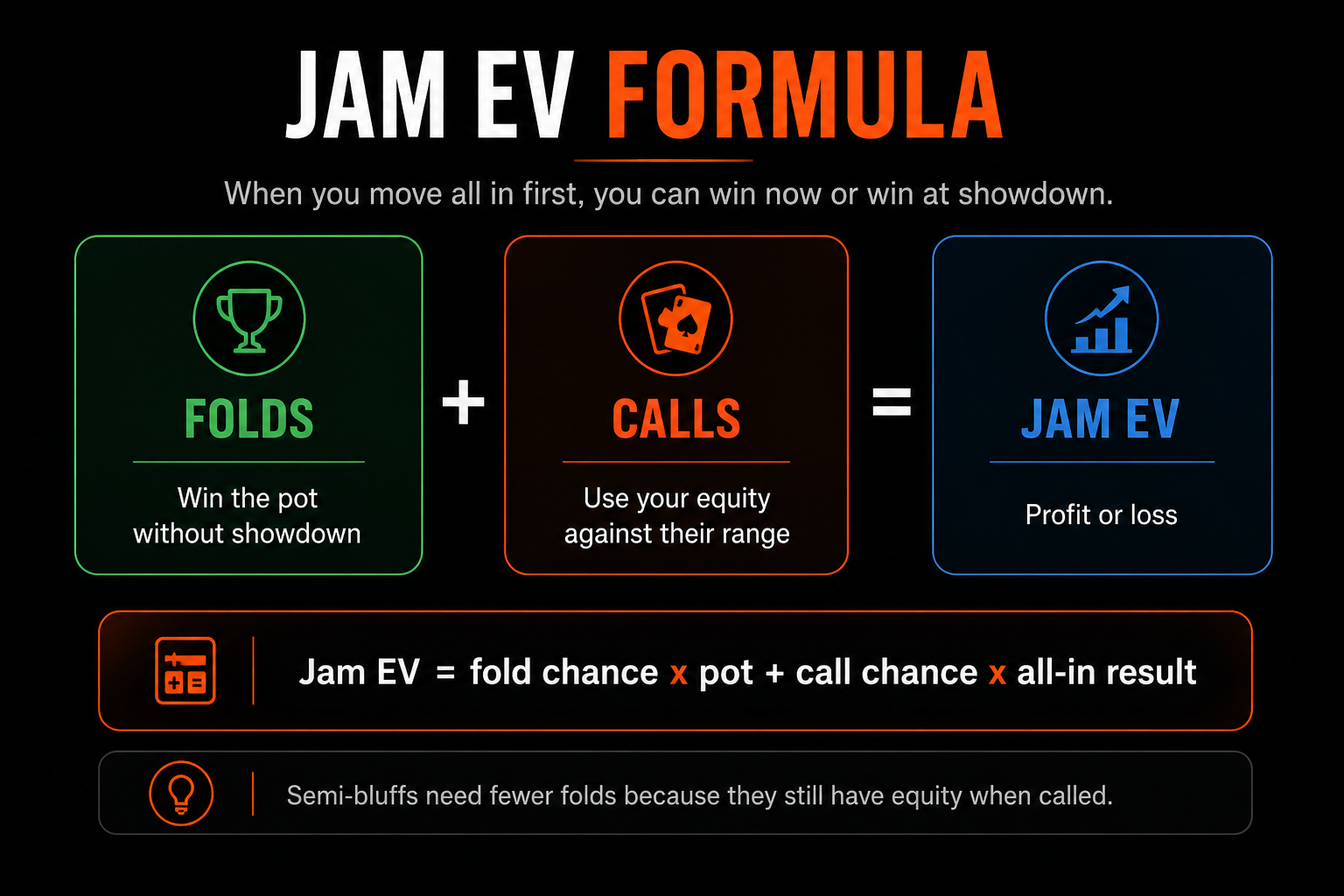
Use this simplified jam formula:
Jam EV = fold chance x pot won now + call chance x all-in result when called
Here is a small-stack tournament example. Blinds are 500/1,000 with a 1,000 big blind ante. You are on the button with 12,000. Everyone folds to you. The pot is 2,500 before your action. You jam 12 big blinds with As 5s.
If both blinds fold, you win 2,500. If one blind calls, your result depends on your equity against the calling range. You are not jamming because A5s is always thrilled to get called. You are jamming because the blinds fold a meaningful amount, and when called, A5s still has equity from an ace, suitedness, and wheel potential.
Now compare that to open-limping or min-raising with the same short stack. Those lines may invite calls, leave awkward stack-to-pot ratios, and give the blinds chances to realize equity. Jamming denies equity and makes them risk a large portion of their stacks to continue.
Jam for Value
A value jam wants calls from worse hands. You jam because the opponent can call with hands you beat often enough.
Example: You have Kh Kd on Qh 8s 4c 2d. The pot is $180, and your opponent has $210 left. If this player calls too much with top pair, overpairs, and sticky queen-x hands, jamming can be better than betting small. You do not want to "keep them in" with a size that misses value. You want worse hands to put in the maximum.
The value-jam question is simple: when called, am I ahead often enough? If yes, use a size that worse hands can still justify. Against calling stations, the answer is often bigger than beginners expect.
Jam as a Bluff or Semi-Bluff
A bluff jam wants folds. A semi-bluff jam wants folds but still has equity when called.
Pure bluff jams need a lot of fold equity because they have little backup plan. Semi-bluffs need less fold equity because the hand can improve. A combo draw, a nut flush draw, or a strong straight draw can be a much better all-in candidate than a hand with blockers but no equity.
For example, if the pot is $100 and you jam $100 as a pure bluff, you risk $100 to win $100. Your bluff must work more than 50% of the time if you have zero equity when called. If you have 25% equity when called, you need fewer folds because some called pots still come back to you.
That is why beginners should prefer semi-bluff jams over random "I hope you fold" jams. Equity gives your bluff a second way to win.
Stack Depth Changes Everything
All-in math is stack-size math. The same hand can be a jam at 10 big blinds, a raise-call at 25 big blinds, and a fold to a 100 big blind 5-bet.
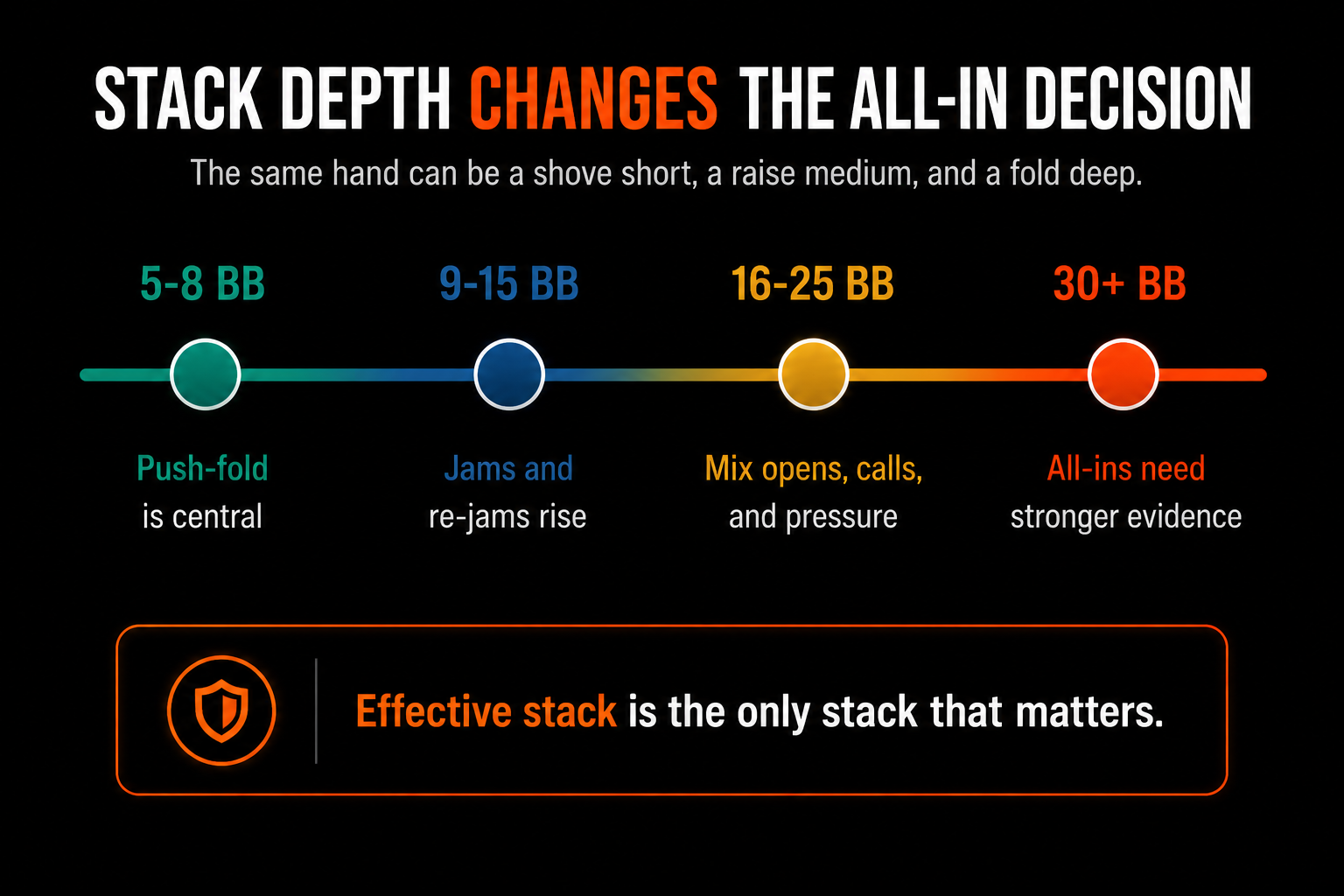
At short stacks, the pot is large relative to your stack. Blinds and antes matter. Fold equity matters. Hands with raw equity become more playable because there is less future betting. Pocket pairs, suited aces, and broadway hands often rise in value.
At deeper stacks, calling off becomes more expensive. A 100 big blind jam represents a much bigger risk than a 12 big blind jam. Ranges also get stronger because players usually need better hands to risk more chips. If someone 5-bet jams 100 big blinds in a cash game, do not call as if they shoved 12 big blinds in a tournament.
Effective stack is the only stack that matters. If you have $500 and villain has $140, the all-in decision is $140 effective. You cannot win the extra $360 in your stack from that opponent, and they cannot make you risk it in the main pot.
Multiway pots add another layer. Calling an all-in against one opponent is not the same as calling after a jam and a cold call. Your equity drops when more ranges are involved, and strong made hands become more common. Hands like one pair and medium draws are often overcalled by beginners in multiway all-in spots.
Preflop Poker All In Strategy for Beginners
Preflop all-ins are common because stack-to-pot ratios are smaller after opens, 3-bets, and antes. The beginner goal is not to memorize every push-fold chart immediately. Start by understanding why those charts exist.
When you are short and first in, jamming can be good because you win blinds and antes uncontested. Your fold equity is highest when players behind you have wide ranges but cannot call wide. Position matters because each player behind is another chance to get called.
As a rough beginner framework:
| Effective stack | First-in idea | Calling-off idea |
|---|---|---|
| 5-8 BB | Jam many playable hands from late position | Call wider in the blinds when price and ranges justify it |
| 9-15 BB | Push-fold decisions become central | Avoid calling off dominated broadways too loosely |
| 16-25 BB | Mix opens, re-jams, and selective calls | Respect early-position jams and strong re-jams |
| 30+ BB | Fewer open-jams; more normal raises | Calling all-in requires stronger range evidence |
This table is not a solved chart. It is a mental map. In tournaments, antes, payout pressure, player tendencies, and table position all change the answer. In cash games, rake and stack depth change the answer. Still, the pattern holds: as stacks get shorter, jamming becomes a more normal strategic tool.
Calling Preflop All-Ins
When you call preflop, compare your hand to the shoving range, not to a single hand. Ace-king against a tight 100 big blind jam may be very different from ace-king against a 12 big blind button jam. Pocket eights can be a profitable call against a wide late-position shove and a bad call against a nitty early-position shove.
Blockers help but do not replace equity. Having an ace reduces the chance villain has pocket aces, but it does not mean their range is weak. Use blockers as a tiebreaker after the pot odds and range estimate make the spot close.
Postflop All-Ins: Made Hands, Draws, and Bluff-Catchers
Postflop all-ins create the biggest beginner mistakes because hand strength changes by board texture.
Top pair can be a stack-off hand on some boards and a clear fold on others. Top pair top kicker on Ah 7d 2c with a short stack is very different from top pair on Js Ts 9s facing a deep turn jam. The first board is dry. The second board is loaded with straights, flushes, two pair, sets, and strong draws.
For made hands, ask what worse hands call or jam. If you have an overpair and the opponent can have worse overpairs, top pair, and draws, stacking off can be good. If the opponent only jams sets and straights, your overpair becomes a bluff-catcher.
For draws, separate raw outs from clean outs. A nut flush draw has cleaner equity than a third-nut flush draw. An open-ended straight draw is cleaner on a rainbow board than on a paired board where some straight cards still lose to boats. Pair-plus-draw hands can be excellent all-in candidates because they have showdown value plus improvement potential.
For bluff-catchers, the question is frequency. On the river, if you need to win 33% and villain under-bluffs, fold. If the same player over-bluffs missed draws, call. Solver-aware study is useful here because it teaches you which hands block value, unblock bluffs, and sit high enough in your range to defend.
Common Beginner All-In Mistakes
The first mistake is calling because you are "priced in" without doing the math. You are not priced in just because the pot is large. You are priced in when your required equity is lower than your realistic equity.
The second mistake is counting every out as clean. If your flush draw can make the second-best flush, discount it. If your straight card completes a flush for villain, discount it. If pairing your ace still loses to two pair, do not treat it as a full out.
The third mistake is jamming without fold equity. If the opponent has already shown they will never fold top pair, your bluff jam is not a bluff. It is a donation unless your hand has enough value when called.
The fourth mistake is ignoring position and players behind. Open-jamming from the cutoff is not the same as jamming from under the gun. Re-jamming over a loose button open is not the same as re-jamming over a tight early-position open.
The fifth mistake is treating cash games and tournaments as identical. In cash games, chip EV maps directly to money EV before rake and practical factors. In tournaments, ICM can make some chip-EV calls bad near bubbles, pay jumps, or final tables. Beginners should learn chip EV first, then add ICM when tournament life and payout pressure matter.
A Simple Table Routine for Every All-In Spot
Use the same routine until it becomes automatic.
- Identify the effective stack.
- Count the pot before the all-in.
- If facing a shove, calculate required equity.
- Estimate the opponent's range.
- Compare your hand's equity to the price.
- If jamming first, estimate fold equity and equity when called.
- Account for tournament pressure, multiway action, and player tendencies.
This routine keeps you from making result-based decisions. If you call with 42% equity when you needed 35%, the call was good even if you lose. If you call with 24% equity when you needed 37.5%, the call was bad even if you spike the river.
For study, save all hands where stacks went in. Tag them by spot: preflop call-off, preflop jam, flop draw, turn made hand, river bluff-catcher. Then write the pot odds and your best range estimate before looking at the result. Over time you will see patterns. Maybe you call river jams too wide. Maybe you fold profitable combo draws. Maybe you jam hands with no fold equity into players who love calling.
That review process is where all-in math becomes practical. You are not trying to become a calculator. You are building instincts from correct numbers. [INTERNAL: poker equity calculator]
Take Action Now
The next time you face an all-in, pause before reacting. Count the final pot, calculate the equity you need, and put your opponent on a realistic range. If your equity clears the price, call. If it does not, fold. If you are considering a jam, ask how often everyone folds and how well your hand performs when called.
That is the foundation of Poker All In Strategy: risk chips when the expected value is there, protect your stack when the range is too strong, and stop judging decisions by the card that comes next.
Frequently Asked Questions
What is the basic Poker All In Strategy for beginners?
Start with pot odds and expected value. When facing a shove, calculate the equity you need to call, then compare that number to your hand's equity against the opponent's range. When jamming first, include fold equity and your equity when called.
How much equity do I need to call an all-in?
Use this formula: amount to call divided by the final pot after your call. If the pot is $100 and villain jams $100, you call $100 to win a final pot of $300, so you need 33.3% equity.
Is going all-in better than making a normal raise?
Sometimes. Jamming can be better when stacks are short, when you gain meaningful fold equity, or when worse hands can call your value shove. A normal raise is often better when stacks are deeper and you want to keep weaker hands in without risking too much.
Should I call all-ins with ace-king?
It depends on stack depth, position, pot odds, and villain's range. Ace-king can be a clear call against a short-stack late-position shove and a fold against a very tight deep-stack range. Do not judge it by the hand name alone.
Do tournaments change all-in math?
Yes. Basic chip EV still matters, but ICM can make some calls worse near bubbles, pay jumps, and final tables. Learn the chip-EV formula first, then adjust tighter or wider when payout pressure changes the value of survival.