Top 10 Quick Poker Strategy Tips That Will Improve Your Game Today
Top 10 Quick Poker Strategy Tips That Will Improve Your Game Today
Poker Strategy Tips only help if you can use them at the table today. You do not need a solver tree, a 40-hour course, or a perfect memory of every preflop chart to make better decisions in your next session. You need a few clear rules that stop the biggest leaks: playing too many hands, calling too often, betting without a plan, and ignoring position.
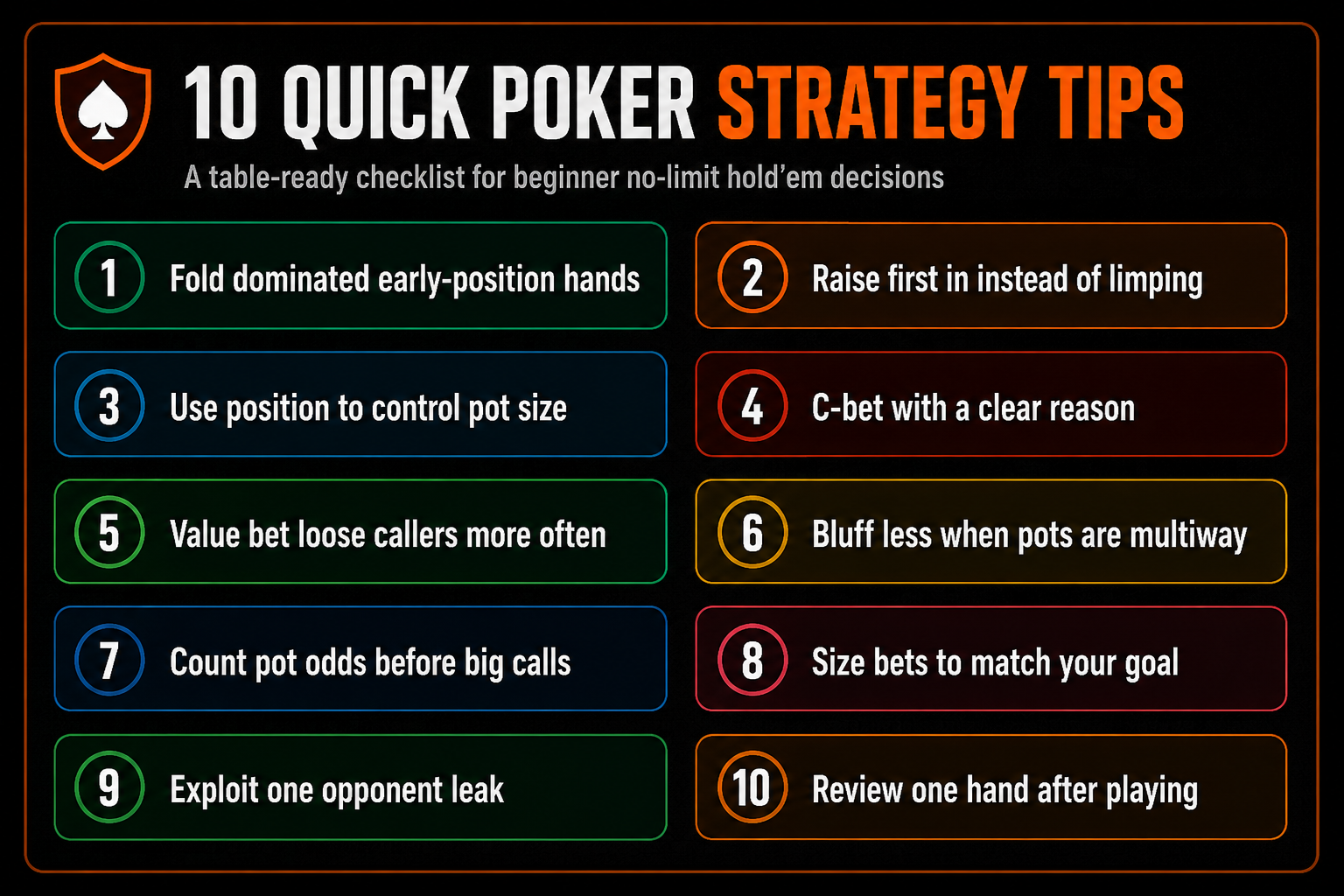
This guide gives you ten practical adjustments for no-limit Texas hold'em. The examples mostly assume beginner cash games around 100 big blinds deep, but the ideas also help in low-stakes tournaments. Treat them as a baseline, then adjust when stack depth, table style, and opponent tendencies give you a reason.
Poker Strategy Tips #1: Play Fewer Hands From Early Position
The fastest preflop improvement is folding more weak hands before they create expensive problems. Early position is where beginners burn money with hands that look playable but make dominated pairs: K-T offsuit, Q-J offsuit, A-8 offsuit, and small suited kings.
When you raise under the gun, several players still have a chance to call or 3-bet. Even when you get called, you often play the flop out of position. PokerStars' position lessons make the core point clearly: late position gives you more information, while early position forces you to act with less.
Use a simple early-position rule. Open strong pairs, A-Q, A-K, and suited broadways like A-J suited or K-Q suited. Add hands only when the table is passive and you understand why they profit. If you are unsure, fold now and save the marginal hand for the cutoff or button.
Quick Table Test
Before you raise, ask: "If the button calls and I miss the flop, will I know what to do?" If the answer is no, your hand is probably too loose for that seat.
Poker Strategy Tips #2: Raise First In Instead of Limping
Limping feels cheap, but it often creates the exact pots beginners handle worst. You invite several opponents, give the blinds a discount, and enter the flop without initiative. A raise gives you two ways to win: everyone can fold preflop, or you can continue representing strength on good flops.
This does not mean raising every hand. It means that when the action folds to you and your hand is worth playing, you usually enter with a raise. If the hand is not strong enough to raise from your position, folding is usually cleaner than limping.
Example: you are in the hijack with A-J suited. Raising is clear because the hand is strong, can make top pair with a good kicker, and can make nut flushes. Now compare 9-6 suited from the same seat. Limping may look tempting, but if someone raises behind you, you are stuck. If several players call, your flushes are not always clean and your one-pair hands are weak.
[INTERNAL: beginner preflop chart]
Tip #3: Respect Position After the Flop
Position matters after the flop because the last player gets to see what everyone else does first. If you are on the button and the big blind checks, you can decide whether to bet, check back, take a free card, or control the pot. If you are the big blind, you act first and reveal information before your opponent.
Use this immediate adjustment: play bigger pots in position and smaller pots out of position. With top pair on the button, you can value bet more comfortably. With the same hand from the blinds, you should be more willing to check, call, or keep the pot manageable on dangerous turns.
Suppose you raise A-Q from the cutoff and the big blind calls. The flop is Q-7-2 rainbow. You have position, top pair, and a strong kicker. Betting for value is simple. Now suppose you defend Q-J in the big blind and the cutoff raises preflop. On Q-7-2, you still have top pair, but your opponent has more strong queens and overpairs. The hand is good, yet it should not automatically become a three-street stack-off.
Tip #4: Continuation Bet With a Reason
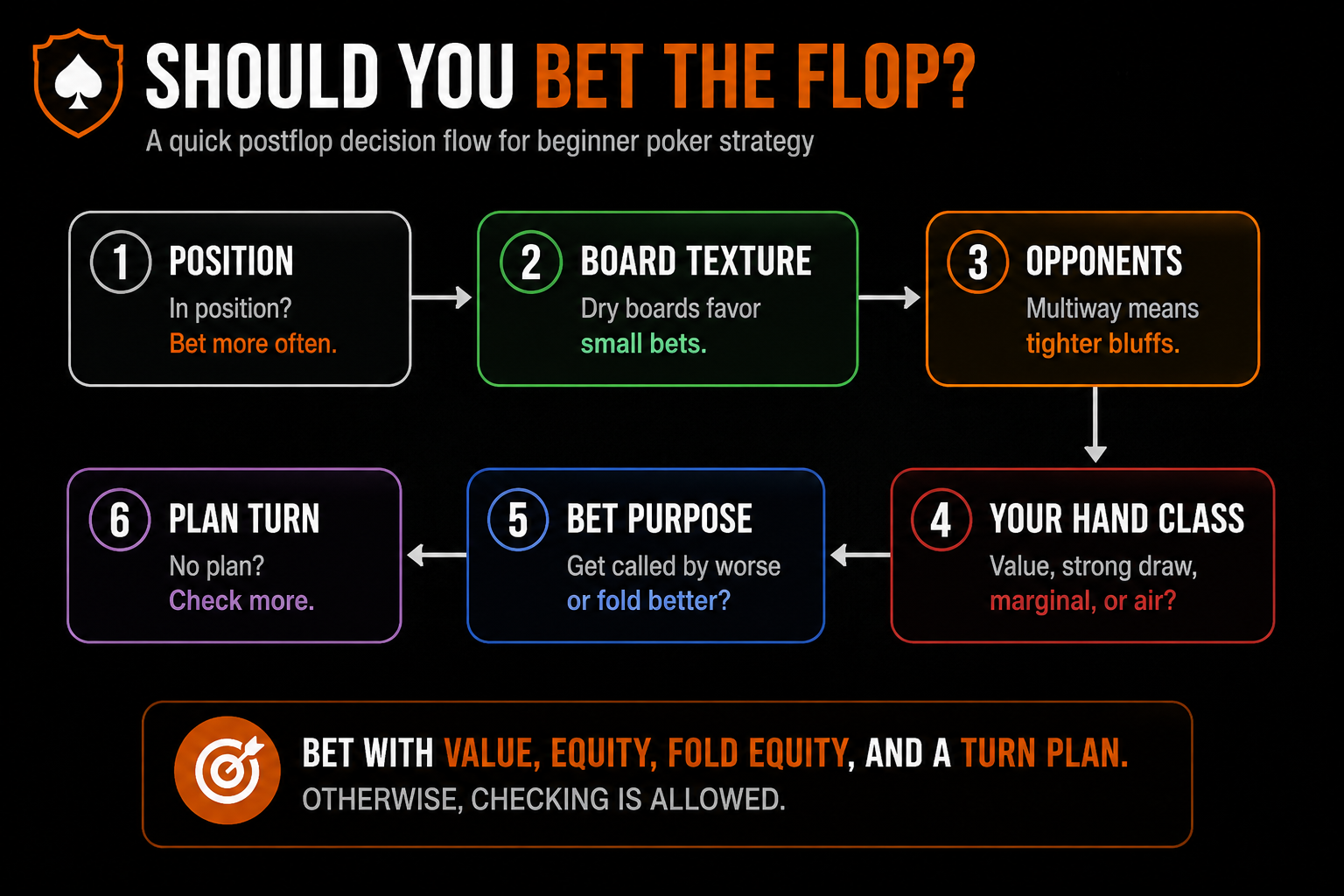
A continuation bet is a flop bet from the player who raised preflop. It is a fundamental move, but automatic c-betting is a leak. Upswing's c-bet material emphasizes that position, board texture, and number of opponents all matter. GTO Wizard's sizing work also points to the bigger idea: your range and nut advantage affect how often and how large you want to bet.
Ask two questions before you c-bet. First, does this flop connect better with my range or my opponent's range? Second, what worse hands call or better hands fold?
On A-7-2 rainbow after you raise from the button and the big blind calls, a small c-bet often works well. You have many strong ace-x hands, and the big blind has plenty of misses. On 9-8-7 two-tone, slow down. The big blind has many pairs, draws, two-pair combos, and straight possibilities. Betting your entire range there creates tough turns.
Tip #5: Value Bet More Against Players Who Call Too Much
At beginner tables, many opponents call too wide. That is not a reason to bluff harder. It is a reason to value bet harder.
A value bet is profitable when worse hands call often enough. Against a calling-heavy player, hands like top pair good kicker, overpairs, and sometimes second pair on safe boards deserve more bets. Upswing's thin value betting advice makes this adjustment explicit: when opponents over-call, your medium-strength value bets improve while your bluffs lose power.
Example: you raise K-Q on the button, the big blind calls, and the board runs K-8-4-2-7 with no completed flush. Against a tight opponent, three streets may be too thin. Against a player who calls flop with any pair and turn with gutshots, betting river for value becomes much more attractive.
The beginner mistake is checking because you are afraid of a better hand. Better hands exist, but worse hands exist too. Your job is not to avoid ever being called by better. Your job is to get called by worse often enough.
Tip #6: Bluff Less in Multiway Pots
Bluffs work best when one opponent can fold enough better hands. Multiway pots make that harder. If three players see a flop, someone is more likely to connect, and each caller has a range that survived preflop.
When you miss in a multiway pot, default to honesty. Bet strong made hands. Bet high-equity draws that can improve to strong hands. Check weak ace-highs, backdoor-only hands, and random overcards that have little chance to win if called.
Say you raise A-K from early position and both blinds call. The flop is T-9-8 with two hearts and you have no heart. This is a poor bluff spot. Both blinds can have pairs, open-enders, flush draws, and two-pair hands. If you bet and get called, many turn cards are bad for you.
Bluffing is still part of winning poker, but beginners usually need fewer hopeless bluffs and more value bets. Save pressure for heads-up pots, good blockers, strong draws, and opponents who have shown they can fold.
Tip #7: Count Pot Odds Before Big Calls
You do not need advanced math to stop bad calls. Start with pot odds. If the pot is $40 and your opponent bets $20, you must call $20 to win $60 total. You need about 33% equity to break even because your call is one-third of the final pot.
For draws, use a quick estimate. With one card to come, multiply your outs by about two to estimate your chance to improve. With two cards to come, multiply by about four. A flush draw with nine outs is roughly 18% by the river card when only one card remains, or around 36% from flop to river if you will see both cards.
This does not make every draw call automatic. Implied odds, reverse implied odds, position, and future betting matter. But pot odds give you a floor. If you are calling $50 into $70 with a weak draw and no implied odds, you are probably paying too much.
[INTERNAL: poker pot odds guide]
Tip #8: Make Your Bet Sizes Match Your Goal
Random bet sizing creates random results. A small bet should usually target folds from weak hands, thin value from worse hands, or cheap protection. A large bet should usually pressure capped ranges, charge strong draws, or get value when you have a big range or nut advantage.
Beginners often bet the same half-pot size with everything. That is easy to use, but it misses profitable adjustments. On dry boards like A-7-2 rainbow, a small continuation bet can fold out plenty of low-equity hands. On wet boards like J-T-8 with a flush draw, bigger bets make more sense with strong hands because many worse hands have real equity.
Keep the rule simple. Bet smaller when the board is dry and your opponent has many weak misses. Bet larger when the board is connected, worse hands and draws can call, and your strong hand needs protection.
Sizing Example
With A-A on K-9-4 rainbow heads-up, one-third pot can be fine. With A-A on K-Q-T two-tone, a larger bet is often better because the caller can have pairs plus draws, straight draws, and flush draws.
Tip #9: Watch Opponents, Then Exploit One Leak
You do not need a perfect read on every player. Look for one clear tendency and adjust. Poker is easier when your exploit is specific.
If a player folds blinds too often, steal wider from the cutoff and button. If a player never folds to flop bets, bluff less and value bet thinner. If a player only raises big with strong hands, fold more to their turn and river aggression. If a player bets every missed c-bet, check some strong hands and let them bluff.
The key is to connect the read to an action. "This player is loose" is vague. "This player calls flop with any pair and any draw" is useful. Against that player, your next adjustment is clear: bet good one-pair hands for value and reduce low-equity bluffs.
Do not over-adjust after one hand. Start with repeated showdowns, bet-sizing patterns, and obvious population tendencies. One strange bluff does not make someone a maniac. Three loose river calls are enough to value bet them more.
Tip #10: Review One Hand After Every Session
The quickest study habit is also the easiest to keep. After every session, review one hand where you felt unsure. Do not pick only the biggest pot. Pick the spot where your decision process got fuzzy.
Write down the stack sizes, positions, preflop action, flop, turn, river, bet sizes, and your question. Then ask: did I have a preflop plan? Was I in position? What worse hands called my bet? What better hands folded? What pot odds did I get? Which opponent tendency mattered?
This habit turns vague frustration into clear improvement. One reviewed hand per session becomes 30 hands in a month. Patterns appear quickly. Maybe you call too many river bets, c-bet bad boards, or miss thin value against loose opponents.
[INTERNAL: hand history review process]
Take Action Now With These Poker Strategy Tips
The best Poker Strategy Tips are not tricks. They are repeatable decisions. Play tighter from early position. Raise first in. Respect position. C-bet with a reason. Value bet callers. Bluff less multiway. Count pot odds. Choose purposeful bet sizes. Exploit one clear tendency. Review one hand when you finish.
Pick two tips for your next session instead of trying to apply all ten perfectly. For example, commit to opening fewer dominated hands from early position and making one extra value bet against loose callers. Those two changes alone can remove common beginner leaks today.
Frequently Asked Questions
What are the best Poker Strategy Tips for beginners?
Start with preflop discipline, position, and value betting. Fold dominated hands from early position, raise first in instead of limping, and bet strong hands when worse hands can call. These habits prevent many expensive beginner mistakes.
Should beginners bluff often in poker?
Beginners should bluff selectively, not constantly. Bluff more in heads-up pots where the board favors your range, you have equity or blockers, and your opponent can fold. Bluff less in multiway pots and against calling-heavy opponents.
How do I know when to continuation bet?
C-bet when the flop favors your range, your opponent has many weak hands, or your hand benefits from value and protection. Check more often on connected boards, multiway flops, and spots where a call leaves you without a turn plan.
Is tight-aggressive poker still a good beginner strategy?
Yes. Tight-aggressive poker gives beginners a strong default: play better starting hands, enter pots with raises, and avoid passive guessing. You can widen and balance your ranges later as your postflop skill improves.
How can I improve my poker game today?
Use a small session goal. Choose one preflop rule and one postflop rule before you play, then review one uncertain hand afterward. That loop turns these Poker Strategy Tips into a repeatable improvement process.