Poker Ranges Explained: Stop Putting People on One Hand
Poker Ranges Explained: Stop Putting People on One Hand
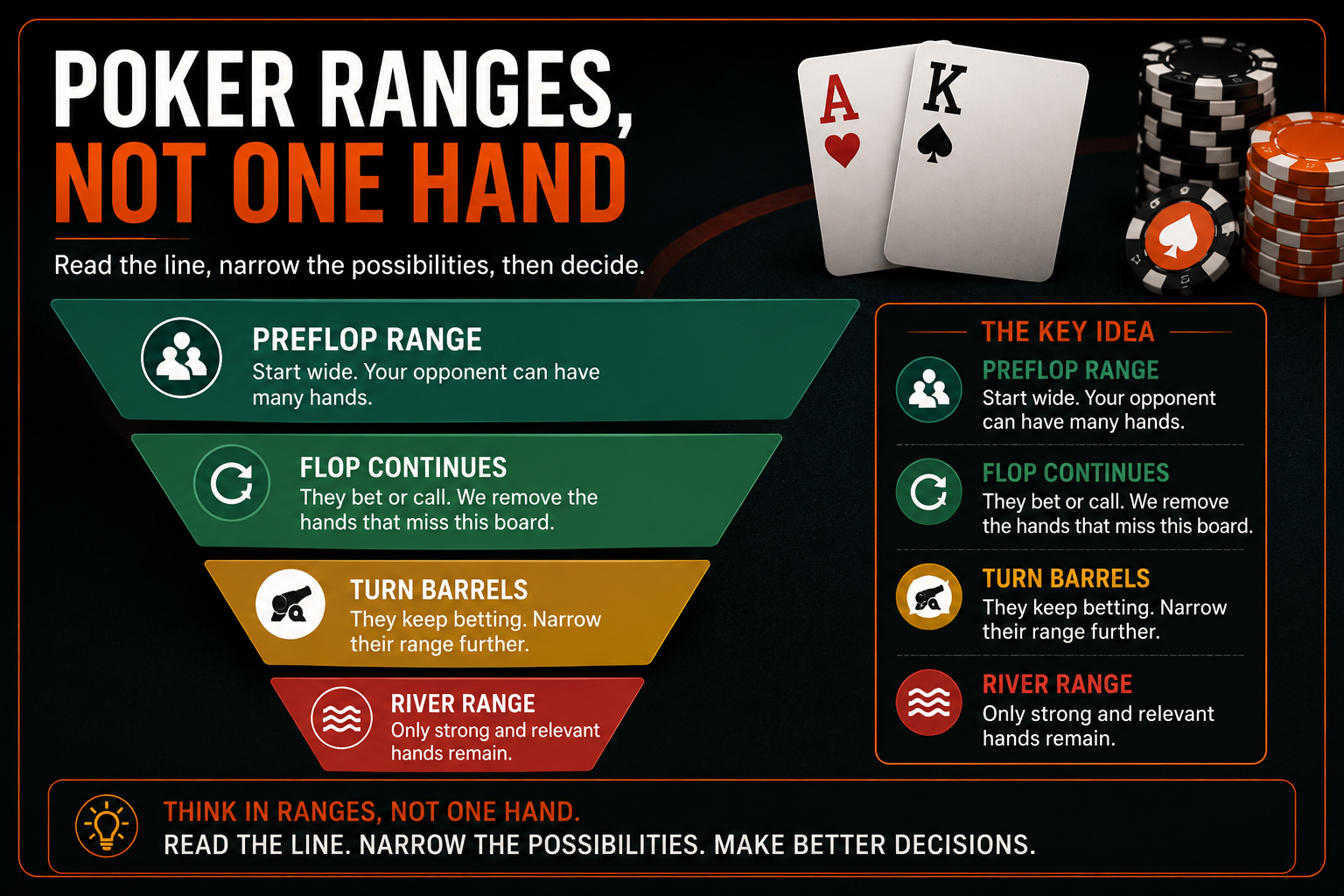
Poker Ranges are how strong players read hands without pretending they can see through cards. Instead of saying, "He has ace-king," you ask which hands make sense for his position, preflop action, postflop line, bet sizing, and player type. That shift sounds small, but it changes every close decision.
What Poker Ranges Actually Mean
A range is the full set of hands a player can reasonably have in a spot. It can be wide, tight, value-heavy, bluff-heavy, capped, uncapped, merged, or polarized. It is never one magic hand you guessed because the line felt familiar.
If a tight player opens under the gun in a nine-handed live game, their range may start around strong pairs, big suited broadways, and better offsuit broadways. If the button opens in a six-max online game, that range can include many more suited connectors, suited aces, broadways, and steal hands. Position changes the starting point before a flop is even dealt.
The same idea applies postflop. A player who checks back on A-K-7 rainbow after raising preflop usually keeps some medium-strength hands and delayed bets in range, but may remove many automatic value bets. A player who bets large on Q-J-T two-tone is representing a different shape: more nutted hands, more draws, and less random air if the pool is under-bluffing.
The practical point is simple: stop asking, "What does he have?" Ask, "What hands arrive here this way, and how many of them do I beat?"
That question is slower at first. With practice, it becomes faster than guessing because you are following a repeatable process.
Why Single-Hand Reads Cost You Money
Putting someone on one hand feels confident. It also lets you justify almost anything.
You call because "he has missed spades." You fold because "he has a set." You jam because "he cannot have the straight." Sometimes you are right, and the table remembers the dramatic read. More often, you are ignoring the rest of the hands that take the same line.
Here is the leak: most actions are taken by groups of hands. A continuation bet can be top pair, an overpair, a draw, ace-high with range advantage, or a total give-up that decided to stab. A river overbet can be the nuts, a blocker bluff, a thin exploit against a calling station, or a confused recreational bet. One label does not capture the whole decision.
Single-hand reads also create emotional bias. Once you decide villain has exactly K-Q, every later action gets forced into that story. If the turn pairs the board and villain bombs, you may still cling to K-Q because changing your mind feels like admitting the first read was wrong.
Range thinking gives you permission to update. You can start wide, remove hands that no longer fit, weight some hands more heavily, and still act with incomplete information. That is the job. Poker does not reward perfect certainty; it rewards better estimates than your opponents.
Poker Ranges Start Before the Flop
Your range work begins with the preflop action. Position, stack depth, raise size, rake, ante structure, and player tendencies all shape the hands that can continue.
Start with a default. If the cutoff opens in a 100bb cash game, you might assign a reasonably wide opening range: pairs, suited aces, suited broadways, many offsuit broadways, suited connectors, and some suited kings. If the small blind 3-bets, the small blind's range is usually stronger and more compact. If the cutoff calls, the cutoff keeps hands that did not 4-bet and did not fold. That alone removes many combos.
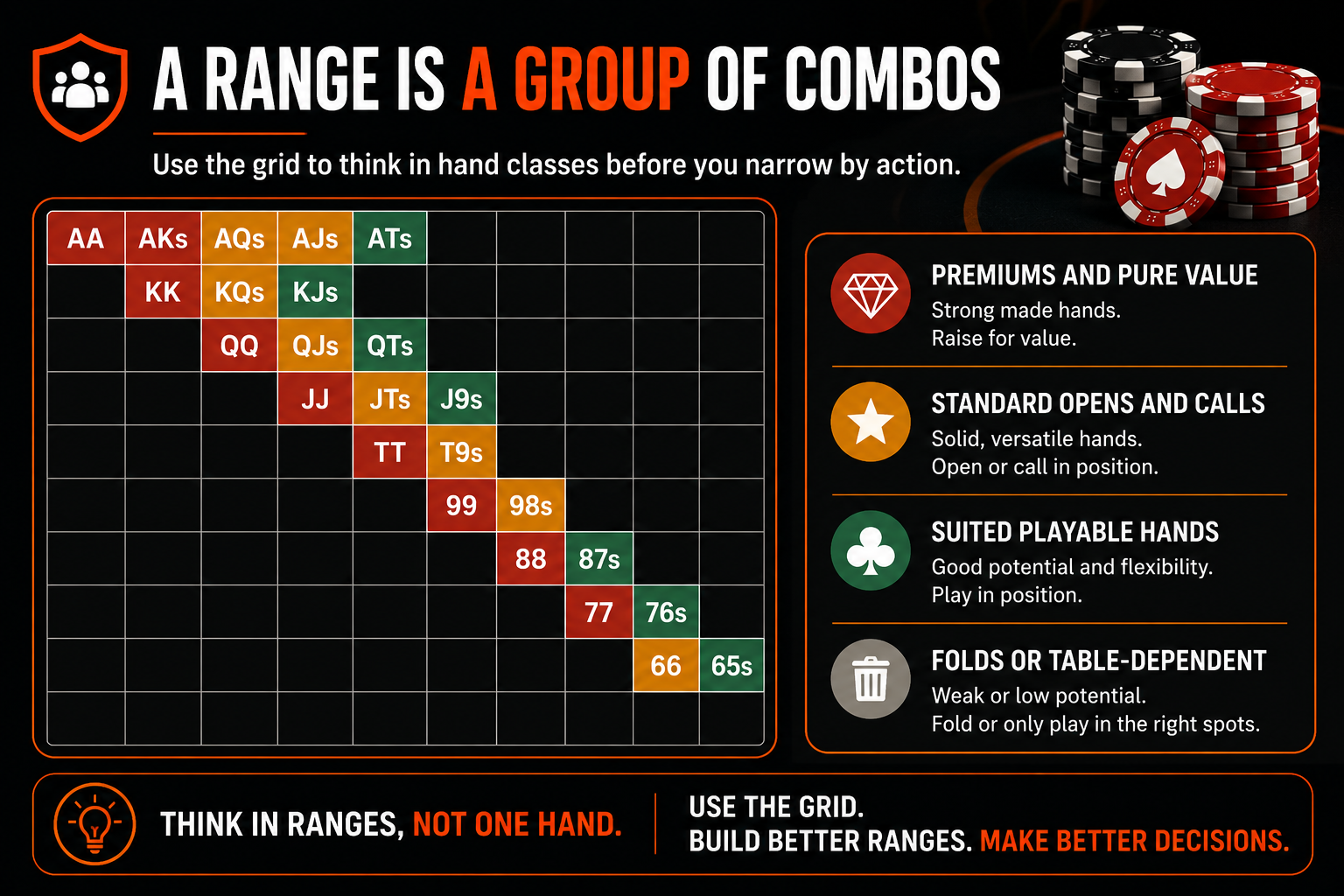
This is why a preflop range chart matters even if you never memorize every square. The chart teaches structure. Early position is tighter. Late position is wider. The big blind defends differently because it has already posted money and closes the action. The small blind plays differently because it is out of position and still has the big blind behind.
Use Combos, Not Vibes
No-limit hold'em has 1,326 possible two-card combinations before card removal. A hand-grid view compresses those combos into 169 starting-hand classes: pairs, suited hands, and offsuit hands.
That matters because not all hand classes have the same number of combinations. A pocket pair has six combos. A suited non-pair hand has four combos. An offsuit non-pair hand has twelve combos. So when someone says, "He can have ace-king," you should ask whether that means all 16 combos, only suited ace-king, or some 4-bet portion that never flats.
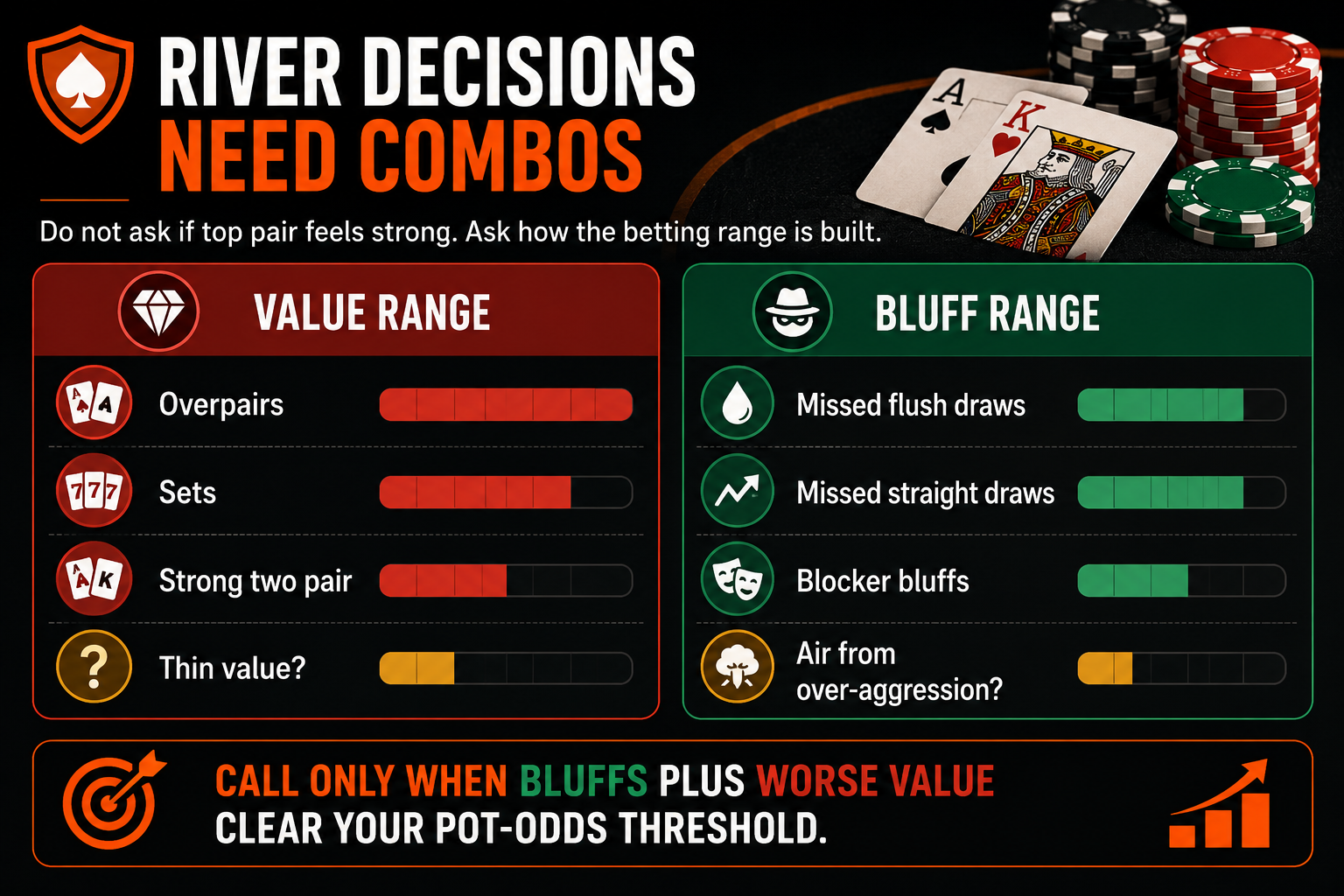
Combo counting keeps your river decisions honest. If villain can have three value combos and twelve bluff combos, your bluff-catcher is in a very different spot than if villain has twelve value combos and three bluffs. You do not need exact solver precision in game, but you do need to stop treating every hand name as equally likely.
The Four-Step Range Audit
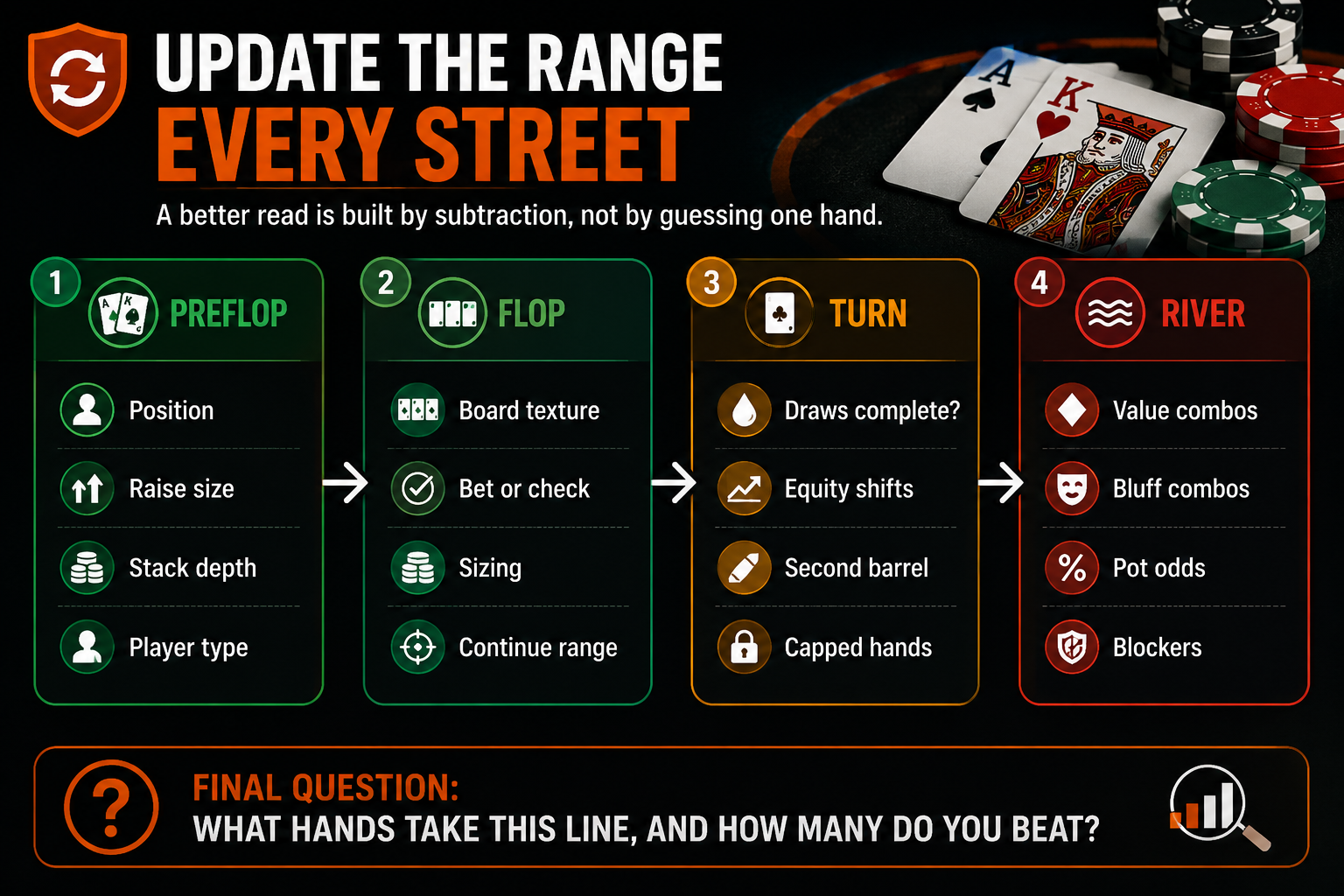
Use the same audit every time you review a hand. First, assign the preflop range. Second, narrow it by the flop action. Third, update it on the turn. Fourth, make the river decision against the range that remains.
Example: you open A-Q suited from the cutoff, and the big blind calls. The flop is Q-8-4 with two hearts. The big blind checks, you bet small, and the big blind calls.
Before the call, the big blind can have many hands: queens, eights, fours, pocket pairs, heart draws, straight draws like 7-6 suited or 6-5 suited, ace-high floats, and some traps. After the call, many total misses disappear. The range becomes pairs, draws, some ace-high hands with backdoors, and slowplayed strong hands.
The turn is the 2 of clubs. The big blind checks again. That card does not complete much. If you bet and get called again, the range tightens: top pair, sticky second pair, stronger heart draws, some straight draws, sets, and maybe a few stubborn bluff-catchers.
The river is the 9 of hearts. The big blind leads large. Now you do not get to say, "He has a flush" and fold automatically, or "He missed 7-6" and call automatically. You ask what the river lead range looks like. Flushes improved. Some Q-x may not lead large. Sets may fear the flush. Missed straight draws may bluff if this player is capable. Your decision is against that whole range.
[INTERNAL: hand range analysis]
Poker Ranges on the Flop
The flop is where many players lose the range thread. They see their own hand first and the board second. Reverse that order.
Ask which player has range advantage. On A-K-4 rainbow after under the gun raises and the big blind calls, the raiser has more strong ace-high and big broadway hands. The big blind has some strong hands too, but also many defended hands that missed. Small continuation bets can make sense because the raiser has a high-frequency advantage across the range.
Now change the board to 7-6-5 with two suits. The big blind has more two-pair, straight, pair-plus-draw, and low connected hands. The preflop raiser still has overpairs, but the caller interacts strongly. Betting the same frequency and size as on A-K-4 is a common range mistake.
Range Advantage Versus Nut Advantage
Range advantage asks who has more equity across all hands. Nut advantage asks who has more of the strongest hands.
Those are related, but they are not the same. A player can have overall range advantage but not a huge nut advantage. Another player can have fewer strong average hands but more nut combos. That distinction affects betting.
Solver work often shows that range advantage pushes betting frequency, while nut advantage helps justify larger sizing. You do not need to copy every solver mix to use the concept. If your range is broadly ahead but neither player has many nutted hands, small frequent bets may perform well. If you have the nut advantage and villain has many medium-strength hands, larger polar bets can make more sense.
This is why board texture beats hand ego. Top pair on a board that heavily favors villain is not the same as top pair on a board that favors you.
Turn and River Ranges
The turn is the best street for separating real range thinkers from guessers. A new card can change equity, complete draws, add new bluffs, counterfeit pairs, or leave the flop structure mostly intact.
On K-8-7 with two spades, a blank 2 of diamonds keeps many flop advantages in place. Hands that were strong on the flop are still strong, and draws now have only one card left. A spade turn is different. It completes flushes, changes which player can credibly bet large, and turns some made hands into bluff-catchers.
The river removes future equity. Draws either got there or missed. Medium-strength hands either want showdown or turn into thin value/bluffs. When facing a river bet, your hand's absolute rank matters less than how it performs against villain's betting range.
Suppose you hold A-J on J-9-5-2-2 after raising preflop and betting flop and turn. The big blind check-raises all in on the river. Your top pair may look strong, but the line may be value-heavy in a live low-stakes pool. Against a player who rarely bluffs river check-raises, your pair is not "too good to fold" just because it beats missed draws. Against an aggressive regular who finds missed T-8, Q-T, and spade-draw bluffs, the same hand can become a call.
The card runout matters. The player matters. The line matters. The range that bets matters most.
Player Type Changes the Range
A range is not just a chart. It belongs to a person.
A tight-passive live player who limp-calls preflop and suddenly check-raises turn usually has a narrow, value-heavy range. A loose-aggressive regular can have more semi-bluffs and delayed aggression. A recreational player who overvalues one pair may put hands into a large bet that a solver would check. A short-stacked tournament player can have push/fold incentives that do not apply in deep cash.
Online, HUD stats can help. PokerTracker's basic HUD guide defines VPIP as how often a player voluntarily puts money in preflop and PFR as how often a player raises preflop. A 42/8 profile and a 24/20 profile do not enter pots with the same range shape. The first player has many calls and limps. The second has more aggressive preflop structure.
Do not overfit tiny samples. Ten hands of VPIP/PFR mean almost nothing. A thousand hands still needs context by position. But when the sample is meaningful, stats help you choose better starting ranges before postflop action narrows them.
Live reads serve the same purpose when used carefully. If a player has shown down only premiums after 3-betting for three hours, their next 3-bet deserves respect. If another player has shown suited trash, cold calls, and river bluffs, their range cannot be reduced to premiums just because they bet big.
Use Blockers Without Overusing Them
Blockers are card-removal effects. If you hold the ace of spades, your opponent cannot hold the ace of spades. That changes how many flushes, nut-flush blockers, and ace-high combinations remain.
Blockers matter most when ranges are narrow, polarized, or facing large bets. If villain overbets river on K-Q-7-4-2, holding A-Q may block some value if ace-king is in range and may unblock missed draws depending on suits. Holding the missed flush ace can be a strong bluff candidate because it blocks villain's strongest flushes when the flush completes.
But blockers are not magic. They are one input after range construction. If a passive opponent never bluffs large rivers, do not talk yourself into calling because you block one value combo. If a player is massively over-bluffing, you may call wider even without perfect blockers.
The order matters:
- Build the range.
- Estimate value and bluff density.
- Check pot odds.
- Use blockers to choose close calls, folds, and bluffs.
When players reverse that order, they use blocker language to justify guesses.
Common Poker Ranges Mistakes
The biggest mistake is starting too narrow. If you begin a hand by saying, "He has A-K," you will miss all the pairs, suited broadways, traps, and bluffs that also fit. Start wide, then narrow.
The second mistake is forgetting removed hands. If villain just called preflop after facing a 3-bet, some hands may be less likely because they often 4-bet. If villain checked back flop, some value hands may be discounted if that player always bets them. Range work is subtraction.
The third mistake is treating all players as balanced. Many pools are not balanced. At low stakes, large river raises are often under-bluffed. Small flop bets may be automatic. Turn probes may be too value-heavy from passive players and too bluff-heavy from aggressive ones. Use theory as a baseline, then adjust to the pool.
The fourth mistake is never assigning your own range. Good opponents are also reading you. If you arrive on the river with only obvious value and no bluffs, you become easy to fold against. If you arrive with too many missed bluffs and too little value, you become easy to call.
The fifth mistake is ignoring stack depth. A 30bb tournament range, a 100bb cash range, and a 200bb deep live range are different animals. Deep stacks increase implied odds for suited and connected hands, but they also punish dominated one-pair hands.
A Full Hand Reading Example
You are playing $1/$3 live cash, $500 effective. A middle-position player opens to $15. You call on the button with J-T suited. The big blind calls.
Preflop, the opener can have pairs, strong broadways, suited aces, and some suited connectors depending on style. The big blind has a wide closing range. Your button calling range includes hands that play well in position, but you usually do not have the very top hands if you would 3-bet some of them.
The flop is T-8-3 with two clubs. The big blind checks, the opener bets $25 into $46, and you call. The big blind folds.
After betting into two players, the opener keeps overpairs, top pairs, sets, club draws, straight draws like Q-J or 9-7 suited, and some high-card hands with backdoors. Your call keeps top pair, strong draws, sets if you slowplay, and some floats.
The turn is the 6 of diamonds. The opener bets $75 into $96. That card improves 9-7 and adds equity to 7-6 or 6-5 suited. It does not change overpairs much. Against a tight player, the second barrel is often overpairs, sets, strong draws, and occasional top pair. Against an aggressive player, more semi-bluffs remain.
You call again. The river is the 2 of spades. The opener bets $225 into $246.
Now build the river betting range. Value could be A-A, K-K, Q-Q, sets, and maybe T-8 suited if opened. Some players value bet A-T; others check it. Bluffs could be missed clubs, Q-J, J-9, A-Q of clubs, A-K of clubs, and other hands that double-barreled with equity.
Your J-T blocks some J-9 and Q-J bluffs. It does not block overpairs or sets. If this player is tight and under-bluffs large river bets, folding is reasonable. If this player barrels too many draws and gives up rarely, calling can be reasonable at the offered price. You need to call $225 to win a final pot of $696, so you need about 32% equity. The question is not whether top pair is strong. The question is whether villain has enough bluffs and thin value you beat.
That is range-based hand reading.
How to Study Poker Ranges Off the Table
You build range instinct away from the table. In game, you execute patterns you already trained.
Start with one common node: button opens, big blind calls. Pick ten flops. For each flop, write who has range advantage, who has nut advantage, which hands want to bet, and which hands prefer checking. Then compare your answers to a trusted training source, solver output, or coaching material.
Next, review your own hands. Do not write, "Villain had K-K." Write:
- Preflop range before action.
- Flop range after bet/call/raise.
- Turn range after the next action.
- River value range and bluff range.
- Pot odds and final decision.
This takes longer than normal hand review, but it fixes the leak that normal review misses. You will see whether your river calls were actually price-based, whether your bluffs represented credible value, and whether your flop c-bets ignored bad boards.
If you use a tracker, filter for big river calls and river folds after calling flop and turn. Those spots expose range-reading errors quickly. [INTERNAL: poker hand history review]
Build Your Own Range Before Attacking Theirs
Your opponent's range is only half the decision. Your own range determines whether your bet tells a believable story.
If you 3-bet preflop, bet A-K-5, barrel the 2, and jam the 9, what value hands do you represent? A-A, K-K, A-K, maybe A-5 suited, and some slowplayed sets depending on preflop. What bluffs arrive there? Suited wheel aces, missed spades, Q-J suited, and some hands with blockers. If you cannot list value and bluff candidates, your opponent may not believe the story either.
Balanced thinking does not mean you must play perfect GTO in every live game. It means you understand what your line represents. Against players who overfold, you can bluff more. Against players who overcall, you value bet thinner and bluff less. But those exploits work best when you know the baseline range first.
This is also how you avoid face-up checking ranges. If you only check weak hands, aggressive opponents can attack. If you check some strong hands, some medium hands, and some give-ups, your range survives pressure. The goal is not to be fancy. The goal is to avoid making your hand obvious.
Quick Table Checklist for Poker Ranges
Use this checklist during hands until it becomes automatic:
- What was the preflop action and position?
- Which hands are removed by that action?
- Who has range advantage on this board?
- Who has nut advantage?
- Which hands bet this size for value?
- Which hands bluff this size?
- Does this player type actually find those bluffs?
- What pot odds am I getting?
- Do my blockers matter in this exact spot?
- What does my own line represent?
You will not answer every question perfectly in real time. That is fine. Even answering five of them is better than staring at the board and guessing one hand.
[INTERNAL: poker range calculator]
Take Action Now
If you want Poker Ranges to become a real table skill, review your next five difficult hands without naming villain's exact showdown hand until the end. Write the preflop range, narrow it on each street, count likely value and bluff combos, then judge your decision by the range instead of the result.
That one habit will do more for your hand reading than another hour of trying to make perfect soul reads. Stop putting people on one hand. Put them on a range, update it, and make the decision that wins against the range that remains.
Frequently Asked Questions
What are poker ranges?
Poker ranges are the collection of possible hands a player can have in a specific situation. They are based on position, action, sizing, board texture, stack depth, and player tendencies.
Why is range reading better than putting someone on one hand?
Range reading is better because most poker actions can be taken by many hands. A single-hand read ignores value combos, bluff combos, traps, and player tendencies that also fit the line.
How do I start assigning a range in real time?
Start with preflop position and action. Then remove hands that no longer make sense after each bet, check, call, or raise. Keep the process simple at first: value hands, draws, medium hands, and likely bluffs.
Do blockers matter for beginners?
Yes, but only after you build the range. Blockers help most in close decisions, especially against large bets or polarized ranges. They should refine your decision, not replace the whole hand-reading process.
Can I learn poker ranges without a solver?
Yes. Preflop charts, hand reviews, equity tools, and structured range notes can teach the fundamentals. Solvers help refine the details, but the first skill is learning to think in groups of hands instead of exact guesses.