Poker Pot Odds Explained: The Simple Formula Every Winning Player Uses
Poker Pot Odds Explained: The Simple Formula Every Winning Player Uses
Poker Pot Odds tell you whether a call is priced correctly before emotion, curiosity, or frustration takes over. The simple formula is this: divide the amount you must call by the final pot after your call. If your hand will win more often than that percentage, calling is profitable in a no-more-betting spot.
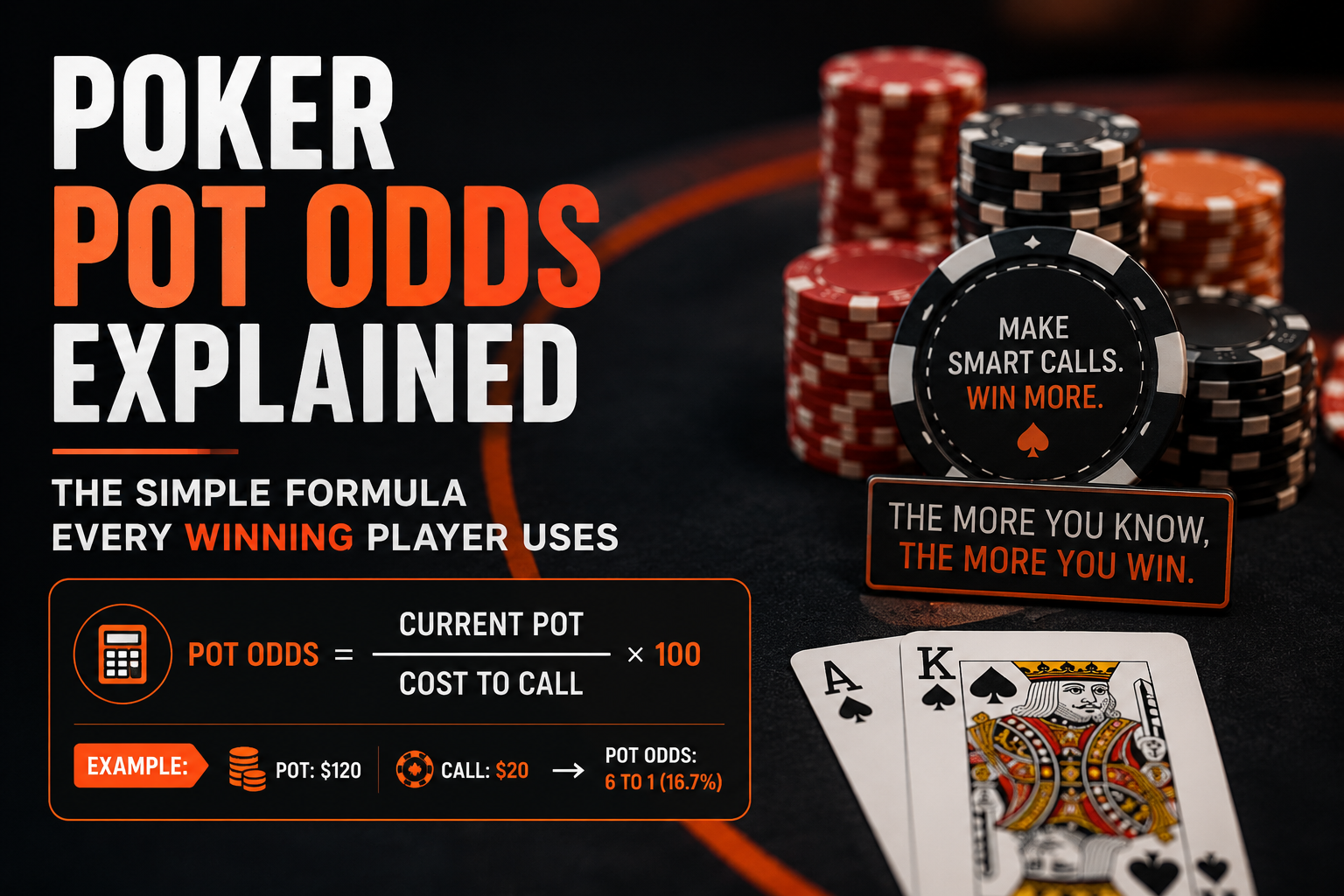
Poker Pot Odds Formula in One Line
Use this version at the table:
Required equity = call amount / final pot after your call
Suppose the pot is $100 and your opponent bets $50. The pot is now $150, and it costs you $50 to call. If you call, the final pot becomes $200.
Your calculation is:
$50 / $200 = 25%
That means you need to win at least 25% of the time to break even. If you estimate your hand has 30% equity, calling shows a profit over time. If you estimate 18%, folding is usually the disciplined play.
The same idea is often written as a ratio. In the same spot, you are calling $50 to win the $150 already out there, so the table may say you are getting 3:1. To convert 3:1 into a percentage, use 1 / (3 + 1), which equals 25%.
The direct percentage version is easier for most players because you can compare it directly to equity. That is the version to memorize first. [INTERNAL: poker equity calculator]
Poker Pot Odds for Common Bet Sizes
You do not need perfect math for every spot. You need a few anchor numbers that let you make quick decisions.
| Opponent bet size | Required equity to call |
|---|---|
| 25% pot | 16.7% |
| 33% pot | 20% |
| 50% pot | 25% |
| 67% pot | 28.6% |
| 75% pot | 30% |
| 100% pot | 33.3% |
| 150% pot | 37.5% |
These numbers explain why small bets get called wide and big bets force folds. Against a one-third pot bet, you only need to win about one time in five. Against a pot-sized bet, you need to win one time in three.
This also helps when you are the bettor. A small value bet gives your opponent a cheap price, so they can continue with many bluff-catchers and draws. A larger bet gives worse pot odds, so their calling range should become stronger. If the player pool still calls too wide against large bets, you can value bet thinner and bluff less.
Turn Draw Example: Do the Poker Pot Odds Justify a Call?
You call in position with 9c 8c. The flop comes Kc 6c 2d. Your opponent bets $40 into $80.
The final pot after your call would be:
$80 pot + $40 bet + $40 call = $160
Your required equity is:
$40 / $160 = 25%
With a flush draw, you usually count nine club outs. Using the rule of 4 and 2, nine outs with two cards to come is roughly 36%, while one card to come is roughly 18%. On the flop, if you expect to see both turn and river without facing another meaningful bet, the immediate price looks good. In real hands, you often face another turn bet, so do not blindly multiply by 4 unless stacks or action make it realistic to realize both cards.
Count Clean Outs, Not Dream Outs
Pot odds only work if your equity estimate is honest. A flush draw to the ace is cleaner than a weak flush draw that can run into a bigger flush. An open-ended straight draw is cleaner on a rainbow board than on a paired, two-flush board where some straight cards complete better hands.
Before you call, ask which outs are clean. If two of your straight cards also complete a flush your opponent can have, discount them. If pairing your overcard may still lose to top pair with a better kicker, do not count it as a full out.
Compare Against a Range
You are not trying to beat one exact hand. You are trying to estimate your equity against a range. Against a tight turn barreling range, your second pair may have far less equity than it appears. Against a player who over-bluffs missed draws, the same pair may clear the required equity threshold.
This is why pot odds are a decision tool, not a decision by themselves. They tell you the price. Your read, range estimate, and hand quality tell you whether the price is worth paying. [INTERNAL: hand range analysis]
When the Simple Formula Is Not Enough
The formula is cleanest on the river or in all-in spots because there is no future betting. Your equity either wins the final pot or it does not.
Earlier streets are messier. A hand can have enough raw equity but still be a bad call because it realizes equity poorly. For example, a weak offsuit hand in the big blind may technically have enough equity against a button open, but it can be dominated, out of position, and forced to fold before showdown. That hand owns equity on paper but does not get to collect it often enough.
The reverse can also happen. A suited connector or nut draw may fall slightly short on direct pot odds but call profitably because it wins extra money when it improves.
Implied Odds
Implied odds are the future chips you expect to win when you hit. Calling with a disguised straight draw is more attractive when stacks are deep, your opponent has strong one-pair hands, and you are in position.
Do not use implied odds as an excuse for every loose call. You need a realistic plan for getting paid. If the obvious flush comes in and your opponent is cautious, your future payoff may be small.
Reverse Implied Odds
Reverse implied odds are the future chips you lose when you improve but still have the second-best hand. Weak flush draws, dominated top pairs, and low straights on coordinated boards are common examples.
When reverse implied odds are high, demand a better immediate price than the table says. If the formula says you need 25%, a fragile hand may need more because some "good" rivers create expensive second-best hands.
A Simple Table Routine for Faster Decisions
Use a three-step routine until the math becomes automatic.
- Calculate the final pot after your call.
- Divide your call by that final pot.
- Compare the result to your realistic equity or winning frequency.
On the river, this becomes a bluff-catching question. If villain bets pot, you need to win 33.3% of the time. If you think the player is under-bluffing that size, fold more bluff-catchers. If the player is over-bluffing missed draws, call more.
On earlier streets, add one extra question: will this hand realize its equity? Position, stack depth, domination, nut potential, and future aggression all matter.
For study, filter your database for "called turn bet" and review hands where you missed the river or faced a river jam. Write down the pot odds you were offered, your estimated outs, and whether future betting made the call better or worse. You will quickly see whether you are over-calling weak draws, folding too much to small bets, or ignoring profitable implied-odds spots. [INTERNAL: poker hand history review]
Take Action Now
Do not try to memorize every poker math chart at once. Memorize the Poker Pot Odds formula, then learn the common bet-size thresholds: one-third pot needs 20%, half pot needs 25%, and pot-sized needs 33%. That alone will clean up many close calls.
The next time you review a hand, write the price before judging the result. If your call needed 25% and your honest equity estimate was 35%, the call was good even if the river missed. If your call needed 33% and you were chasing dirty outs with 18%, the winning river does not make it a good play. Winning players use Poker Pot Odds to judge decisions, not outcomes.
Frequently Asked Questions
What are poker pot odds?
Poker pot odds are the price you are getting to call a bet compared with the size of the pot you can win. In percentage form, they show the minimum equity or winning frequency needed for a call to break even.
What is the easiest Poker Pot Odds formula?
The easiest formula is: call amount divided by final pot after your call. If you call $50 and the final pot will be $200, you need $50 / $200, or 25% equity.
Should I use ratios or percentages?
Use whichever format you can apply fastest. Percentages are usually easier because hand equity is also discussed as a percentage. Ratios are still useful when players say they are getting 3:1, 4:1, or 2:1.
Do Poker Pot Odds matter more on the river?
They are cleanest on the river because no future cards or bets remain. On the flop and turn, you still use the formula, but you also account for implied odds, reverse implied odds, and equity realization.
Can pot odds tell me when to bluff?
Indirectly, yes. When you bet, you are giving your opponent a price. Larger bets force your opponent to defend with stronger hands, while smaller bets let them continue wider. Your bluffing frequency should also account for their actual folding habits.