Poker Equity Explained: How to Know When Your Hand Is Actually Ahead
Poker Equity Explained: How to Know When Your Hand Is Actually Ahead
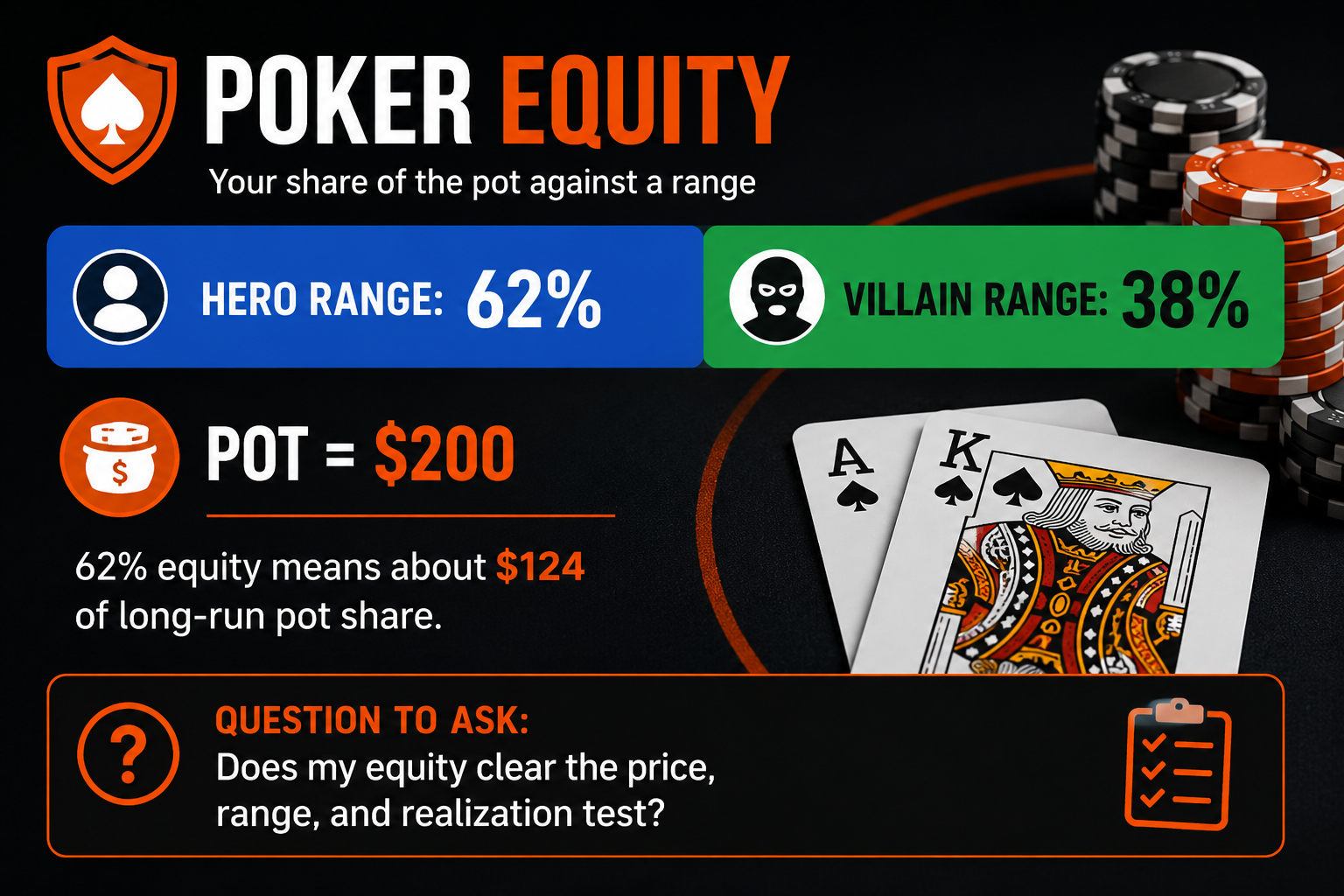
Poker Equity is your share of the pot if the hand were dealt to showdown from the current point. If you have 60% equity in a $100 pot, your hand is worth about $60 before future betting, fold equity, rake, and execution enter the picture. That simple idea answers one of the most important questions in poker: are you actually ahead, or are you only hoping you are?
Poker Equity in Plain English
Equity is not a feeling. It is a percentage estimate of how often your hand wins, chops, or loses against another hand or range after the remaining cards come.
Preflop, the cleanest example is AA against KK. Aces are a heavy favorite, usually around 80% to 82% depending on suits. That does not mean aces are guaranteed to win. It means that if both hands went all in thousands of times, aces would win the large majority of those pots, kings would still crack them sometimes, and the long-run money would flow toward the aces.
Postflop, equity changes every street. Ah Kh on Qh 7h 2c may have strong equity because it can make the nut flush and sometimes win with ace high or top pair. The same Ah Kh on Qs 7d 2c has much less immediate backup because the flush draw is gone. Your cards did not change, but your equity did.
The key habit is to stop asking, "Do I like my hand?" and start asking, "How much of this pot does my hand own against the range I am facing?"
Poker Equity Versus Pot Odds
Equity becomes actionable when you compare it to the price you are being offered. Pot odds tell you the minimum equity you need to call. Equity tells you whether your hand clears that threshold.
Use this formula:
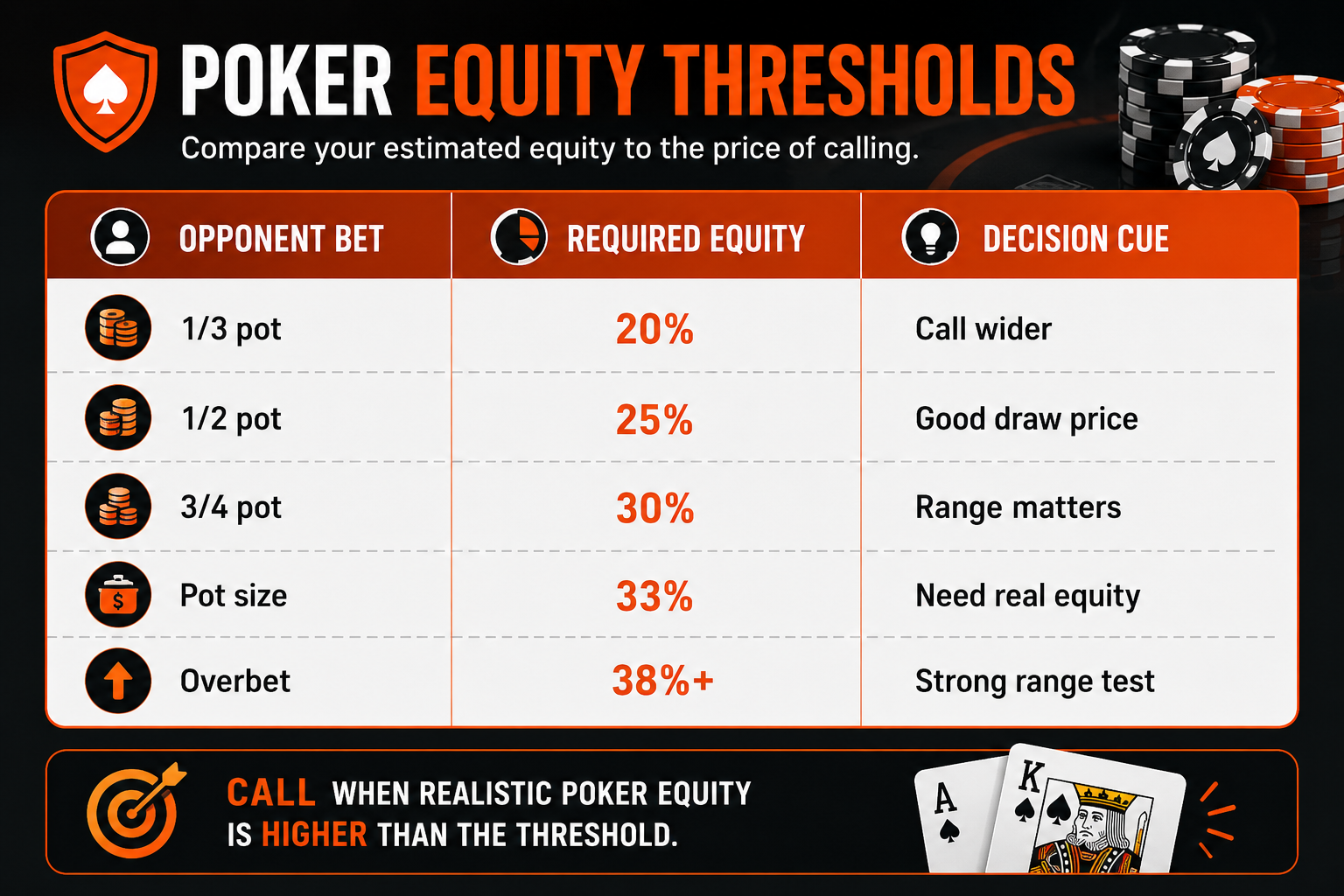
Required equity = call amount / final pot after your call
Suppose the pot is $100 and your opponent bets $50. The pot is now $150, and it costs you $50 to call. If you call, the final pot will be $200.
Your required equity is:
$50 / $200 = 25%
If your hand has more than 25% equity, the call is profitable in a no-more-betting spot. If your hand has less than 25%, the call loses money unless implied odds, fold equity on later streets, or a specific exploit changes the picture.
This is why equity is not only for all-in spots. On the river, it helps you decide whether a bluff-catcher wins often enough. On the flop and turn, it helps you decide whether a draw, pair, or overcard hand can continue at the current price.
How to Estimate Poker Equity at the Table
You will not run a solver while facing a turn bet in a live game. You need fast approximations.
Start with common draw numbers. A flush draw usually has nine outs. On the flop, the rule of 4 gives a rough two-card estimate of 36%. On the turn, the rule of 2 gives a rough one-card estimate of 18%. An open-ended straight draw has eight outs, so it is about 32% from flop to river and about 16% on the turn.
Those numbers assume your outs are clean. If your flush draw is weak and villain can hold higher flush draws, some of your "good" cards create reverse implied odds. If your straight draw completes a flush for the opponent, discount those outs. If pairing your ace still loses to top pair with a better kicker, do not count the ace as a full out.
A Turn Draw Example
You call on the button with Jh Th. The flop is Qh 8h 2c. The pot is $80 and villain bets $40.
You are calling $40 to play for a final pot of $160, so you need 25% equity. With a flush draw plus gutshot, you may count nine hearts and three non-heart nines, for roughly twelve clean-looking outs. By the rule of 4, that is about 48% from flop to river.
That sounds like an easy continue. But ask the next question: will you actually see both cards for one bet? If villain often fires the turn for a large size, your flop call is not simply buying two cards. You may need enough equity, implied odds, or fold equity to handle future pressure.
A River Bluff-Catcher Example
You hold Ad Qd on Qs 9h 6c 2s 2d. The pot is $200. Your opponent bets $150 on the river.
If you call, the final pot is $500. Your required equity is $150 / $500 = 30%. Since no cards remain, your equity is just your winning frequency against villain's betting range. If villain has value hands 80% of the time and bluffs 20% of the time, you do not have enough equity. If the line is over-bluffed and you estimate at least 35% missed draws and air, calling becomes profitable.
The hand name "top pair" does not decide. Your equity against the betting range decides.
Poker Equity Against a Range, Not a Hand
One of the biggest beginner mistakes is putting the opponent on one exact hand. You rarely know that villain has AK, a set, or a missed draw. You know they took a line, used a sizing, and reached the current street with a range.
Your equity against that range is what matters.
Imagine you have 9c 9d on Js 8s 4h after opening from middle position and getting called by the button. If the button raises your continuation bet, your pocket nines may be ahead of some draws but crushed by sets, two pair, and strong jacks. Against "a draw," you are ahead. Against the full raising range, your equity may be mediocre.
Now change the opponent. Against a tight regular who mostly raises value on this board, pocket nines perform poorly. Against an aggressive player who raises every combo draw, backdoor draw, and overcard hand, pocket nines can have enough equity to continue, especially if you have a plan for turns.
Range thinking also explains why suited broadways and connected hands can feel stronger than raw preflop equity suggests. They make nut hands, retain semi-bluff options, and can continue profitably on many textures. Weak offsuit hands may show passable raw equity against a wide open but still lose money because they make dominated pairs and fold too much before showdown. [INTERNAL: hand range analysis]
Raw Equity Is Not the Same as Realized Equity
Raw equity asks what your hand would win if all remaining cards were dealt without more betting. Realized equity asks how much of that theoretical share you actually capture after position, bet sizing, fold pressure, stack depth, and player tendencies.
This distinction is where many close poker decisions live.
A hand can have 35% raw equity and still be a bad call out of position if it faces barrels on many turns and rivers. A hand can have only 25% raw equity but be a strong semi-bluff because it makes better hands fold now and still has backup when called.
Position is the cleanest example. In position, you see what your opponent does before you act. You can check back medium-strength hands, value bet when they check too much, and choose better bluff candidates. Out of position, you are more likely to face bets before you know where you stand, so marginal hands under-realize.
Nut potential matters too. A low flush draw may have similar raw draw odds to the nut flush draw, but it does not realize equity as cleanly. When it hits, it sometimes loses a large pot to a better flush. When it misses, it may have no showdown value. When it faces aggression, it may not be able to continue.
When Your Hand Is Actually Ahead
Being ahead is not the same as having the prettiest made hand. You are ahead when your equity against the opponent's current range is above the decision threshold.
Before calling, betting, or raising, run this sequence:
- Define villain's range from preflop position, action, sizing, and player type.
- Estimate your equity against that range.
- Compare your equity to the pot odds if you are calling.
- Adjust for realization: position, future betting, nut potential, and reverse implied odds.
- Choose the action that wins the most, not the action that feels safest.
Consider top pair on the turn. You raise Ac Qc from the cutoff, the big blind calls, and the board is Qd 9d 5s 4d. You bet flop and get called. The big blind checks turn.
Your top pair may still be ahead of worse queens, pairs plus draws, and diamond draws. But the diamond turn also improves some flushes and gives many hands strong equity. If you bet large, worse hands may fold and better hands continue. If you check, you protect your checking range and realize equity. If villain is a calling station, value betting may still be best. If villain is check-raising aggressively on flush turns, pot control may perform better.
Equity tells you how your hand stands. Strategy tells you how to convert that standing into money.
Common Poker Equity Mistakes
The first mistake is counting every out as clean. A gutshot to the bottom end of a straight is not the same as a gutshot to the nuts. A pair draw against a range full of overpairs is not worth the same as a pair draw against missed overcards.
The second mistake is ignoring the final pot. Players say, "I think I am behind," and fold hands that need to win only 20% of the time against a small bet. Other players call large river bets with bluff-catchers that need 35% or more when the pool is under-bluffing.
The third mistake is treating equity as permission to continue forever. Having 30% equity on the flop does not mean you can call any turn size. Future betting can force you off your hand, reduce your realization, and turn a profitable-looking flop call into a losing line.
The fourth mistake is using result-based review. If you called a turn bet with a flush draw and missed, that does not prove the call was bad. If you called without the right price and hit, that does not prove the call was good. Judge the decision by equity, price, and realization, not by the river card.
Study Routine for Building Equity Instinct
You can improve your equity estimates quickly with a simple review process.
Filter hands where you faced a flop or turn bet and called. For each hand, write down the pot, bet size, call amount, and required equity. Then estimate your actual equity against a realistic range. Do this before checking the result.
Next, mark whether the hand realized equity well. Were you in position? Did you have nut outs? Could you bluff profitable runouts? Did villain's sizing force you to fold later? Did you win extra when you improved?
Finally, compare similar spots. If you keep calling weak flush draws out of position and folding the turn, you are overestimating raw equity. If you keep folding strong draws to small flop bets, you are underusing pot odds. If you keep value betting top pair and getting called only by better, you are overestimating equity against the calling range. [INTERNAL: poker hand history review]
For off-table study, use an equity calculator or solver to test hands against ranges. Start with common spots: button open versus big blind call, cutoff c-bet on ace-high boards, and turn barrels after draws complete. You do not need to memorize every output. You need to train your guesses until they become close enough for real-time decisions. [INTERNAL: poker equity calculator]
Take Action Now
Poker Equity is the bridge between hand strength and profitable decisions. Learn the basic draw numbers, compare them to pot odds, and then adjust for range and realization. That process will keep you from folding hands that are priced in, calling hands that are secretly crushed, and overvaluing hands that look good only in isolation.
The next time you review a hand, write one sentence before judging the outcome: "My Poker Equity against this range was about X%, and the price required Y%." If X is higher than Y and your hand realizes well, your hand was actually ahead enough to continue. If X is lower than Y, the river card does not rescue the decision.
Frequently Asked Questions
What is Poker Equity?
Poker Equity is your expected share of the pot from the current point in the hand. If your hand wins 40% of the time against an opponent's range, you have about 40% equity before future betting and realization adjustments.
How do I know if my hand is ahead?
Estimate your equity against the opponent's range, then compare it to the price or action in front of you. On the river, this is mostly a winning-frequency question. On earlier streets, also account for future betting and equity realization.
Is Poker Equity the same as pot odds?
No. Pot odds tell you the minimum equity needed to call. Poker Equity tells you how often your hand should win or chop against a hand or range. A call is attractive when your realistic equity is higher than the required equity.
Why does my equity change after every card?
Every community card changes the possible final hands, range advantages, blockers, and draw combinations. A turn card can improve your hand, improve villain's range, remove outs, or make your existing outs less clean.
Should beginners use equity calculators?
Yes, but use them for study, not as a crutch. Run common hands against realistic ranges, guess first, then check the output. The goal is to build table-ready intuition for Poker Equity, pot odds, and equity realization.