Online Cash Game Strategy: How to Beat 6-Max Games in 2026
Online Cash Game Strategy: How to Beat 6-Max Games in 2026
Online Cash Game Strategy in 2026 is less about memorizing one perfect chart and more about building a rake-aware, solver-informed, exploit-ready system for 6-max No-Limit Hold'em. You need solid preflop ranges, disciplined table selection, clear postflop heuristics, and a review routine that turns your database into specific adjustments.
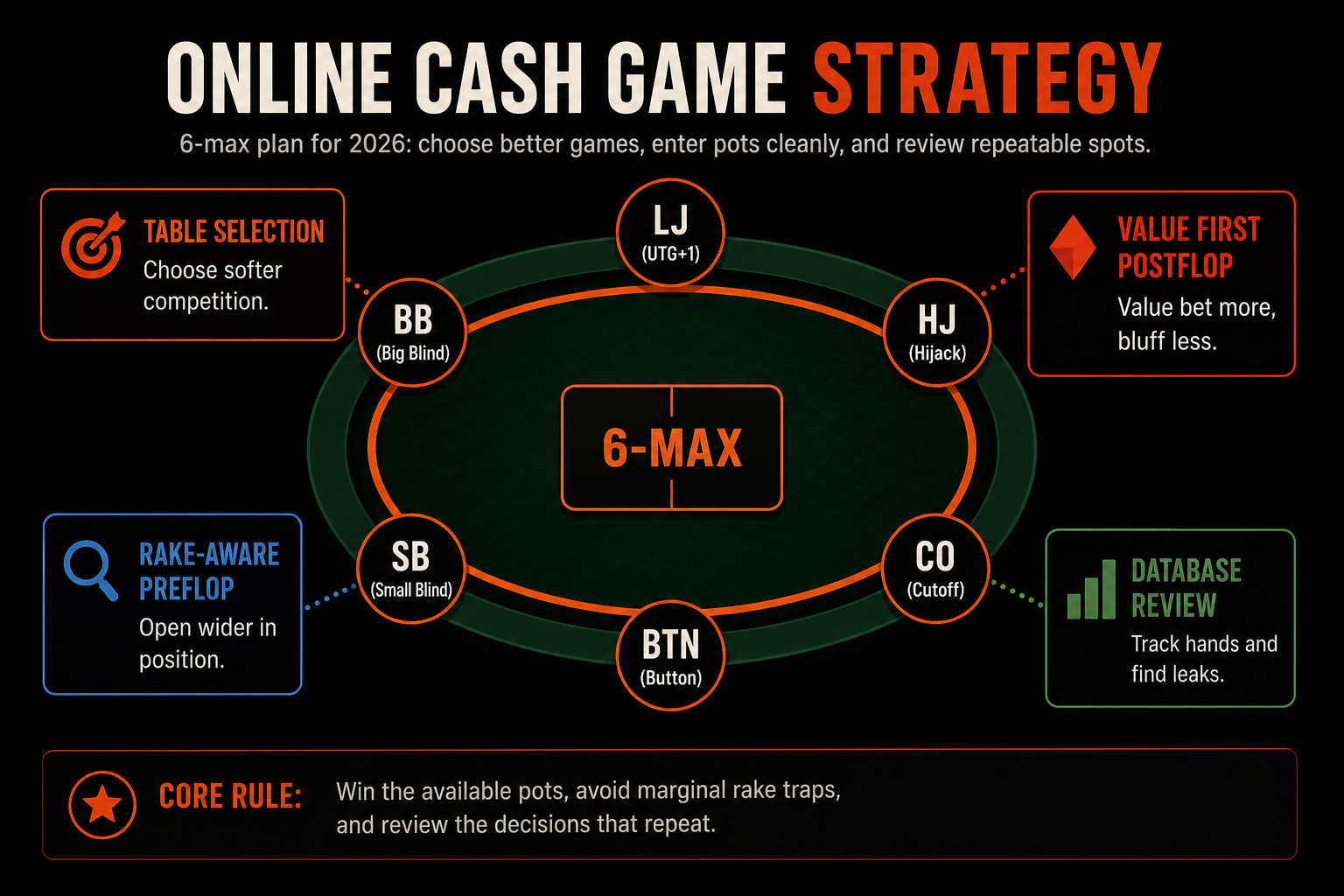
The modern 6-max pool is not soft in the same way old online games were soft. Recreational players still call too much, limp too often, and overplay one-pair hands. Regulars also have preflop charts, solver language, database filters, and population reports. If your plan is "play tight and wait," you will miss too much value. If your plan is "battle everyone like a high-stakes regular," rake and variance will punish you.
This guide gives you a practical framework for online 6-max cash games, especially 100bb No-Limit Hold'em. The exact ranges and bet sizes depend on site rules, rake structure, player pool, stack depth, and whether HUDs are allowed. The strategic job stays the same: choose profitable games, enter pots with better ranges, attack weak ranges, protect yourself in high-rake marginal spots, and review the hands that cost you the most.
Why Online Cash Game Strategy Changed for 2026
The biggest change is not that poker became solved. It did not. The change is that many players now understand the language of solver poker even when they do not execute it well. They know about range advantage, blocker effects, small c-bets, overbets, and mixed strategies. That means your edge comes from applying simple ideas accurately under pressure, not from saying advanced terms.
6-max is still action-heavy compared with full-ring poker. There are fewer early-position players to get through, so ranges are wider, blind battles are more frequent, and you play more pots per hour. That creates more opportunities, but also more chances to leak money with dominated hands.
The second pressure is rake. In online cash games, rake is a recurring cost. A close preflop call may look fine before rake and become losing after rake. A low-stakes player who defends every suited hand because "it has equity" often discovers that the hand makes too many small losing pots and too few big clean wins.
The third pressure is volume. Online players can play hundreds or thousands of hands quickly, especially if they multi-table. Volume exposes weak defaults. If you defend the big blind too wide, call too many 3-bets out of position, or bluff the wrong rivers, the database will show the leak fast.
A winning 2026 strategy should be:
- Structured enough that you do not guess in common spots.
- Flexible enough that you can exploit obvious pool mistakes.
- Rake-aware enough that you avoid thin, low-EV gambles.
- Reviewable enough that every session gives you better information.
Start With Table Selection and Seat Quality
Your first strategic decision happens before the first hand. A tough 25NL table with five studied regulars can be worse than a softer 50NL table with two loose recreational players, assuming your bankroll supports the stake. You are not paid extra for choosing harder lineups.
Look for signs of beatable games:
- Incomplete stacks such as 41bb, 63bb, or 78bb.
- Players limping into unopened pots.
- Players posting blinds out of position.
- Obvious VPIP/PFR gaps when HUDs are allowed.
- Multiway pots happening often.
- Chatty, distracted, or obviously recreational table behavior.
- Regulars on your left who are not aggressively 3-betting.
If every stack is full, every pot is open-raise or 3-bet, and the blinds defend well, you may still beat the game, but your edge is thinner. Move tables when a good seat disappears. Quitting a bad table is not weakness; it is win-rate protection.
Seat position matters too. You want loose-passive players on your right so you can isolate them in position. You want aggressive 3-bettors and strong regulars on your right less often, because they put pressure on your opens. If a recreational player sits two seats to your left and keeps calling, the table can still be good. If a strong regular sits directly on your left and attacks every cutoff and button open, your steal EV drops.
Keep Your Table Count Honest
Multi-tabling is only profitable when your decisions remain high quality. If you add tables and start auto-calling 3-bets, missing value bets, or timing out with river decisions, you have traded win rate for false efficiency.
Start with two tables while building your system. Add one table only when your preflop decisions feel automatic and your postflop notes are still specific. If you cannot mark hands, identify player types, and think through ranges, reduce tables.
Your table count should be based on decision quality, not ego. A player winning 6bb/100 on two tables is in a better position than a player breaking even on six tables while practicing bad habits faster.
Online Cash Game Strategy Starts Preflop
Online Cash Game Strategy begins with preflop discipline because most expensive postflop mistakes are created before the flop. You call the 3-bet too wide, flop one pair in a bloated pot, and then blame the river. The real leak happened when you entered the pot with a dominated range.
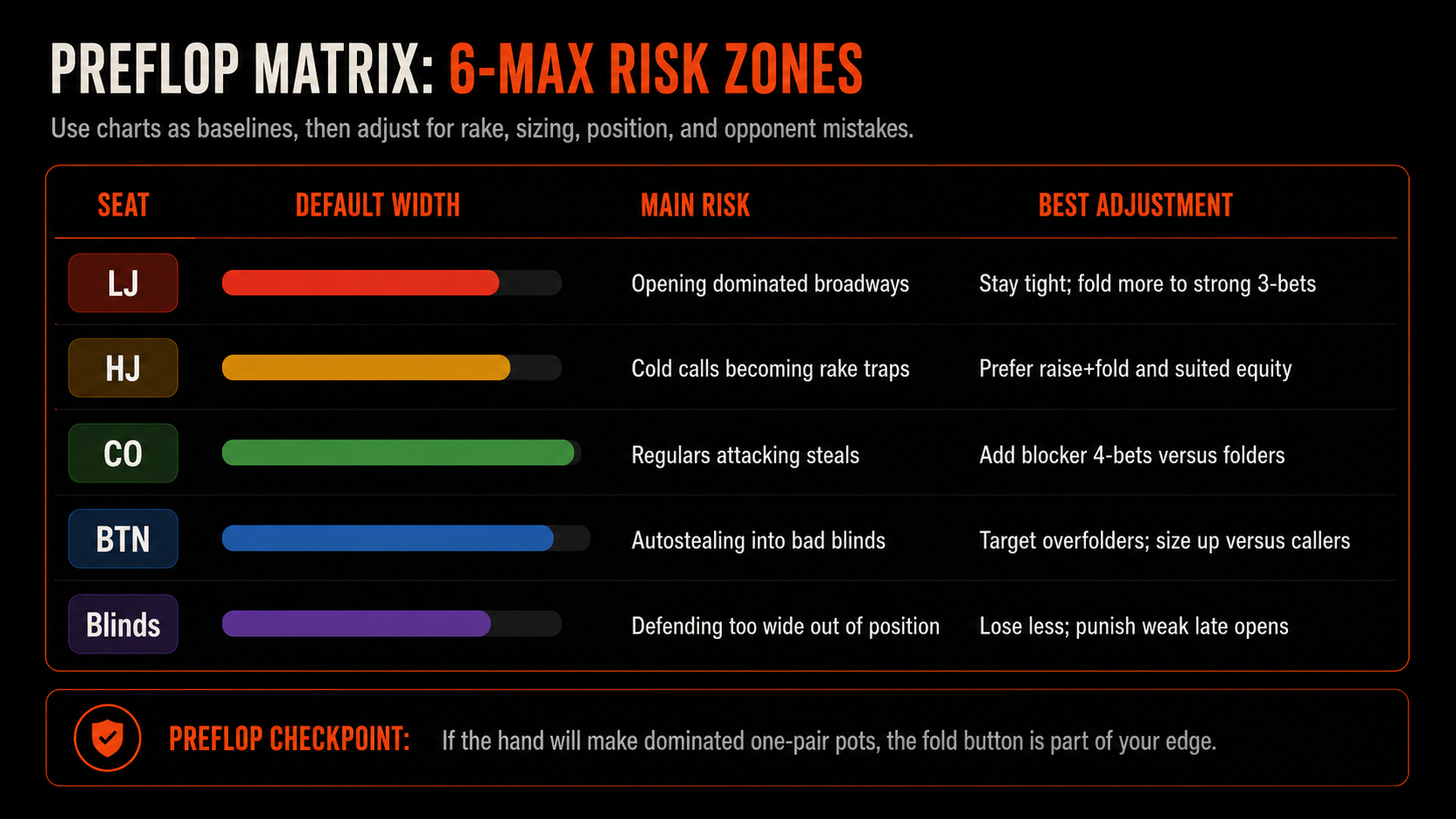
Use position as your first filter. In 6-max, the common seats are lowjack, hijack, cutoff, button, small blind, and big blind. The button is your most profitable seat because you act last postflop. The blinds are structurally losing seats because you put money in before seeing cards and often play out of position.
Use these conservative defaults as a starting point:
- Lowjack: pairs, strong suited aces, AJo+, KQo, suited broadways, and selected suited connectors.
- Hijack: add more suited aces, medium suited kings, suited broadways, and medium connectors.
- Cutoff: open more suited kings, suited queens, suited connectors, suited one-gappers, and good offsuit broadways.
- Button: attack the blinds with a wide but structured range.
- Small blind: avoid completing weak hands; use a raise-or-fold plan unless the game has a specific reason to limp.
- Big blind: defend based on opener position, sizing, rake, and postflop skill.
Do not turn this into a permission slip to play every pretty suited hand. Hands like K7s, Q8s, and 86s can be profitable in some button situations and bad in early-position or high-rake calls. Preflop charts are baselines, not autopilot.
Open Sizes and Rake
Small online opens are common because they risk less and let you steal frequently. A 2bb or 2.5bb open can work well in tough pools. Against loose blinds who call too much, larger opens with a stronger range can increase value.
The key is to avoid random sizing tells. If you open 2bb with weak hands and 3bb with strong hands, observant players will adjust. If you size up because the blinds call too much, do it with the whole profitable opening range from that spot, not just aces and kings.
Rake also affects preflop decisions. In high-rake environments, marginal calls become worse. Calling a small suited connector in the cutoff versus an early open may look playable in a solver sim with one rake setting and become unattractive in your actual game. When in doubt at low stakes, prefer clean raises, folds, and value-heavy continues over thin cold calls.
Build a 3-Bet and 4-Bet Plan
A modern 6-max player needs a clear 3-bet plan. If you only 3-bet premiums, regulars can fold too much. If you 3-bet random suited hands without understanding blockers and position, you create expensive pots with weak ranges.
Start with three categories:
- Value 3-bets: hands happy to continue against a 4-bet or play a big pot, such as AA, KK, QQ, AK, and sometimes JJ or AQs depending on positions.
- Linear 3-bets: strong playable hands that perform well against calls, such as AQs, AJs, KQs, TT, JJ, and suited broadways.
- Polar 3-bets: strong value plus selected bluffs, often blocker-heavy suited aces or suited kings, used more in position or blind-versus-late-position spots.
Against loose callers, use more linear value. They are not folding enough, so hands like AQs, KQs, TT, and JJ gain value. Against players who open too wide and fold too much to 3-bets, add blocker-based bluffs, especially in position.
Against tight early-position opens, stop forcing action. Your A5s 3-bet bluff can be fine in some configurations, but not if the opener is under-opening and never folding. Your KJo call out of position is usually worse than it feels. Poker rewards disciplined folding.
Facing 3-Bets Without Leaking
Many players lose money by defending opens emotionally. They think, "I opened, so I cannot just fold." You can. You should. Folding to a strong 3-bet is often the best decision.
Use these default adjustments:
- Continue tighter out of position than in position.
- Fold dominated offsuit broadways more often.
- Call hands that realize equity well, such as suited broadways and pairs, when price and stack depth support it.
- 4-bet value hands decisively.
- 4-bet bluff mostly with blockers against players who can fold.
- Do not call because you want to "see a flop" in a bloated pot.
Example: You open AJo from the hijack. The button is a tight regular with a low 3-bet rate and makes it 9bb. Calling creates a pot where you are dominated by AQ, AK, and strong pairs, while playing out of position after the button acts last. Folding is not nitty. It is clean.
Now change the spot. You open the button with A5s. The small blind is an aggressive regular who 3-bets too much and folds to 4-bets. A small 4-bet bluff can make sense because your ace blocks AA and AK, and your suited wheel ace has backup equity when called. Same hand class, different configuration, different answer.
Postflop Fundamentals: Range, Board, Player
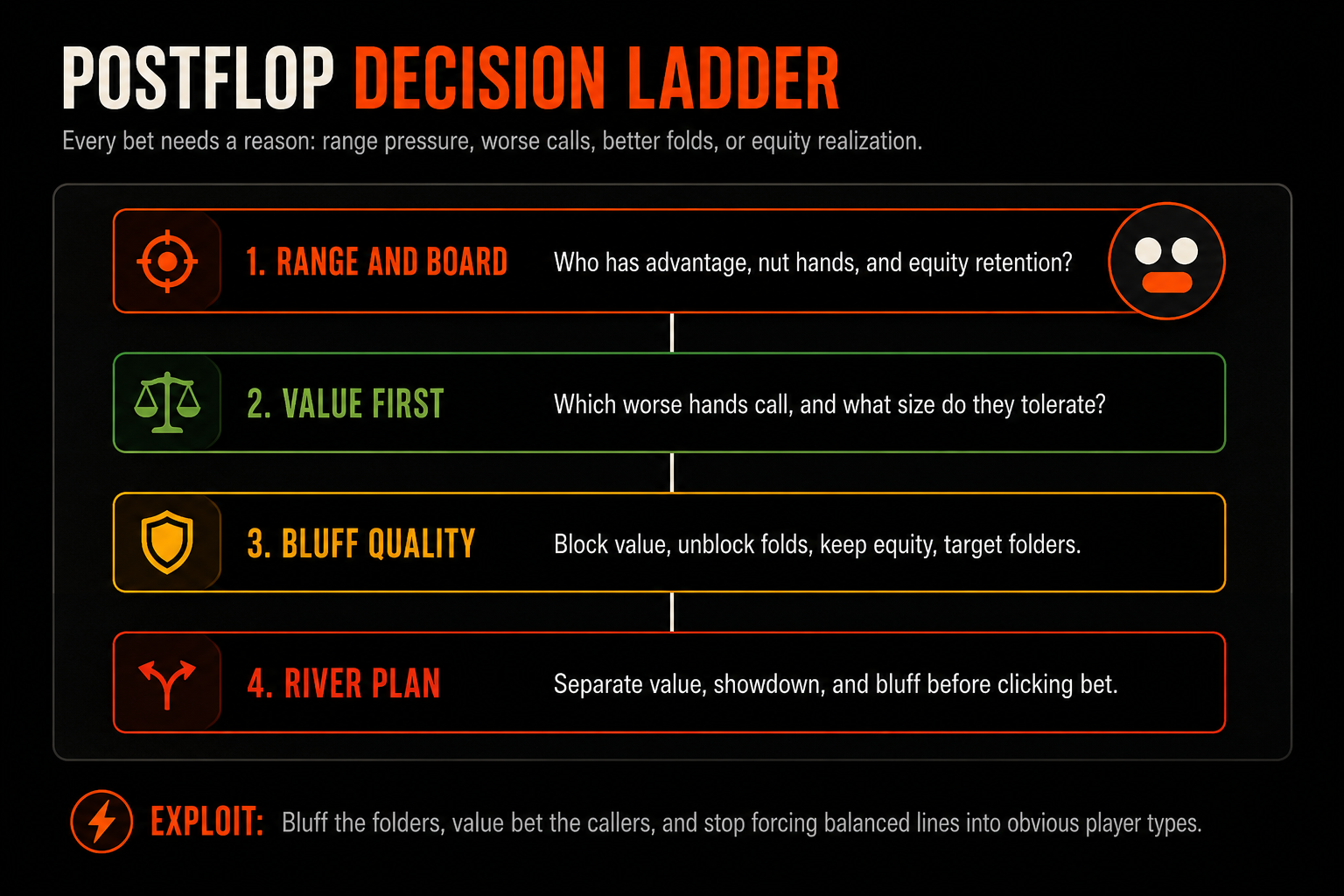
Postflop, stop asking only, "What do I have?" Better questions are:
- Who has the range advantage?
- Who has the nut advantage?
- How does this board hit preflop ranges?
- What worse hands call my value bet?
- What better hands fold to my bluff?
- Is this opponent capable of folding or bluffing?
On A72 rainbow after you raise button and the big blind calls, you often have range advantage. Your range contains many strong aces and premium pairs; the big blind has many weaker hands. A small c-bet can put pressure on a wide range.
On 987 two-tone after you raise lowjack and the big blind calls, slow down. The big blind has more two pair, straights, pair-plus-draws, and suited connectors. Range betting because "I was the preflop raiser" burns money.
Against weaker players, simplify:
- Bet strong hands for value.
- Check medium hands that do not want to face a raise.
- Bluff boards where your story is credible and the opponent can fold.
- Stop barreling calling stations with no equity.
- Punish capped ranges when regulars overfold.
Solver study helps because it teaches how ranges interact with boards. But at the table, you need useful shortcuts. Dry high-card board? Preflop raiser often bets small. Dynamic connected board? Bet more selectively. Turn improves your range and gives you equity? Continue more often. River bricks and villain's line is passive? Value bet thinner against callers, bluff less against stations, bluff more against overfolders.
Online Cash Game Strategy for C-Betting
Online Cash Game Strategy for c-betting should not be "bet because I raised." A c-bet is profitable when your range, hand, sizing, and opponent create pressure or value.
Use small bets when:
- You have a strong range advantage.
- The board is dry and hard for the caller to connect with.
- You want folds from many weak hands at a low price.
- You can comfortably bet a high frequency.
Examples include button versus big blind on A72 rainbow, K83 rainbow, or Q62 with limited draws. A 25-33 percent pot bet can fold out trash, charge weak floats, and keep your range protected.
Use larger bets when:
- Your value hands want to build a pot.
- The board is draw-heavy.
- Your opponent has many worse hands that call.
- Your range is more polarized.
Examples include betting sets and strong overpairs on J98 two-tone, or betting top pair plus draw against a loose caller who will not fold worse pairs and draws.
Check more often when:
- The board strongly connects with the caller.
- Your hand has medium showdown value.
- You face a check-raise from aggressive opponents too often.
- The pot is multiway.
- Your opponent is unlikely to fold and your hand has low equity.
Turn Barrels and River Plans
A flop bet without a turn plan is a common leak. Before c-betting, ask what turns you will continue on. If you bet QJ on K72 rainbow and the turn is a ten, you picked up equity and can often continue. If the turn is a low brick and the opponent is sticky, checking may be better.
Good barreling cards usually improve your range, give your hand equity, or pressure the opponent's capped range. Bad barreling cards improve the caller or leave you with no fold equity.
On rivers, split your hands into value, showdown, and bluff. Value hands need worse calls. Showdown hands prefer checking. Bluffs need better folds. If you cannot name the better hands that fold, do not bluff just because you missed.
Value Betting Is Still the Main Engine
Even in 2026, most low and midstakes online cash-game profit comes from value. Players call too much in the wrong spots, especially when they have top pair, second pair, draws, or emotional investment in the pot.
Your job is to value bet clearly:
- Overpairs on safe boards.
- Top pair top kicker against loose ranges.
- Sets and two pair on dynamic boards.
- Strong top pair when draws miss.
- Thin river value when villain arrives capped.
Example: You open AQs on the button. The big blind calls. The flop is AQ6 rainbow. They check-call your small bet. The turn is 8 completing no draw. They check again. Bet. They can call worse aces, queens, pair-plus-backdoor hands, and stubborn floats. Checking back because you fear a check-raise leaves money on the table against most pools.
Now consider QQ on K87 two-tone after a tight big blind check-calls flop. The turn is a suited 9, adding draws and improving parts of their range. Your hand may still be ahead, but it is not a mandatory value barrel. Checking can control the pot and let you call reasonable river bets.
Thin value is where good players separate themselves. If a passive player checks river after calling flop and turn on A9642, and you hold AJ, you may be able to bet for value. If an aggressive regular check-raises river in the same spot, your hand changes category fast.
Bluff With Blockers, Equity, and Fold Equity
You cannot win 6-max cash games by never bluffing. You also cannot win by bluffing every missed draw into players who hate folding. Good bluffs combine blocker value, equity, and fold equity.
A useful bluffing checklist:
- Does my hand block villain's strongest calls?
- Does my hand unblock folds?
- Did my line credibly represent value?
- Is this opponent capable of folding?
- Is the board better for my range than theirs?
- Do I have equity when called on flop or turn?
Preflop, suited wheel aces are common bluff candidates because they block AA and AK, can make nut flushes, and can sometimes make straights. Postflop, blockers depend on the board. On a four-straight board, having the key straight blocker can matter. On a missed flush-draw river, holding a missed flush draw may be bad for bluffing if it blocks the hands you want villain to fold.
Avoid low-quality bluffs:
- Multiway flop stabs with no equity.
- River bluffs against players who call any pair.
- Turn barrels on cards that improve the caller.
- Bluffing hands that block villain's folding range.
- Bluffing because you are frustrated from losing previous pots.
Against many low-stakes pools, the best exploit is not "never bluff." It is "bluff the folders and value bet the callers." Use HUD stats and notes to separate them. A player with high fold-to-c-bet and low aggression can be attacked. A player with high VPIP, low PFR, and sticky showdown habits should be value-owned.
Play the Blinds Like They Matter
The blinds decide your long-term win rate more than most players admit. Everyone loses money from the small blind and big blind. The goal is to lose less while creating profitable steals and resteals.
From the small blind, you are out of position against the big blind for the rest of the hand. Avoid completing weak hands by default. A raise-or-fold strategy is easier to execute and denies the big blind free realization. If the big blind overfolds, raise wider. If they defend too much and play poorly postflop, raise a value-heavy range and punish them after the flop.
From the big blind, you get a discount, but that does not mean you print money by defending everything. Defend wider versus button min-raises than versus lowjack 3bb opens. Fold more against tight ranges, larger sizes, and high-rake environments. Continue with hands that realize equity: suited hands, broadways, pairs, and connected hands. Be careful with dominated offsuit hands.
Blind-versus-blind pots are unique because ranges are wide. Top pair is stronger than it would be lowjack versus big blind, but wide ranges also mean more strange two pairs and draws appear. Pay attention to opponent type. Some players stab too much when checked to; others underbluff and only apply pressure with value.
Multiway Pots Require Tighter Thresholds
Multiway pots are where many online players overestimate marginal hands. When two or more opponents continue, ranges become stronger. A hand that is a comfortable heads-up value bet may become a check in a three-way pot.
Simple multiway rules:
- Bluff less often.
- Value bet stronger ranges.
- Use smaller sizing more often when betting into multiple players.
- Prefer hands with nut potential.
- Stop stacking off light with one pair.
- Respect raises more, especially from passive players.
Example: You raise KQo from the cutoff, the button calls, and the big blind calls. The flop is KJ8 two-tone. Heads-up against the big blind, top pair may be a clear value bet. Three-way, the button and big blind have more sets, two pair, straight draws, flush draws, and Kx. You can still bet sometimes, but you should not treat top pair as invincible.
Multiway pots also punish bad preflop calls. If you cold-call suited trash because "the pot is going multiway," you need to make strong hands and get paid enough to overcome rake and reverse implied odds. Weak flushes, dominated top pairs, and low-equity draws are not a strategy.
HUDs, Notes, and Database Review
If your site allows HUDs and tracking software, use them responsibly and within site rules. If your site does not allow them, use manual notes and post-session hand histories. The goal is the same: turn observed behavior into better decisions.
Useful HUD stats include:
- VPIP: how often a player voluntarily enters the pot.
- PFR: how often a player raises preflop.
- 3Bet: how often a player reraises preflop.
- Fold to 3Bet: whether steals and resteals print.
- Fold to Flop C-Bet: who gives up too often.
- Went to Showdown: who is sticky.
- Aggression Frequency: who bluffs and bets.
- Hands: whether the sample is meaningful.
Do not overreact to tiny samples. A player can show 50 VPIP over 12 hands because they got dealt playable cards. But a 43/8 player over 300 hands is probably loose-passive, and your strategy should change. Isolate more, value bet larger, and fold more when they suddenly raise.
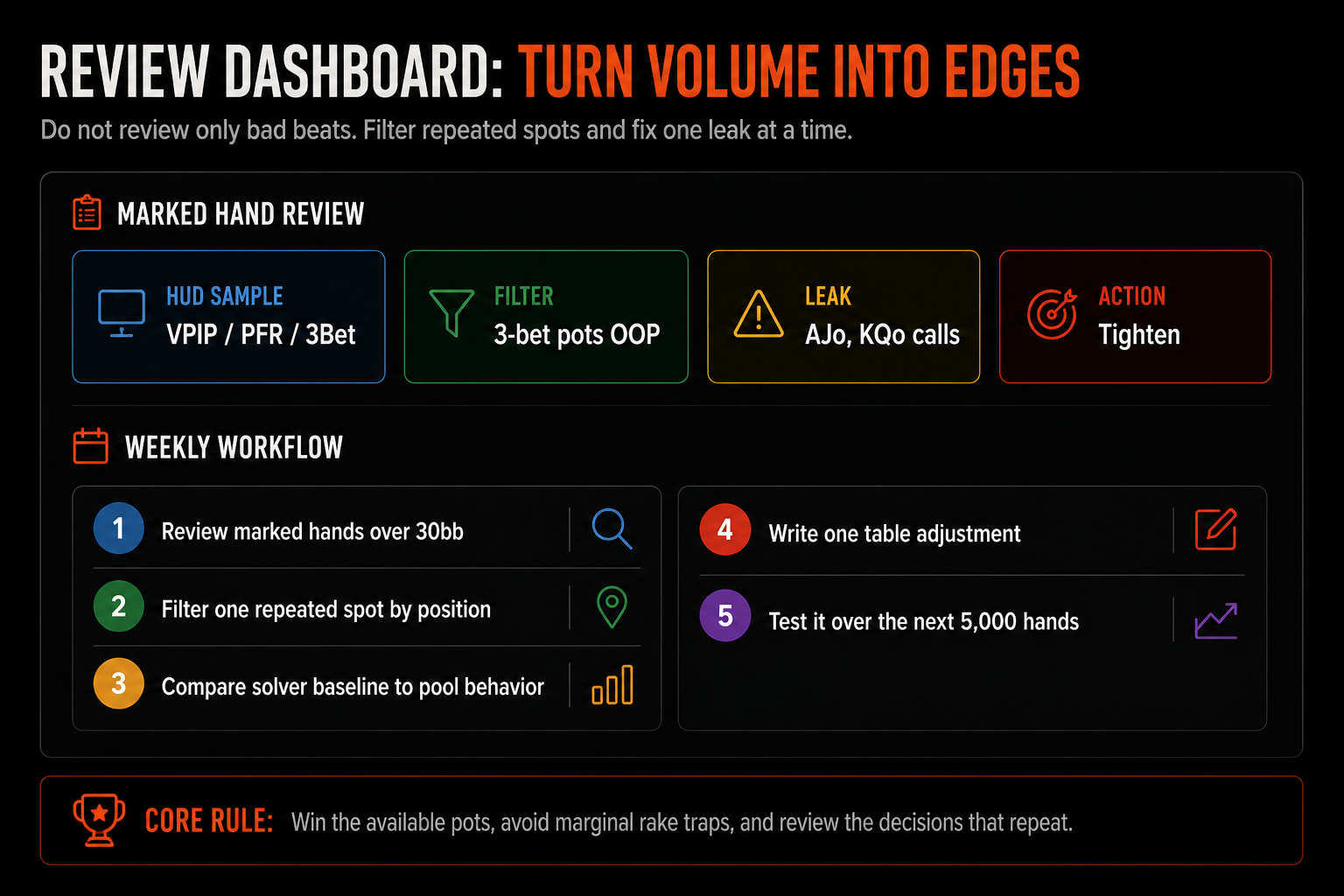
Mark hands during play:
- Big 3-bet pots.
- River calls over 30bb.
- Spots where you were unsure about c-bet sizing.
- Hands where you deviated from your chart.
- Bluff candidates that got called.
- Thin value spots you skipped.
Then review by category. Do not just watch the biggest losing hands. Review repeated spots. Filter button opens, big blind defense, 3-bet pots out of position, c-bets on low connected boards, and river calls. Your biggest leak may be a small mistake repeated 400 times.
Bankroll, Stop-Losses, and Moving Up
Cash games feel stable because you can leave whenever you want, but No-Limit Hold'em still has brutal variance. A good player can lose many buy-ins while playing well. A weak player can win for a week and think they have solved the game.
Use a bankroll plan before you need one. For online 6-max cash, many players use at least 30 buy-ins for a stake, with more if the games are tough, the rake is high, or poker money matters to life expenses. A cautious player may prefer 40-50 buy-ins. If you are learning, protect yourself by moving down quickly.
A simple plan:
- Take standard shots when you have 35-40 buy-ins for the next stake.
- Move down if you lose 5-8 buy-ins during a shot.
- Keep life money separate from poker money.
- Do not chase losses by adding tables or moving up.
- Review before increasing volume after a downswing.
Stop-losses are not magic, but they prevent emotional sessions from becoming expensive. If you lose three buy-ins and feel clear, you can continue. If you lose two buy-ins and start clicking call because "they always have it against me," stop immediately.
Moving up should require both bankroll and evidence. Evidence includes a meaningful sample at your current stake, controlled tilt, positive redline or showdown explanations, and review notes showing you understand your leaks. A heater is not evidence by itself.
A 2026 Study Routine for 6-Max Cash
The best study routine is boring enough that you actually do it. You do not need to solve every node in a massive tree. You need repeated, focused work on the spots you play every day.
Use this weekly routine:
- One session reviewing marked hands.
- One database filter for a repeated spot.
- One preflop range check by position.
- One solver comparison for a common board texture.
- One exploit note update for your player pool.
For example, Monday you review all 3-bet pots where you called out of position. Wednesday you filter button opens that faced big blind calls and study c-bet success by board type. Friday you compare a solver baseline for A-high dry boards versus low connected boards. Sunday you update your exploit notes: who overfolds, who overcalls, who underbluffs rivers.
Use solvers to learn principles, not to shame yourself for missing a 14 percent mixed check. Ask:
- Which player has range advantage?
- Which hands bet for value?
- Which hands bluff and why?
- What sizing does the strategy prefer?
- Which simplification can I execute in game?
Then translate the answer into a rule you can use at the table. "On dry ace-high button-versus-big-blind boards, I can bet small often." "On wet low boards after early-position opens, I should check more." "Against loose-passive players, river raises are underbluffed until proven otherwise."
[INTERNAL: hand history review process]
Common Leaks That Still Crush 6-Max Players
Most losing online cash players do not lose because of one dramatic punt. They lose because repeatable leaks show up every session.
The biggest leaks are:
- Opening too loose from early position.
- Calling too many 3-bets out of position.
- Defending the big blind without considering rake.
- C-betting every board as the preflop raiser.
- Under-value-betting rivers.
- Bluffing calling stations.
- Overfolding to small bets but overcalling big bets.
- Playing too many tables while learning.
- Ignoring table selection.
- Reviewing only bad beats.
Fix leaks in order. Preflop comes first because it affects every street. Then fix flop c-bets because they happen constantly. Then fix turn barrels and river calls because those pots are larger. Do not spend three hours studying rare river overbet nodes if you are still cold-calling KTo versus early-position opens.
A Practical Leak-Finding Drill
Pick one leak per week. Suppose you suspect you call too many 3-bets. Filter all hands where you open-raised, faced a 3-bet, and called. Split by position. Look at win rate, showdown results, and hand classes. You may discover AJo, KQo, KJo, and QJo are losing heavily out of position.
Your adjustment might be:
- Fold dominated offsuit broadways versus tight 3-bettors.
- 4-bet bluff suited wheel aces only versus folders.
- Call more suited broadways in position.
- Stop defending because you are annoyed.
That is real improvement. It is specific, measurable, and easy to test next week.
Frequently Asked Questions
What is the best Online Cash Game Strategy for 6-max beginners?
The best beginner strategy is tight-aggressive and position-aware. Open solid ranges, avoid weak cold calls, value bet clearly, bluff selectively, and review marked hands after every session. Do not try to copy high-stakes mixed strategies before you can execute clean fundamentals.
How many tables should I play online?
Play the number of tables that lets you make strong decisions. For many players learning 6-max, that means one or two tables. Add tables only when you can still track player types, mark review hands, and avoid automatic calls in big pots.
Should I use a HUD for online cash games?
Use a HUD only where the poker site allows it. If allowed, focus on basic stats like VPIP, PFR, 3Bet, fold to c-bet, went to showdown, aggression, and sample size. If HUDs are not allowed, take manual notes and review hand histories.
How much bankroll do I need for 6-max cash games?
Many online cash players use at least 30 buy-ins, with 40-50 buy-ins for tougher games, higher variance, or cautious bankroll management. The right number depends on win rate, stake, life situation, and willingness to move down.
Can you beat online cash games without solvers?
Yes, especially at lower stakes, but solver study helps you understand range interaction, bet sizing, and bluff selection. You do not need to memorize outputs. Use solver work to build simple heuristics and then exploit the actual player pool.
Take Action Now
The fastest way to improve your Online Cash Game Strategy is to make your next 5,000 hands measurable. Choose better tables, reduce table count, follow position-based ranges, mark every tough 3-bet pot and river decision, then review the patterns. In 2026, the winners are not the players with the fanciest vocabulary. They are the players who execute clean fundamentals, exploit obvious mistakes, and keep improving one repeatable spot at a time.
[INTERNAL: Level X cash game training]