$1/$2 Live Cash Game Strategy: How to Beat Loose Passive Players
$1/$2 Live Cash Game Strategy: How to Beat Loose Passive Players
Live Cash Game Strategy at $1/$2 is mostly about taking money from players who call too often and raise too rarely. Loose passive players want to see flops, chase hands, avoid uncomfortable raises, and pay off when they convince themselves you might be bluffing. Your edge comes from building bigger pots when you are ahead, avoiding ego bluffs when they are not folding, and trusting their aggression when they finally wake up.
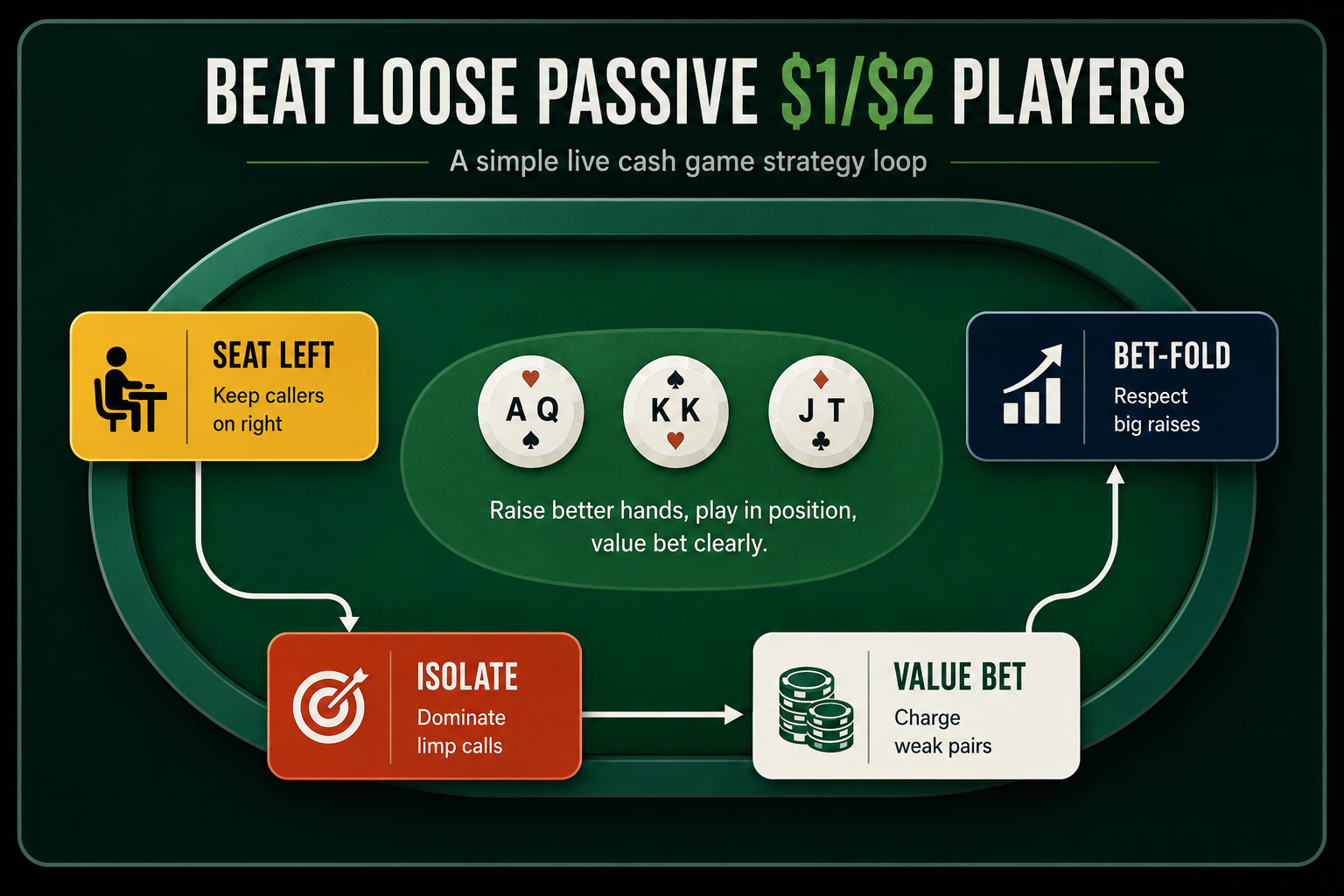
This article is written for live no-limit hold'em cash games, especially $1/$2 and similar low-stakes rooms where stacks are often 100 to 250 big blinds, open sizes are larger than online opens, and multiway pots are normal. The exact chips change by room, but the player type is familiar: limps too much, calls raises too wide, check-calls with weak pairs, chases draws without counting price, rarely turns hands into bluffs, and treats a big river bet like a hand announcement.
The exploit is not to become a maniac. It is to become selectively aggressive. You raise more when position and hand quality let you dominate their loose range. You value bet more often because their calling threshold is low. You bluff less into sticky ranges, but you still bluff when their range is full of missed trash and your bet can target that exact trash. You fold more when the passive player chooses a line that represents strength.
The goal is a clear, repeatable system you can use tonight: identify loose passive players, isolate them correctly, size for value, play multiway pots with discipline, and stop paying off obvious strength.
Why Live Cash Game Strategy Changes Against Loose Passive Players
Loose passive opponents create a different game tree than solid aggressive opponents. Against a strong regular, you worry about balanced 3-bets, check-raises, delayed bluffs, and river pressure. Against a loose passive player, the main leak is simpler: they put too much money in the pot with hands that are not strong enough, then fail to apply enough pressure with hands that could deny your equity.
That combination is powerful for you. Their looseness gives you more value opportunities. Their passivity gives you more equity realization. When you raise AJs on the button over two limpers, you are not just punishing weak starting hands. You are also buying position against players who are unlikely to 3-bet you light, unlikely to check-raise enough, and unlikely to make you indifferent with properly chosen bluffing ranges.
The mistake many players make is assuming loose passive means "easy money in every pot." It does not. These players still get dealt sets, straights, flushes, and two pair. Because they play so many hands, they also show up with odd combinations on boards that should not hit disciplined ranges. If you refuse to fold overpairs or top pair because "this player is bad," you turn their looseness into your leak.
Your default should be: attack their weak range before and on the flop, value bet thinner than usual, protect yourself from multiway chaos, and respect large passive aggression until proven otherwise.
Profile the Player Before You Attack
Loose passive is not one exact range. You need to sort players into useful subtypes before the pots get big.
The first type is the pure flop-seeker. This player limps almost any suited hand, any ace, broadways, small pairs, connectors, and plenty of offsuit clutter. They call raises because folding preflop feels boring. They miss most boards and check-fold more than they should, but when they connect they hate folding pair-plus-draw, top pair, or any hand they call "live."
The second type is the speculative limper. This player has a mental split between "raising hands" and "drawing hands." They may open-raise big pairs and big broadways, then limp-call small pairs, suited connectors, suited aces, and suited gappers. Against them, an isolation raise still performs well, but low connected boards deserve more caution because their limp-call range is concentrated around the hands that connect there.
The third type is the sticky showdown player. They may not be wildly loose preflop, but once they put money in, they do not like folding. They call flop and turn with any pair, gutshots, ace-high backdoors, and weak top pairs. They are the best target for repeated value bets and the worst target for ambitious triple-barrel bluffs.
The fourth type is the trap-passive player. They limp-call too much but also slow-play monsters. They check-call sets on wet boards, call two streets with the nut flush, and raise the river only when they think they are unbeatable. Against them, your bet-fold discipline matters as much as your value betting.
Quick Live Reads That Matter
Watch showdowns before judging. A player who limp-called K8o under the gun and called two streets on K-high is a different target from a player who limp-called 55 and folded ace-high flops. One gives you thin top-pair value. The other gives you isolation and continuation-bet profit but may have a more condensed continuing range on coordinated boards.
Useful notes include:
- Limp-call hands by position.
- Whether they call raises with dominated offsuit aces.
- Whether they raise draws or only made hands.
- Whether they donk small with weak pairs.
- Whether they lead river when draws miss.
- Whether big bets make them curious or scared.
You do not need a perfect scouting report. You need enough evidence to decide whether your money comes from isolation, thin value, fold equity, or disciplined folds.
Live Cash Game Strategy Starts With Seat and Table Selection
Your first exploit happens before you play a hand. In a $1/$2 room, the difference between a good seat and a bad seat can be larger than the difference between two close river decisions. Loose passive players are most profitable when they are on your right. That lets you isolate their limps in position, value bet after they check, and control pot size when the board changes.
If the loose passive player is on your left, they still make mistakes, but you lose leverage. They can call behind you and force you into out-of-position multiway pots. They can flatten your raises and deny you clean heads-up situations. They can make your marginal opens worse because you know you will often play postflop without position.
Look for tables where several of these are true:
- Many players limp before the flop.
- Opens get called by two or more players.
- Players show down dominated top pairs.
- Few players 3-bet without premium hands.
- Straddles create larger pots but not better aggression.
- Stacks are deep enough for value bets to matter.
- The players with the widest ranges are not directly on your left.
[INTERNAL: live poker table selection guide]
If you cannot change tables, change your expectations. A loose passive game with three callers to every raise is profitable, but it requires patience. You will lose more small and medium pots than you think you should. Your edge appears when you make strong hands and get paid too much, not when you win every continuation-bet spot.
Isolation Raising: Punish Limpers Without Splashing Around
Isolation raising is the central preflop weapon against loose passive players. When they limp weak hands and call raises too wide, you want to build pots with hands that dominate them, especially in position. The key phrase is "with hands that dominate them." Raising any two cards because a limper is bad creates expensive second-best hands.
At $1/$2, a normal open might be $10 to $15 depending on room conditions. Over limpers, a useful default is the table's normal open plus one big blind per limper, then adjusted for position, stack depth, and how sticky the table is. If $12 is the normal open and two players limp, $16 to $20 may be reasonable. If $15 always gets four callers, you may need $20 to $25 with your value-heavy range.
Your goal is not always to "thin the field" at any cost. Sometimes the table will not fold. Your goal is to charge loose ranges and create a pot where your better hands can win more money. If five people call your $12 raise, bigger sizing with better hand selection becomes more important.
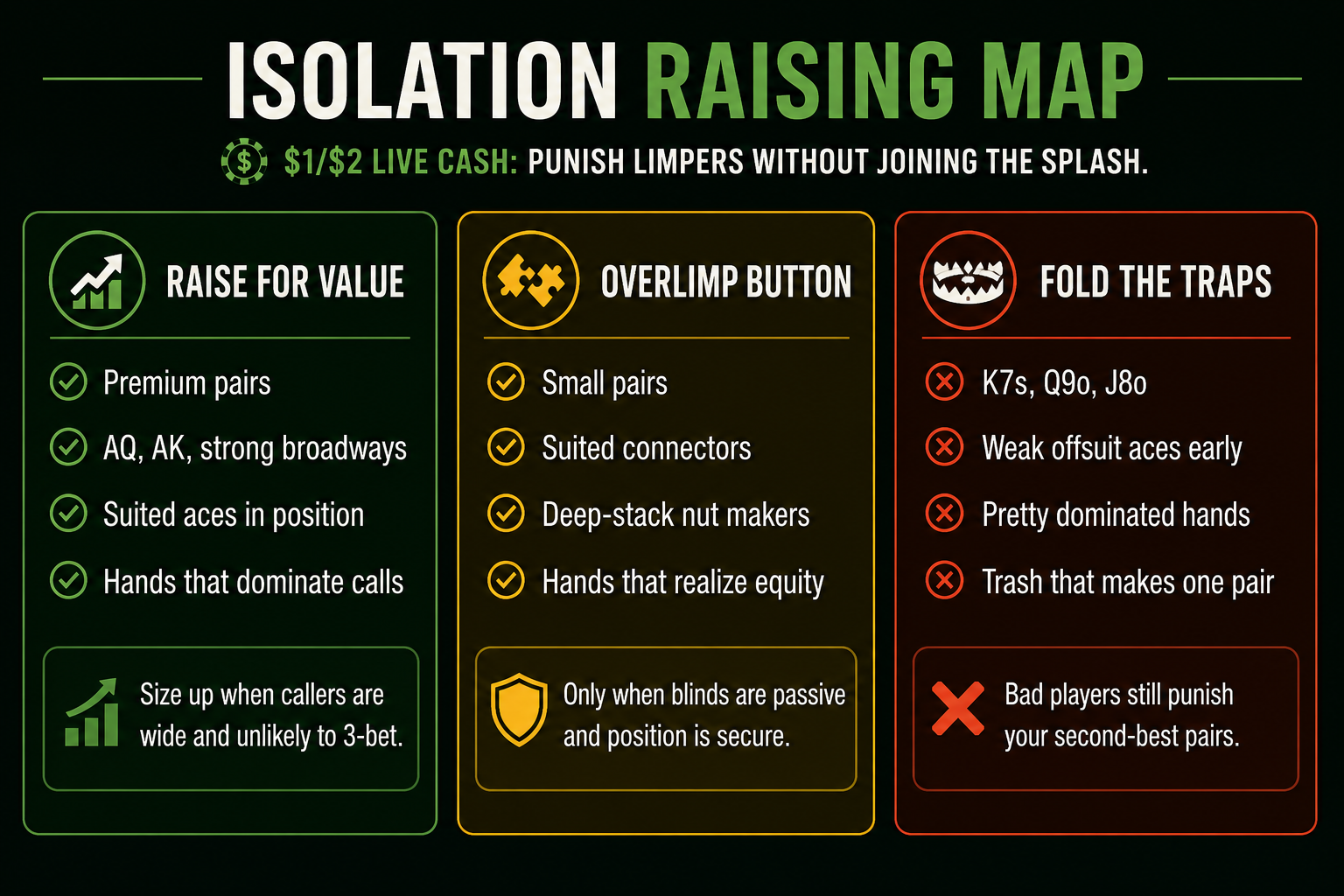
Good isolation candidates include:
- Big pairs and strong broadways.
- AJs, ATs, KQs, KJs, QJs, and similar suited broadways.
- AQo and AKo, especially in position.
- Suited aces that dominate weaker suited aces and make nut flushes.
- Medium pairs when stacks are deep and callers pay off.
- Suited connectors mostly from late position, not from early position into a calling field.
Bad isolation candidates are hands that look pretty but make dominated one-pair hands: K7s, Q9o, A6o from early position, J8o, and low suited trash. These hands do not become profitable just because the opponent is loose. They become traps when you make top pair and face resistance.
When Overlimping Is Better
A raise-or-fold strategy is clean when you are not guaranteed position. But on the button, with multiple limpers, overlimping can be profitable with hands that play well in high-SPR pots and are not strong enough to raise for value.
Examples include 55, 44, 76s, 65s, and suited hands that can make disguised strong holdings. You are risking one blind, closing action more often, and playing in position. That does not mean limp behind with everything. It means your button can contain a controlled overlimp range when the blinds are passive and stacks are deep.
If aggressive players in the blinds squeeze often, tighten your overlimps. If the blinds never punish limps and the limpers pay off, widen slightly in position. Position is the difference between exploiting their looseness and joining it.
Build a Preflop Plan for $1/$2 Sizing
Live $1/$2 sizing often looks strange to online players. A 2.5bb open is standard in many online environments, but in live low-stakes games, $10, $12, $15, and larger opens can all be normal. You should not copy online sizing blindly into a game where four players will call $8 without thinking.
Start with the smallest size that accomplishes your goal. If $12 gets heads-up or three-way action against weak ranges, $12 may be fine. If $12 creates a six-way pot and $20 creates a three-way pot with the same weak players, use $20 with the hands that benefit from it. If the table calls any size, tighten your raising range and choose hands that perform well in bloated multiway pots.
A practical framework:
- Unopened pot from late position: use the table's normal winning open size.
- One limper in position: add $3 to $5 over the normal open.
- Multiple limpers: add roughly one big blind per limper, then adjust to table stickiness.
- Out of position: raise tighter and size for value, not for style.
- Against short stacks: reduce speculative hands because implied odds shrink.
- Against deep sticky stacks: value hands and nut-making suited hands increase.
Do not turn this into a rigid formula. Live poker is too table-specific. The point is to think in incentives. If callers make large mistakes by continuing too wide, increase the price with the hands that punish those calls. If bigger bets only get called by stronger ranges, reduce the size and extract value postflop.
Win More With Thin Value, Not Just Monster Value
The biggest money in loose passive games comes from value betting. But many players misunderstand value. They wait for sets and nut flushes, then complain they never get paid enough. Against calling stations, you often make money with top pair good kicker, overpairs, second pair in checked-down pots, and river block/value bets that a better player would never call.
Before betting, ask: which worse hands call?
If the answer is specific, bet. If you raise AQs over two limpers, get called by the cutoff and big blind, and the flop is Q72 rainbow, worse queens, 7x, pocket pairs, and backdoor floats can call. Bet. If the turn is 4 and they call again, many $1/$2 opponents still have QJ, QT, Q9s, 88, 77 slow-played sometimes, 7x, and stubborn pocket pairs. You can keep betting for value, adjusting size to the player.
If the answer is vague, slow down. Suppose you isolate with KQo, get two calls, and the flop is KJ9 two-tone. Top pair is strong, but the board connects hard with limp-call ranges. You still often bet, but you should know which turns are dangerous and which opponents can raise only two pair or better.
Your best value targets are:
- Top pair good kicker against players who call any top pair.
- Overpairs against players who call with second pair and draws.
- Two pair and sets on wet boards where draws and worse made hands continue.
- Ace-high top pair against players who limp-call many worse aces.
- River bets when draws miss and worse pairs want to "keep you honest."
[INTERNAL: value betting in live poker]
Value betting thinly does not mean value betting blindly. Loose passive players call too much, but their calling range gets stronger after each street. If they call flop and turn on a wet board, then lead river when the obvious draw completes, your one-pair hand is not automatically a value hand anymore.
Use Bet Sizing That Targets Their Mistake
There is no single perfect value size against loose passive players. The right size depends on what mistake they are making.
If they call too much with weak pairs and draws, bet larger with strong hands. A player who calls $35 into $45 with any queen is a gift when you have AQ on Q742. Do not bet $15 because you are afraid of losing them. Make them pay for curiosity.
If they continue wide against small bets but fold too much to large bets, use smaller bets with medium value and cheap equity denial. This is especially useful on dry flops where their range contains many weak hands that still have live equity. A one-third pot bet can get called by worse, deny overcards, and keep the pot manageable.
If they are inelastic, meaning they call the same range against $25 as $45, choose the larger size with strong value. Inelastic calling is common at $1/$2 because many players think in absolute dollars and hand attachment, not pot odds. Once they decide they have "a hand," they call.
If they are elastic, meaning big bets scare them into folding worse hands, size down. This is common against older risk-averse passive players who limp too much but hate calling large turn and river bets without near-nut hands.
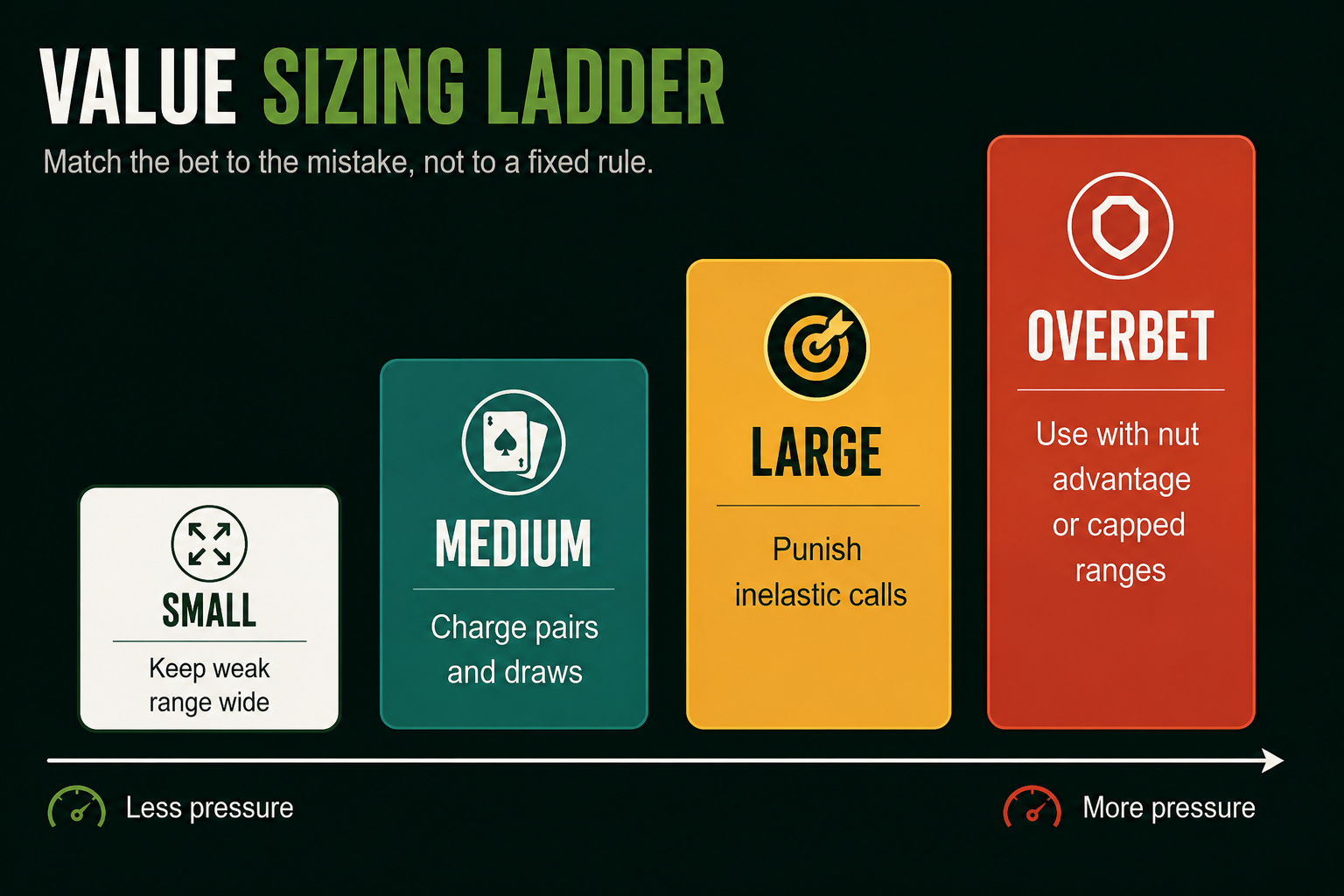
Think of sizing as a conversation with their range:
- Small: "Call with your whole weak range."
- Medium: "Pay with pair-plus and draws."
- Large: "Make a big mistake with a hand you cannot fold."
- Overbet: "Your range is capped or you are too sticky with bluff catchers."
Overbets can be excellent in live games, but they need a reason. Use them when you have a nut advantage, the opponent's range is capped, and the player type will call too much with bluff catchers or fold too much to pressure. Do not overbet just because the pot is big and you are excited.
Bluff Less Often, But Do Not Stop Bluffing
The lazy advice is "never bluff a calling station." It is too simple. You should bluff less against loose passive players because they call too often, especially with pairs. But some bluffs still print, especially on earlier streets where you have equity or on rivers where their range contains missed trash that beats your trash.
Good bluffing spots share clear features:
- You have position.
- Your opponent has shown weakness.
- The board favors your raising range.
- Your hand has equity or relevant blockers.
- The target hand class is realistic.
- The player can fold the specific hands you target.
Example: You raise the button with As5s over one limper. The big blind and limper call. The flop is K72 with one spade. Both check. A small continuation bet can work because you have ace-high backdoor equity, range advantage, and two opponents who may have missed. If called by the loose passive limper, you should not automatically barrel every turn. Barrel spades, aces, wheel cards, and cards that improve your range. Give up on blanks against a player who will not fold any pair.
Bad bluffs are easier to identify:
- River bombs into players who never fold top pair.
- Multiway bluffs on coordinated boards.
- Turn barrels with no equity after a sticky flop call.
- Bluffing missed flush draws when the opponent's range is mostly pairs that hate folding.
- Trying to represent a narrow hand when the opponent is not thinking about ranges.
The profitable middle ground is to semi-bluff more than pure bluff. Nut flush draws, combo draws, overcards plus backdoors, and hands that can improve to strong value are much better than no-equity air. Loose passive players may not fold enough, so give yourself ways to win when called.
Multiway Pots Require a Different Gear
Loose passive $1/$2 tables produce multiway pots. This is where many otherwise solid players lose discipline. They raise preflop with a good hand, get four callers, flop one pair, and play like they are heads-up.
One pair loses value as the number of opponents increases. The chance someone flopped two pair, a set, a strong draw, or a pair-plus-draw rises. The chance your continuation bet gets through falls. The chance someone slow-plays a big hand also rises because passive players often call instead of raise.
In multiway pots, tighten your betting range and clarify your goal. Bet strong hands for value and protection. Check medium-strength hands that cannot stand a raise. Bluff much less often, especially without equity.
Consider this hand: You raise to $18 over two limpers with AcAd from middle position. Four players call. The flop is Jc9c7d. This is not a board for autopilot. You can still bet for value because worse jacks, draws, and pair-plus-draw hands call, but you should size with a plan. If a passive player check-raises large, their range is often much stronger than "they might be messing around." If three players call your flop bet and the turn is Tc, your overpair has changed dramatically.
Now compare Aces on J72 rainbow. You can bet more comfortably because there are fewer two-pair and straight interactions. Even then, four-way action means calls have more weight than they would heads-up.
Out of Position Multiway
Out of position, simplify. Lead less often into several players unless your hand benefits from building the pot. Check more medium hands. When a player bets into a crowd, treat it as stronger than the same bet heads-up. Low-stakes live players do bluff, but multiway aggression from passive players is underbluffed in many rooms.
Your mantra should be: strong value, strong draws, fewer hero plays.
Read Passive Aggression as Information
Loose passive players communicate through action frequency. They call with many hands, check with many hands, and raise with few hands. When a low-frequency action appears, pay attention.
A flop check-raise from a player who has not raised in two hours is not the same as a check-raise from a capable aggressive regular. A turn donk bet from a passive player when a flush completes often means they improved. A river raise after check-calling two streets is heavily weighted toward strong value unless you have evidence otherwise.
This does not mean you fold every strong hand. It means you stop giving passive players balanced ranges by default.
Example: You isolate two limpers with KhKc to $20. The cutoff and button call. The flop is Qh8s4s. You bet $45 into $63. The cutoff calls. The button folds. The turn is 2d. You bet $90. The cutoff calls. The river is 6s. You bet $125 for value against queens and stubborn pairs. The cutoff raises to $375.
Against a creative aggressive opponent, you might analyze blockers, missed straight draws, and bluff frequency. Against a loose passive player who has not raised postflop all night, this is usually a fold. Their line contains many flushes, sets, and slow-played two pair. Their bluff region may be tiny.
Bet-folding is not weak. It is the exploit. You bet because they call too much with worse. You fold because they raise too little as a bluff.
River Decisions: Where $1/$2 Win Rates Change
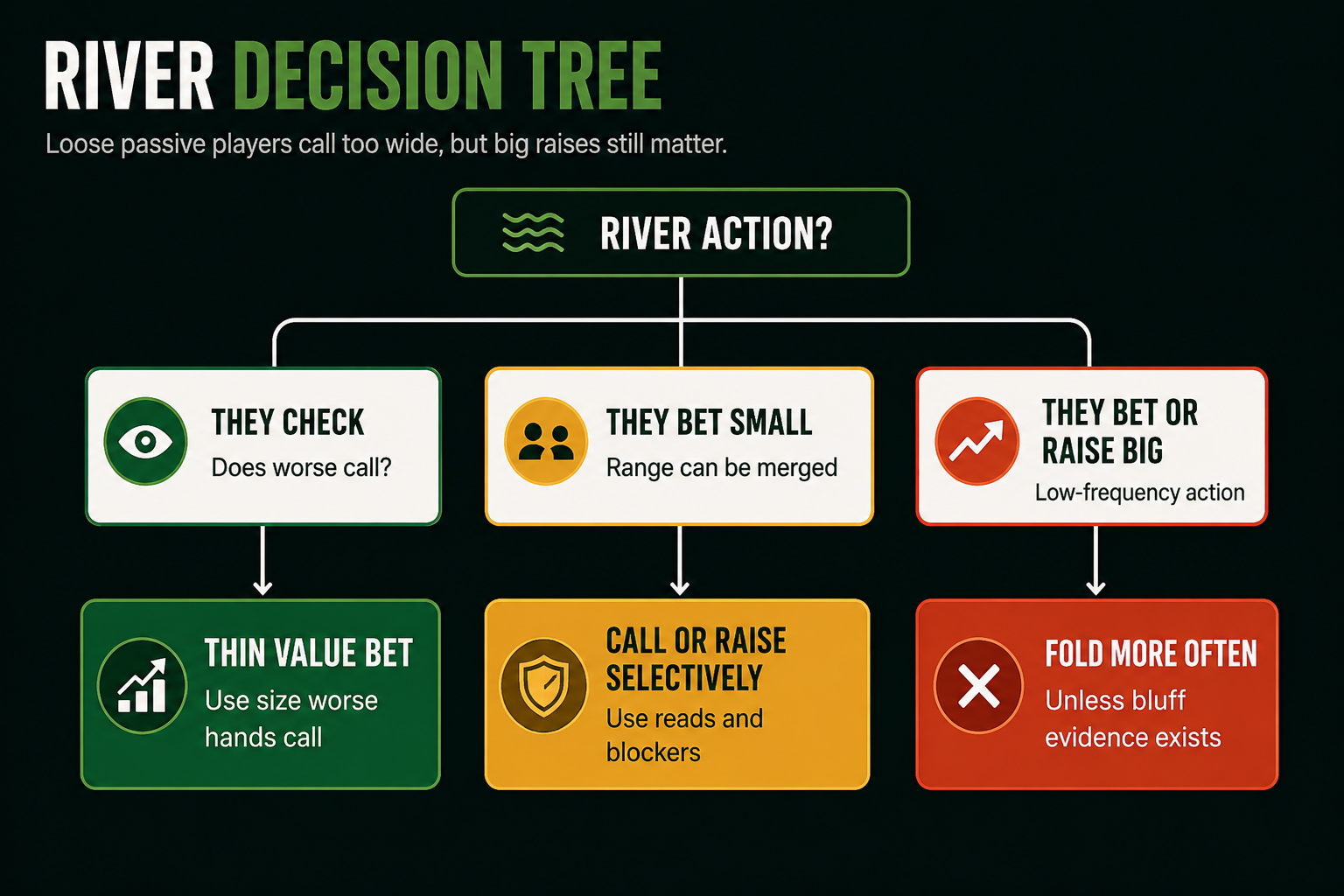
The river is where $1/$2 win rates change. Loose passive players arrive at the river with too many hands. Some are bluff catchers. Some are missed draws. Some are slow-played monsters. Your job is to separate value bets from check-backs and calls from folds.
When checked to on the river, ask:
- Does worse call?
- Did missed draws brick?
- Did an obvious draw complete?
- Does my hand block or unblock calls?
- Has this player shown curiosity with weak pairs?
- Will a smaller bet get paid by a wider range?
Thin river value examples:
- AQ on Q7422 against a player who calls any queen.
- KJ on J8633 after draws miss and the opponent checks.
- 99 on 8742K after the flop and turn check through and the opponent checks river.
- A7 on A6422 against a player who limp-calls worse aces and never check-raises bluff.
Bad river value examples:
- One pair after a passive player check-calls two streets and a front-door flush completes.
- Second pair on a river that improves many top-pair hands.
- Top pair weak kicker when the opponent's range narrowed heavily by calling large bets.
When facing river bets, start with population. Loose passive players do not bluff enough in large river spots. Small blocker bets can be weak, merged, or confused. Big bets and raises are different. If a passive opponent bets pot on the river after calling down, require a real reason to call. "I have top pair" is not enough.
Adjust to Straddles, Deep Stacks, and Room Dynamics
Many $1/$2 games play bigger than advertised. A $5 button straddle or $4 under-the-gun straddle changes stack depth, open sizing, and hand values. If everyone has $300 and the straddle is $5, you are effectively playing 60 straddles deep, not 150 big blinds deep. Speculative hands lose implied odds. Top-pair hands rise in value. Preflop mistakes get more expensive.
Against loose passive players in straddled pots:
- Tighten early position ranges.
- Raise larger for value when callers are too wide.
- Be careful calling speculative hands without deep effective stacks.
- Treat the straddle as the real big blind for stack-depth decisions.
- Avoid defending because "it is only a few more dollars."
Deep stacks create the opposite adjustment. If you and the loose passive player both have $600, suited aces and pocket pairs gain value in position because the implied odds are real. But reverse implied odds also grow. KJo out of position against a sticky player is not a deep-stack gift. It is a hand that makes expensive second-best pairs.
Room dynamics matter too. Some rooms have players who call any preflop size but fold too much postflop. Others have players who call flop and turn but fold rivers to large bets. Others have true stations who need to see it. Your strategy should update by showdown, not by stereotype.
Common Mistakes Against Loose Passive Players
The first mistake is bluffing too much. You see weakness, so you attack every street. But loose passive weakness is often calling weakness, not folding weakness. If they call flop with bottom pair and call turn with a gutshot, your no-equity bluff is lighting chips on fire.
The second mistake is raising too wide preflop. You want to isolate, but you choose hands that make dominated pairs. The result is a bloated pot where your opponent's mistakes are smaller than yours.
The third mistake is slow-playing strong hands on wet boards. Passive players call too much, so charge them. If you flop a set on T87 two-tone against two players, checking because you want to trap can give free equity to exactly the hands that would have paid you.
The fourth mistake is failing to bet-fold. Many players understand the value bet but not the fold part. Against passive opponents, the raise usually matters. You should be willing to put in money when worse calls and release when the story changes.
The fifth mistake is treating every loose passive player the same. Some call flops and fold turns. Some call turns and fold rivers. Some never fold pairs. Some slow-play monsters. The more precise your profile, the more money you make.
A Complete $1/$2 Hand Example
You are on the button with AhQh and $420. Two loose passive players limp. The cutoff folds. You raise to $22. The small blind folds, the big blind calls, both limpers call. The pot is $89.
The flop is Qs8h4d. Everyone checks to you. This is a clear value bet. You have top pair top kicker against ranges with worse queens, 8x, pocket pairs, backdoors, and random floats. You bet $55. The big blind folds. The first limper calls. The second limper folds. The pot is $199.
The turn is 6h. This is a strong card. You still beat many worse queens and pair-plus-draw hands, and you pick up the nut flush draw. The limper checks. Against a sticky player, bet again. You choose $115. The limper thinks for ten seconds and calls. The pot is $429. Effective stacks are $228.
The river is 2c. Draws miss. The limper checks. This is a value spot if your read is that he calls too much with queens and stubborn pairs. Shoving may fold out worse hands if he is dollar-sensitive, but checking leaves value behind against QJ, QT, Q9s, 99, TT, and "I put you on ace-king" calls. A smaller all-in is natural because the stack-to-pot ratio is low. You shove $228.
If he calls with QJ, the hand looks easy. But the important decisions happened earlier: you isolated with a dominating hand, bet flop for value, bet a turn that improved your equity, and chose a river size based on the opponent's calling range.
Now change the river to 7h, completing hearts and adding straights. If the limper donk-shoves, you have the nut flush, so you call. If you had black AQ instead and he donk-shoved, you would need to respect the passive lead. Same preflop and flop. Different river action, different decision.
Build a Simple Study Routine After Each Session
Live poker does not give you hand histories, so your review process has to be intentional. After each session, write down five hands before memory degrades. Do not only record coolers. Record the uncomfortable value bets, missed thin bets, failed bluffs, and river folds.
Use this review template:
- Effective stacks and positions.
- Player profile and evidence for that profile.
- Preflop action and sizing.
- Flop, turn, river actions and pot sizes.
- Your intended target range for each bet.
- What worse hands call and what better hands fold.
- Whether a passive aggressive action changed the range.
- Showdown, if any.
[INTERNAL: live poker hand review process]
Then tag the hand:
- Isolation sizing.
- Thin value.
- Multiway pot.
- Bet-fold.
- River bluff catch.
- Missed value.
- Overlimp candidate.
This builds pattern recognition. After ten sessions, you may discover you are calling too many passive river raises, checking back too much river value, or isolating hands that do not dominate enough. Those are fixable leaks.
Solver study can help, but do not ask a solver to validate every live exploit without context. Standard solutions assume opponents use strategic ranges and pressure frequencies that many $1/$2 loose passive players do not use. Use solver concepts for range advantage, equity realization, nut advantage, and sizing logic. Use live evidence to decide how far to deviate.
Live Cash Game Strategy Checklist for Loose Passive Tables
Before you sit:
- Choose seats with loose passive players on your right.
- Check stack depth before playing speculative hands.
- Notice who limps, who calls raises, and who 3-bets.
Preflop:
- Isolate wider in position, tighter out of position.
- Size up when callers continue too wide.
- Avoid dominated trash hands.
- Consider button overlimps with deep stacks and passive blinds.
Postflop:
- Value bet hands worse players can call.
- Use smaller bets to keep weak ranges wide.
- Use larger bets when calling ranges are inelastic.
- Bluff less into sticky players.
- Semi-bluff with equity rather than firing air.
Multiway:
- Reduce automatic c-bets.
- Respect bets into several players.
- Protect strong hands on wet boards.
- Do not stack off one pair without new information.
River:
- Thin value when checked to by curious players.
- Fold more to large passive raises.
- Bet-fold confidently.
- Keep notes on showdown tendencies.
Take Action Now
The best Live Cash Game Strategy for $1/$2 loose passive players is not complicated, but it does require discipline. Put the right players on your right, isolate them with hands that dominate, bet for value before you worry about fancy bluffs, and believe their big raises until they prove they can bluff. In your next live session, choose one focus: isolation sizing, thin river value, or folding to passive aggression. Track it for the whole session, review five hands afterward, and turn the table's looseness into a structured edge.
Frequently Asked Questions
Should I bluff loose passive players at $1/$2?
Yes, but less often and with better reasons. Bluff when you have equity, position, range advantage, or a river spot where their missed trash can fold. Avoid big no-equity bluffs into players who call any pair.
How large should I raise over limpers in a $1/$2 live cash game?
Use the table's normal open size plus roughly one big blind per limper as a starting point, then adjust. If $12 gets five callers and $20 gets two callers from the same weak ranges, use the larger size with value-heavy hands. If bigger sizing only gets strong calls, tighten and size down.
Is it okay to overlimp behind loose passive players?
Yes, especially on the button with deep stacks, passive blinds, and hands that play well multiway, such as small pairs and suited connectors. Avoid overlimping dominated offsuit hands that make weak top pairs.
Why do passive players suddenly raise the river?
Usually because they have a strong hand. Some passive players slow-play until the river, and many underbluff large raises. You can still call with strong bluff catchers against proven bluffers, but your default should be to respect low-frequency aggression.
What is the biggest mistake winning online players make in live loose passive games?
They often use online assumptions in multiway live pots. They c-bet too automatically, bluff too much into calling ranges, and underestimate how often passive players have strong hands when they finally raise. A better Live Cash Game Strategy uses live exploitative adjustments instead of forcing a balanced template.