ICM Poker Explained for Tournaments: Why Chips Don't Equal Dollars
ICM Poker Explained for Tournaments: Why Chips Don't Equal Dollars
ICM Poker is the tournament concept that explains why a chip you might lose is usually worth more than a chip you might win. In a cash game, $100 in chips is $100. In a tournament, 100,000 chips is not a direct claim on 100,000 dollars, because prizes are paid by finishing position, not by the chip count you hold after one hand.
That difference changes everything near bubbles, pay jumps, satellites, and final tables. A call that wins chips in the long run can still burn real money if it risks your tournament life while shorter stacks are about to bust. A fold can be worth money because it preserves your chance to ladder. A big stack can open hands that would look loose in a cash game because covered stacks cannot fight back normally.
This guide breaks ICM down without turning it into a calculator exercise. You will learn what the model measures, why chips do not equal dollars, how stack sizes and payouts reshape ranges, and how to review common tournament spots away from the table.
What ICM Poker Actually Measures
ICM stands for Independent Chip Model. It estimates the real-money value of each remaining stack by using two inputs: the stacks still in the tournament and the payout structure. The model asks, "Given these stacks, how often should each player finish first, second, third, and so on?" Then it multiplies those finishing probabilities by the prizes for those places.
That output is tournament equity, often written as $EV. It is not the same as chip EV, or cEV. Chip EV asks whether a play wins chips. Dollar EV asks whether a play increases your expected share of the prize pool.
The cleanest way to feel the difference is to compare formats.
In a cash game, you can cash out the chips in front of you. If you buy in for $500 and win another $500, your stack is worth $1,000. The value scales linearly.
In a tournament, you buy in and receive tournament chips. Those chips are tools for survival and leverage. If you win every chip in play, you do not receive the entire prize pool. You receive first-place money, while the other paid places still receive their listed prizes. That means doubling your stack rarely doubles your real-money equity.
ICM Poker exists because tournament chips have diminishing marginal value. Your first chips are survival. Your last chip is extremely important because losing it ends your tournament. Extra chips are valuable, but they do not buy dollars at a fixed rate.
Why Chips Don't Equal Dollars in Poker Tournaments
Most players understand the phrase "chips don't equal dollars," then ignore it when a close all-in appears. The practical point is harsher: chips lost usually hurt more than chips won help.
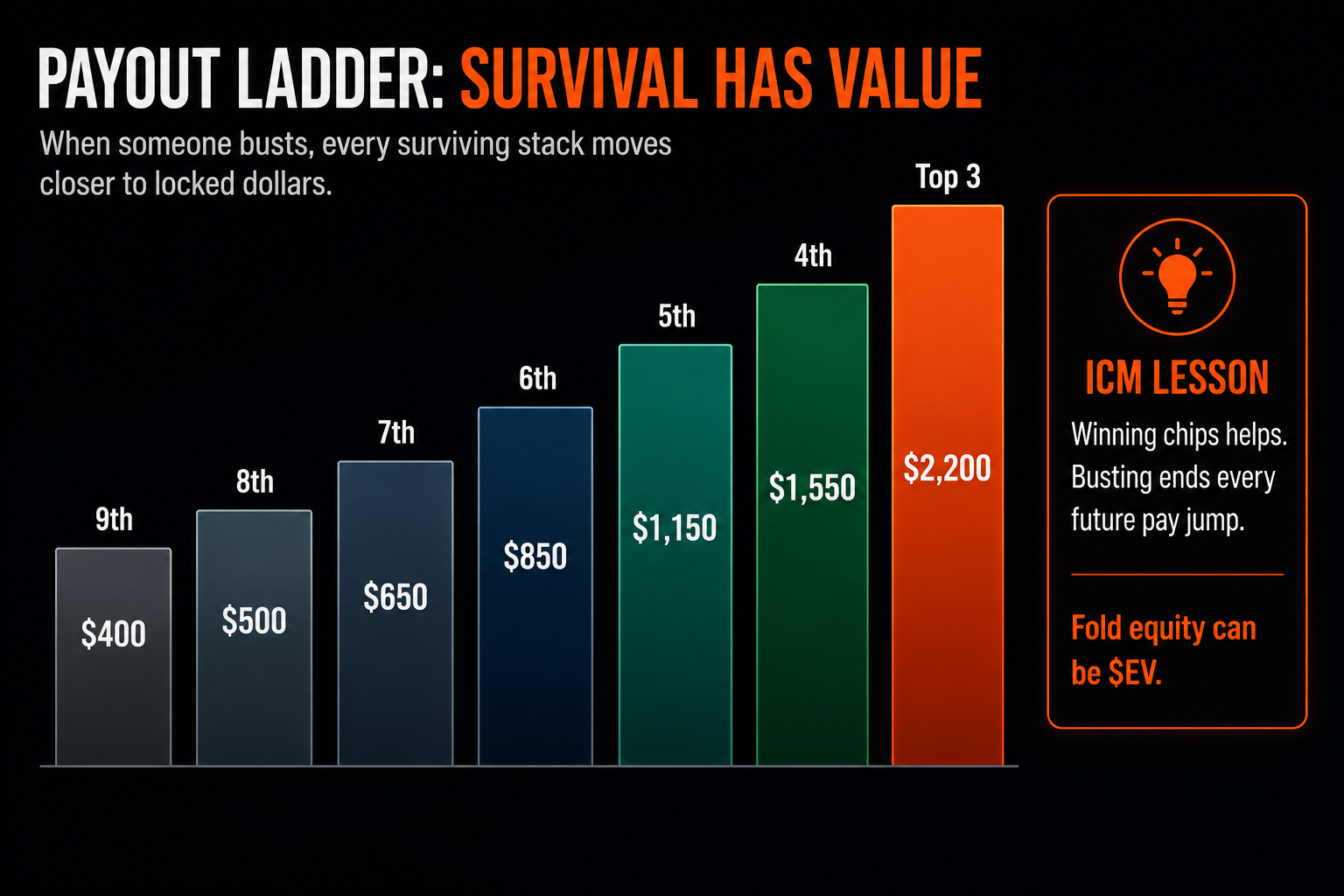
Imagine a 9-player final table with these payouts:
| Place | Prize |
|---|---|
| 1st | $5,000 |
| 2nd | $3,200 |
| 3rd | $2,200 |
| 4th | $1,550 |
| 5th | $1,150 |
| 6th | $850 |
| 7th | $650 |
| 8th | $500 |
| 9th | $400 |
If you have a medium stack, busting in ninth costs you the chance to reach every pay jump above you. Doubling up helps, but it does not lock up first place. You still have to play future hands, survive future blinds, and beat other stacks. The upside is spread across many possible finishes. The downside is immediate elimination.
That asymmetry is why tournament players pass on spots that cash-game players would happily take. It is also why the most painful tournament mistakes often happen with hands that look too strong to fold: AQo, 99, TT, AJs, KQs, or a strong top-pair hand facing a covered-stack jam near a major pay jump.
The hand is not automatically bad. The price may even look reasonable in chips. But under ICM, you are not just calling to win the pot. You are putting your remaining tournament equity at risk.
A Simple ICM Poker Example
Here is a small example you can calculate conceptually without software.
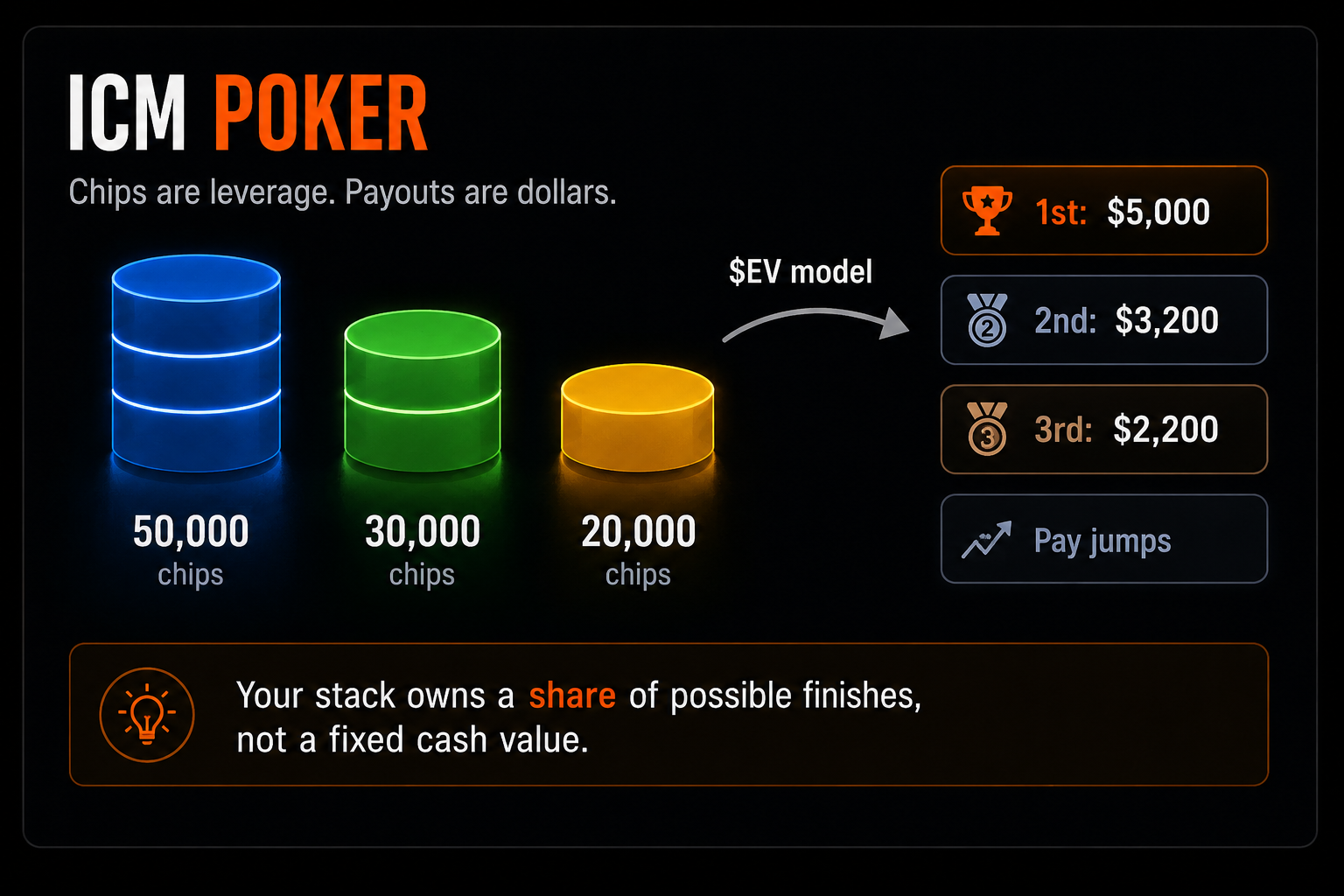
Three players remain in a sit and go. The payouts are:
- 1st: $500
- 2nd: $300
- 3rd: $200
The stacks are:
- Player A: 50,000
- Player B: 30,000
- Player C: 20,000
There are 100,000 chips in play. Player A has 50% of the chips, so ICM starts by giving Player A a 50% chance of first place. Player B has 30%, and Player C has 20%.
But nobody's stack is worth the first-place prize multiplied by their chip share. Player A's stack is not worth $500 just because Player A has half the chips. Player A has the best chance to win, but if Player A does not win, they can still finish second or third. Player C has the shortest stack, but Player C still has guaranteed tournament equity because third place is already worth $200.
This is the heart of ICM: every stack owns a weighted share of all possible finishing positions.
Now suppose Player A shoves from the small blind into Player C's big blind. If Player C calls and loses, Player C gets third-place money and no more. If Player C calls and wins, Player C doubles to 40,000, but Player C does not win the tournament on the spot. They become a contender.
That is why Player C needs more equity to call than basic pot odds suggest. The all-in risk is not symmetrical. Calling and losing ends the tournament. Calling and winning improves the stack but leaves more work to do.
Chip EV Versus Dollar EV
Chip EV is still useful. You should not become so afraid of ICM that you stop trying to win chips. The issue is that cEV answers an incomplete question.
Suppose you face an all-in and your hand has 52% equity against the shoving range. In a cash game or a winner-takes-all chip EV model, calling looks profitable if the price is close to even. You win slightly more often than you lose.
In a tournament, the same 52% equity might not be enough. If losing eliminates you before two shorter stacks, and winning does not guarantee a major jump, you may need 58%, 62%, or even more equity depending on stack distribution and payouts. The exact number requires an ICM tool, but the strategic lesson is table-ready: marginal chip edges shrink when your tournament life is at risk.
The reverse is also true. If you are the covering stack, you can often apply pressure with hands that do not need to show down as often. Covered players must fold more because calling off incorrectly costs them more than the pot.
This is why ICM Poker creates two very different jobs:
- When you are covered and pay jumps matter, avoid thin calls for your tournament life.
- When you cover opponents who are under pressure, steal more pots without risking your own elimination.
Do not reduce this to "play tight." The better phrase is "risk chips where your downside is controlled and your opponent's downside is not."
Risk Premium and Bubble Factor
Risk premium is the extra equity you need before taking a tournament-life risk. Bubble factor is a related way to measure how much more losing hurts than winning helps.
In a pure chip EV spot, losing 10 big blinds and winning 10 big blinds have equal but opposite value. The bubble factor is effectively 1. In an ICM spot, losing those 10 big blinds can cost more tournament equity than winning 10 big blinds gains. The bubble factor rises above 1.
You do not need to calculate bubble factor during a hand. You do need to recognize the conditions that make it high:
- You are near the money bubble, final table bubble, or a meaningful pay jump.
- You are a medium stack with shorter stacks still alive.
- A larger stack can eliminate you.
- The payout jump you are risking is large relative to the chips you can win.
- The tournament is a satellite or flat-payout format where survival is unusually valuable.
When those conditions appear, your all-in calling range should tighten. Your open-jamming range may also change, but the biggest adjustment usually happens on calls. Calling all-in is where you realize the full downside of ICM pressure.
A Medium-Stack Bubble Spot
You are 18 players from the money in a large MTT. You have 24 big blinds. Two players at your table have 7 big blinds and 5 big blinds. The chip leader covers everyone.
You open AJo from the cutoff. The chip leader shoves from the big blind for your stack.
In a chip EV vacuum, AJo might be close against an aggressive big blind. Under ICM, it becomes a much worse call. If you fold, you keep 22 big blinds and still have two shorter stacks likely to face pressure soon. If you call and lose, you finish before the money. If you call and win, you move to about 50 big blinds, which is excellent but not a guarantee of a deep run.
This does not mean AJo is always a fold. It means the threshold for calling is much higher than "I think he can be light." You need to know the shover is wide enough, your hand performs well enough, and the pay-jump pressure is not overwhelming.
A Big-Stack Pressure Spot
Now reverse the seats. You are the chip leader with 58 big blinds. The cutoff has 24 big blinds. Two shorter stacks are waiting behind them.
When action folds to you in the big blind after the cutoff opens, you can pressure more aggressively than normal. You might 3-bet hands that block strong continues, call some hands that play well, and force the cutoff to defend carefully. The cutoff cannot treat the spot like a cash game because every mistake risks elimination before shorter stacks.
Your goal is not to punt into strong ranges. Your goal is to attack players whose ICM incentives make their defense narrower than their chip EV defense.
When ICM Poker Matters Most
ICM technically exists whenever a tournament has more than one non-identical prize remaining. But it matters most when decisions can change real-money outcomes quickly.
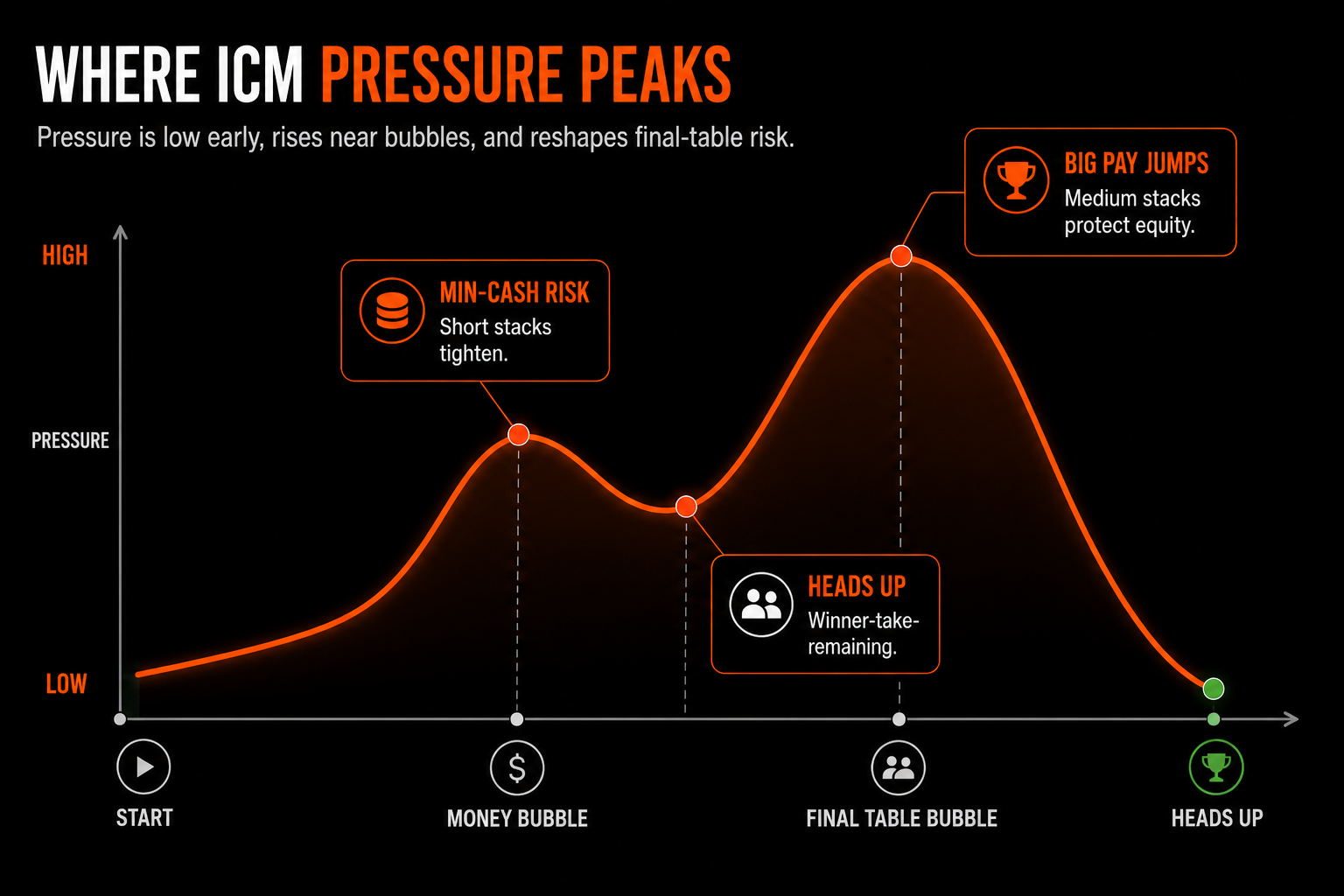
The money bubble is the most obvious point. One player busts with nothing, and the next player locks up at least a min-cash. That single elimination can move everyone else from zero payout to a confirmed return. If several short stacks remain, medium stacks should be careful about gambling with each other or calling off against big stacks.
The final table bubble is often even more important. Reaching the final table puts you close to the largest prizes, and the next pay jumps are much bigger than the min-cash jump. The pressure does not always fall on the same stacks as the money bubble. Short stacks on a final table bubble may need to take risks because surviving with 3 big blinds has limited upside. Medium and big stacks can have more to lose because they are already positioned for major money.
At the final table, ICM shapes almost every close decision. Open sizes, 3-bet frequencies, c-bet sizing, river bluff-catching, and all-in ranges all change when stack-off risk is uneven.
Satellites create the most extreme version. If every remaining prize is the same seat, accumulating extra chips above a safe stack has much less value. Survival becomes the point. In some satellite situations, even extremely strong hands can become folds if calling risks a seat that is already close to locked.
PKO and bounty tournaments are special cases. Bounties add a separate reward for eliminating players, so risk premiums can be lower when you cover someone and can win their bounty. Standard ICM still matters, but bounty equity must be included. Do not copy freezeout ICM ranges into PKOs without adjusting for the bounty.
Stack Sizes: Who Feels the Pressure?
ICM pressure is not spread evenly. Your stack category changes your job.
Short stacks often feel pressure near the money bubble because busting misses the payout. But when they are very short, they cannot simply wait forever. Each blind orbit damages them, and one double-up can restore fold equity. A 5 big blind stack usually needs to take spots that a 22 big blind stack can decline.
Medium stacks are the classic ICM danger zone. They have enough chips to lose, enough tournament equity to protect, and not enough chips to ignore the chip leader. If several shorter stacks remain, medium stacks should avoid thin stack-offs against players who cover them.
Big stacks have leverage. They can pressure stacks that do not want to bust. They can open more hands into risk-averse blinds, 3-bet medium stacks, and use position to force folds. But big stacks still need discipline. Clashing with another big stack can create a massive ICM punt if the pot risks a dominant position for a marginal edge.
The most important question is not "Am I short, medium, or big?" It is "Who covers me, who do I cover, and what happens to my payout equity if this pot goes wrong?"
Covered Versus Covering
Being covered means an opponent can eliminate you. Covering means you can eliminate them while surviving if you lose a smaller all-in.
That distinction changes ranges. If you have 30 big blinds and the opener has 28, you can apply more pressure than if the opener has 60. Against the 28 big blind stack, you can win the whole pot and eliminate them; if you lose, you still have chips. Against the 60 big blind stack, a stack-off can end your tournament.
This is why final-table charts are not just arranged by big blinds. They depend on who covers whom, the payout ladder, and the other stacks at the table.
Preflop Adjustments Under ICM Poker
Preflop is where ICM Poker is easiest to study because stack-off decisions are common and ranges can be compared cleanly.
The biggest adjustment is tighter all-in calling. Calling off your tournament life requires more equity than calling in a chip EV model. Hands with decent raw equity but poor domination profiles become dangerous. AJo, KQo, 77, and A9s can all become folds in spots where they would be standard continues without ICM pressure.
Opening ranges can become wider or tighter depending on your stack. A big stack can open wider into pressured blinds because they cannot defend enough. A medium stack opening into a covering big blind may need to choose hands with better blocker value, postflop playability, or raise-fold flexibility.
3-betting also changes. Non-all-in 3-bets from big stacks can be powerful because they force medium stacks to continue with a condensed range. But if you are a medium stack, careless 3-bet/folding can waste chips you cannot afford to lose, while 3-bet/calling too wide can torch dollar EV.
Rejamming ranges are highly stack-dependent. A 14 big blind short stack may need to rejam a hand that a 28 big blind medium stack should fold. The short stack wins fold equity and restores survival; the medium stack risks a much larger chunk of tournament equity.
If you study only one ICM preflop pattern, study big blind calling versus late-position opens and jams. Many players defend too wide because the pot odds look attractive. Under ICM, closing the action does not erase the cost of busting.
[INTERNAL: tournament preflop ranges]
Postflop Adjustments Under ICM Poker
ICM is not only a push-fold topic. Postflop pots also change because stack-off thresholds change.
When you are covered near a pay jump, you should be careful with hands that make medium-strength bluff-catchers. Top pair may be strong in chip EV, but it can become a hand that wants pot control when a big stack can apply maximum pressure on later streets.
Big stacks can use smaller bets to generate folds. If an opponent's calling range is constrained by ICM, you do not always need a huge bet to make them uncomfortable. A one-third pot continuation bet on a board that favors your range can produce enough folds because the turn and river threats are expensive.
At the same time, ICM can reduce reckless bluffing from covered stacks. If you are a medium stack and a big stack calls your flop bet, barreling off with a weak draw may be much worse than it looks. You are not only risking chips. You are giving the big stack a chance to put you all in.
Turn Example: Top Pair Under Pressure
You are at a final table with six players left. You have 26 big blinds in the cutoff. The button has 52 big blinds and covers you. Two players have 9 and 11 big blinds.
You open KQs. The button calls. The flop is Kd 8s 4s. You bet small, and the button calls. The turn is 2c.
In a cash game, you might barrel confidently for value and protection. Under ICM, you need a plan for the button's raise. If you bet large and get jammed on, calling off with top pair could be a disaster when two shorter stacks remain. Checking does not mean playing scared. It can protect your tournament equity, keep weaker hands in, and avoid creating a pot where the covering stack gets to use maximum leverage.
The correct line still depends on ranges and player type. Against a passive player who calls too wide and rarely raises, betting for value may be best. Against an aggressive chip leader, you may prefer smaller bets, checks, and lines that avoid committing your stack with one-pair hands.
Common ICM Poker Mistakes
The first mistake is treating ICM as a reason to stop playing poker. You still need chips to win tournaments. Folding every close spot lets good players steal from you. ICM should change your risk thresholds, not paralyze you.
The second mistake is calling too wide because a hand is "too good to fold." Tournament poker is full of painful but correct folds. If three shorter stacks are alive and a chip leader jams into you, a hand like 88 or AQo may be a fold even when it feels strong.
The third mistake is pressuring the wrong stacks. A big stack should not blindly attack everyone. Short stacks who must gamble may call correctly. Other big stacks can fight back. The cleanest pressure target is often the medium stack with something meaningful to protect.
The fourth mistake is ignoring payout shape. A flat payout structure, a top-heavy MTT, a satellite, and a PKO do not create the same incentives. Always check how many players are paid, what the next jump is, and how much first place matters.
The fifth mistake is using chip EV charts too late in tournaments. Chip EV ranges are a baseline, not a final-table solution. If you study only cEV, you will over-call all-ins and miss profitable big-stack pressure spots.
The sixth mistake is reviewing only bustout hands. ICM leaks often happen before the bustout: a loose defend that drops you from 26 big blinds to 19, a thin river call that makes you the short stack, or a failed 3-bet that removes your leverage. Review the hands that changed your stack category.
How to Study ICM Poker Away From the Table
You do not need to solve every final table to improve. Build a repeatable study process.
Start with payout awareness. When you play an MTT, write down the number of paid places, the min-cash, the final table payouts, and the largest pay jumps. You should know whether the tournament is flat, top-heavy, a satellite, or a bounty format before important spots arrive.
Next, review all-in decisions by stack class. Mark hands where you called off, reshoved, or folded to a shove from 10 to 35 big blinds. Label whether you were short, medium, or big, and whether you were covered.
Then compare the spot in an ICM tool or solver. You are not trying to memorize every combo. You are trying to learn patterns:
- Which hands disappear from calling ranges?
- Which blockers matter most?
- How much tighter do medium stacks become?
- Which opponents can you pressure?
- When do short stacks regain permission to gamble?
Postflop review should focus on pot geometry. Ask whether your flop and turn sizing created a river SPR where you were forced into an ICM-disaster call. Many final table mistakes come from building a pot that makes the last decision miserable.
Finally, compare chip EV and ICM versions of the same spot. The difference between those outputs is the lesson. If KQo is a profitable cEV call but a losing ICM call, ask why. Is it domination? Pay jump pressure? A shorter stack? Being covered? The pattern will show up again.
[INTERNAL: poker hand history review]
Table Checklist for Real-Time Decisions
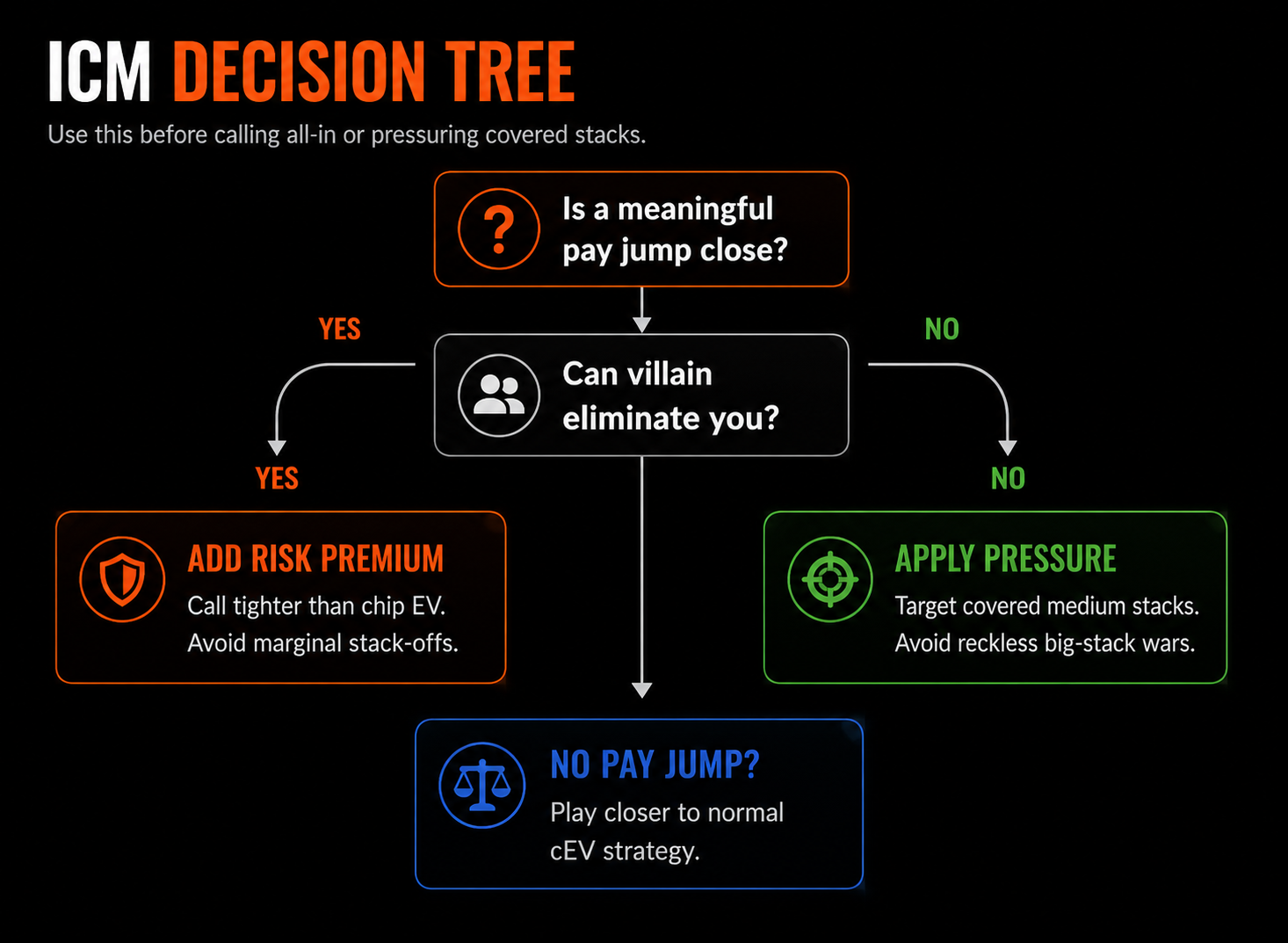
Use this quick checklist when you cannot run math at the table.
- What is the next meaningful pay jump?
- Who covers me?
- Who do I cover?
- Are there shorter stacks that can bust before me?
- Am I calling all-in or applying pressure?
- Does winning this pot change my payout prospects as much as losing it hurts them?
- Is this hand strong enough after adding risk premium?
If you are calling all-in while covered, be stricter than your chip EV instincts. If you are raising into players who cannot call enough, widen intelligently. If you are short enough that the blinds will cripple you, do not wait for a perfect hand.
The goal is not to become timid. The goal is to risk chips where the tournament incentives support the risk.
Take Action Now
ICM Poker is one of the biggest differences between playing hands well and playing tournaments well. The next time you review a late-stage hand, do not ask only whether your play won chips. Ask whether it increased your tournament equity after stack sizes, payout jumps, and elimination risk were included.
Pick five recent tournament hands where you faced an all-in near a bubble or final table. For each one, write down the stacks, payouts, who covered whom, and your estimated calling range before checking a solver or ICM calculator. That simple review habit will make your folds less emotional, your big-stack pressure more precise, and your tournament decisions more profitable.
[INTERNAL: ICM calculator]
Frequently Asked Questions
What is ICM Poker?
ICM Poker is the use of the Independent Chip Model to estimate the real-money value of tournament chip stacks. It converts stack sizes and payouts into tournament equity so you can compare decisions by dollar EV, not just chip EV.
Why don't tournament chips equal dollars?
Tournament chips do not equal dollars because prizes are paid by finishing position. Doubling your chips does not double your payout equity, and losing your last chip eliminates you. That creates diminishing chip value and makes survival worth real money.
When does ICM matter most?
ICM matters most near the money bubble, final table bubble, final table pay jumps, satellites, and any spot where an all-in can change your payout equity sharply. It technically exists throughout most tournaments, but the pressure becomes much stronger near meaningful prizes.
Should I always play tighter because of ICM?
No. You should call off tighter when your tournament life is at risk, especially as a covered medium stack. But if you are the big stack, ICM can let you pressure opponents more aggressively because they must fold hands that would continue in chip EV.
Can I calculate ICM at the table?
Not precisely. Full ICM calculations are too complex for real-time play. Study common spots away from the table, then use practical cues in game: payout jumps, stack distribution, who covers whom, and whether you are calling off or applying pressure.