Low Stakes Poker Strategy: How to Win at Online Poker as a Beginner
Low Stakes Poker Strategy: How to Win at Online Poker as a Beginner
Low Stakes Poker Strategy is not about memorizing every solver output or trying to outplay regulars in every marginal spot. It is about building a simple, disciplined system that wins money from common beginner and recreational-player mistakes while keeping you out of expensive situations.
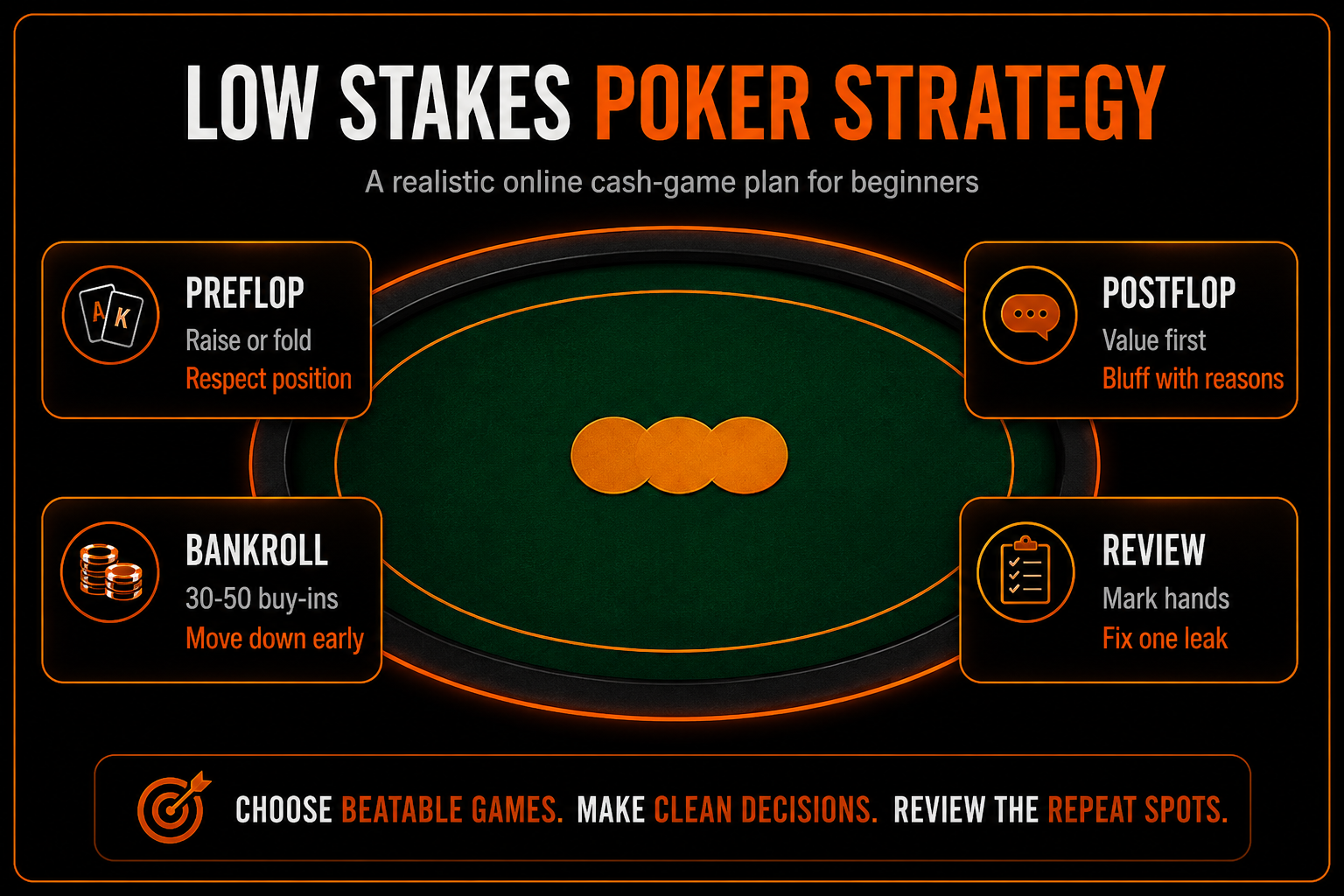
If you are new to online cash games, the best goal is not to crush every table immediately. Your first goal is to stop leaking chips in obvious places: too many preflop calls, loose calls against 3-bets, optimistic bluff catches, and big river payoffs when passive players suddenly show strength.
Most low-stakes online games are beatable, but they are not free money. The rake matters. Players are tighter and more studied than casual live players. Multi-tabling can make your decisions automatic in a bad way. A realistic beginner strategy has to respect all of that.
This guide focuses on No-Limit Hold'em online cash games, especially full-stack 6-max tables from the micro stakes through low stakes. The exact numbers will vary by site and rake structure, but the principles stay stable: play solid ranges, attack weak ranges, value bet clearly, bluff selectively, review your biggest leaks, and protect your bankroll.
Why Low Stakes Poker Strategy Starts With Realistic Expectations
The first adjustment is mental. You should not expect low-stakes online poker to feel like a movie scene where everyone punts stacks with bottom pair. Some players will be weak. Some will be too tight. Some will use HUDs, charts, and study tools. You win by making fewer expensive mistakes than they do.
Online cash games also produce a lot of hands quickly. That is good for learning, but it can distort your emotions. You might play 1,500 hands in a few sessions and feel like you have discovered your true win rate. You have not. Short-term variance can make a good session look brilliant and a bad session look hopeless.
A beginner should measure progress with process markers before results:
- Are you open-raising instead of limping?
- Are you folding dominated hands out of position?
- Are you taking notes on obvious player-pool tendencies?
- Are you value betting when worse hands can call?
- Are you marking hands for review instead of guessing in real time?
That does not mean results do not matter. Poker is played for money, and cash-game chips have direct cash value. It means your first edge is a repeatable decision process, not a hot graph.
For most beginners, the realistic path is to become a small winner at one stake, build enough hands to identify leaks, then move up only when your bankroll and skill both support it. A player who beats 10NL cleanly with discipline is in a much better position than a player who takes random shots at 50NL because one weekend went well.
Choose Games You Can Actually Beat
Your strategy starts before the first hand. Low-stakes online poker has a wide skill spread. One 25NL table might be full of regulars battling for small edges. Another might have two loose recreational players calling too many hands. Your job is to sit in games where mistakes are available.
Look for tables with clear signs of weaker play:
- Players with incomplete stacks, such as 37bb or 64bb.
- Players who limp or min-raise frequently.
- Big gaps between VPIP and PFR when HUDs are allowed.
- Multiway pots that happen often.
- Players posting blinds out of position instead of waiting.
- Obvious bet-sizing patterns, such as tiny bets with draws and large bets with strong made hands.
If your site does not allow HUDs, you can still table select by observing. Watch one orbit before opening extra tables. If every pot is raise, 3-bet, fold, and every stack is exactly 100bb, that table may not be your best learning environment.
Game selection is not cowardice. It is part of your win rate. Beginners often want to prove they can beat tough players. That mindset costs money. You are not paid extra for choosing harder seats.
Start With Fewer Tables
Multi-tabling feels efficient, but it magnifies leaks. If you call too wide against 3-bets on one table, you will call too wide on four tables. If you miss river value bets because you are rushed, volume only creates more missed value.
Start with one or two tables until your preflop decisions are boring. Add tables only when you can still answer basic questions in real time:
- What position opened?
- What range does this player likely have?
- Who has range advantage on this flop?
- Which worse hands call if I bet?
- Which better hands fold if I bluff?
When you cannot answer those questions, reduce tables. You are not sacrificing profit. You are protecting your learning rate.
Low Stakes Poker Strategy for Preflop Discipline
Most beginner win-rate problems begin preflop. You enter too many pots, call from the wrong seats, and arrive postflop with ranges that cannot stand pressure. A strong Low Stakes Poker Strategy fixes that first.
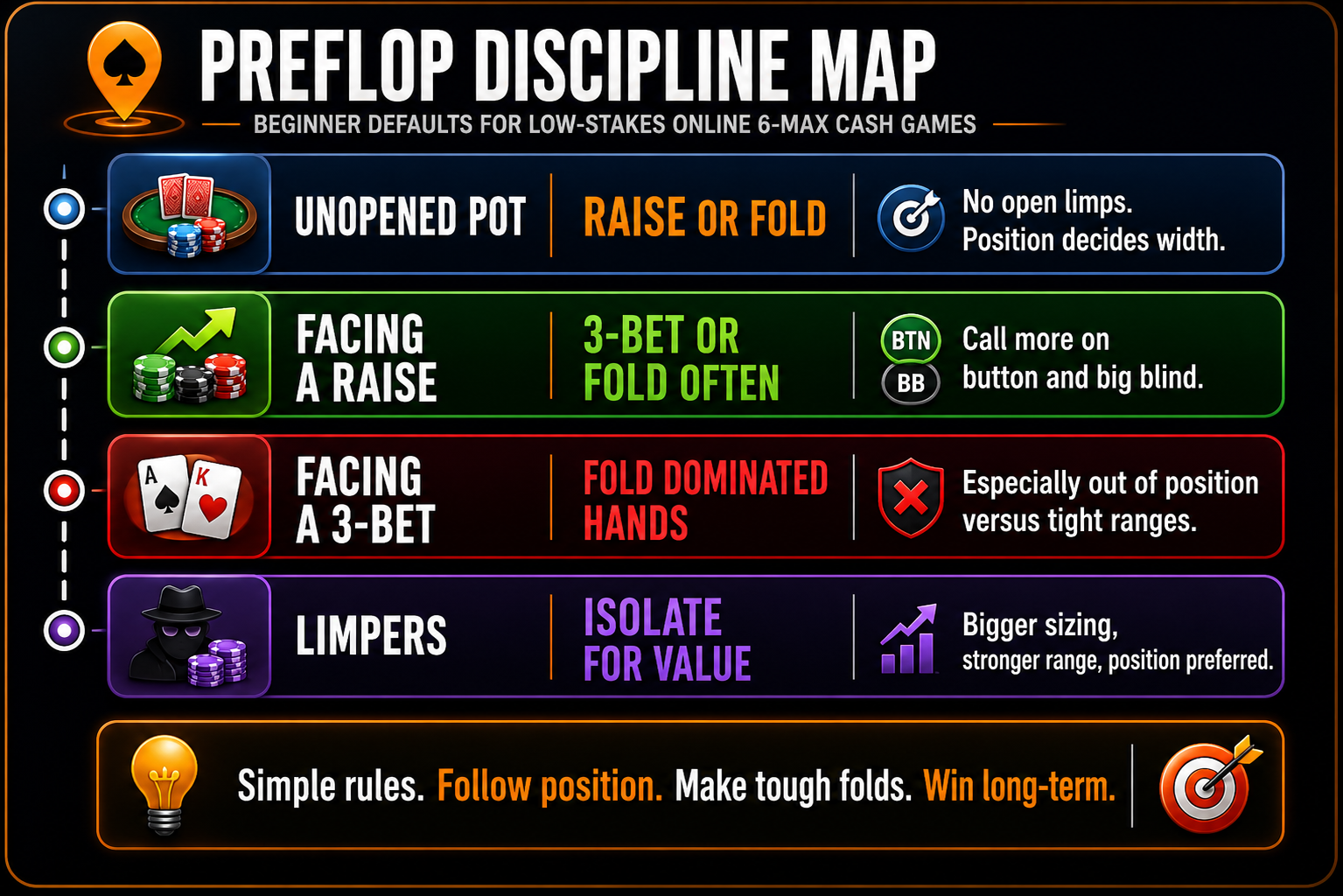
The easiest rule: be raise-or-fold in unopened pots. Do not open limp. When you limp, you give the blinds a cheap chance to realize equity, you invite raises behind you, and you enter the pot without initiative. If a hand is not strong enough to open from your position, fold it.
Use a simple preflop chart as your baseline. You do not need perfect mixed frequencies. You need clean defaults:
- Tight from under the gun.
- Wider from the cutoff.
- Widest from the button.
- Careful from the small blind because you play out of position.
- Defend the big blind with hands that realize equity well, not random offsuit trash.
[INTERNAL: beginner preflop chart]
Position is the engine. A hand like KTo may look playable, but it performs very differently on the button than under the gun. From early position, dominated top pairs are expensive. From the button, position lets you control pot size, value bet thinner, and bluff more accurately.
A Practical Opening Baseline
As a beginner, you can use this as a conservative 6-max starting point:
- Under the gun: pairs, strong suited aces, AJo+, KQo, broadway suited hands.
- Hijack: add more suited broadways, suited aces, medium pairs, some suited connectors.
- Cutoff: add more suited kings, suited connectors, suited one-gappers, good offsuit broadways.
- Button: open many suited hands, broadways, pairs, suited connectors, and selected offsuit hands.
- Small blind: raise a structured range, but avoid completing weak hands just because it is cheap.
These ranges are intentionally approximate. The point is not to debate whether Q9s is a pure open in every rake structure. The point is to stop entering weak, dominated, out-of-position pots that cause beginners to lose stacks later.
How to Handle 3-Bets Without Ego
Calling 3-bets is one of the most expensive leaks in low-stakes online poker. Beginners hate folding after they open. They think, "I already put money in," or "This player could be bluffing." Both thoughts can be true and still not justify a call.
Against low-stakes populations, many 3-bets are value-heavy, especially from early position, the blinds versus early opens, and passive-looking players. When you call too wide, you enter a bloated pot with a capped or dominated range. You then flop one pair and feel trapped.
Example: You open AJo from the hijack. A tight button 3-bets. You call. The flop comes A72 rainbow. You check-call. The turn bricks. You check-call again. The river is small, and now you hate your hand but cannot fold. This line often loses to AK, AQ, or a slow-played premium pair. The mistake was not the river. The mistake was calling the 3-bet with a dominated hand against the wrong player type.
Your default should be simple:
- Continue tighter out of position.
- Fold more offsuit broadways than your ego wants.
- 4-bet for value with premium hands.
- Use a few blocker-based 4-bet bluffs only against players who can fold.
- Call more in position with hands that make strong, disguised hands.
Hands like suited broadways and medium pairs can be playable in position against reasonable sizing. Hands like KJo, QTo, ATo, and weak suited kings become expensive quickly when you are dominated.
This is also where rake changes the game. In high-rake cash games, marginal calls lose value because small pots are taxed heavily and speculative hands need more future profit to justify entering. That pushes beginners toward cleaner, more aggressive preflop decisions.
Attack Limpers and Loose Callers, But Do It Cleanly
Even online, you will find players who limp, call too wide, and play fit-or-fold after the flop. These players are your main source of profit. The adjustment is not to splash around with them. The adjustment is to isolate them with hands that perform well.
If a weak player limps and you are on the button, raise larger than your normal open with a value-heavy range. You want heads-up pots in position against someone who starts with weak hands and makes postflop mistakes.
Good isolation hands include:
- Big pairs and strong broadways.
- Suited aces that can make strong top pair or nut flushes.
- Good suited kings and queens in position.
- Medium pairs when stacks are deep enough.
- Suited connectors in position against players who pay off too much.
Avoid the common beginner overcorrection: isolating any two cards because the limper is bad. A weak opponent still gets dealt strong hands sometimes. More importantly, trash hands make trash pairs. If you isolate J4s and flop top pair on J87, you have created a difficult pot with a dominated kicker.
Size Up When They Call Too Much
Low-stakes players often call preflop raises with hands they should fold. Punish that by raising bigger with your profitable range. If your normal open is 2.5bb and a loose player is in the blinds, you may choose 3bb. If there is a limper, you might raise 4bb plus 1bb per limper, then adjust for position and stack depth.
The purpose is not to scare everyone away. The purpose is to charge weak ranges and build pots when your range is ahead.
Postflop, continue the same logic. Do not run huge multi-street bluffs into calling stations. Bet bigger for value when worse hands call. Check back medium-strength hands when betting only gets called by better hands.
Postflop: Win With Value Before Fancy Bluffs
At low stakes, value betting is your primary weapon. Many opponents call too often on the flop and turn, then arrive at rivers with weak pairs, missed draws, and bluff catchers they do not want to fold. Your job is to bet hands that can be called by worse.
Beginners often slow-play because they fear losing customers. Online low-stakes pools give you plenty of customers. If you raise JJ, get called by the big blind, and see J82 with two clubs, bet. If you check back every strong hand, you miss value and allow free equity.
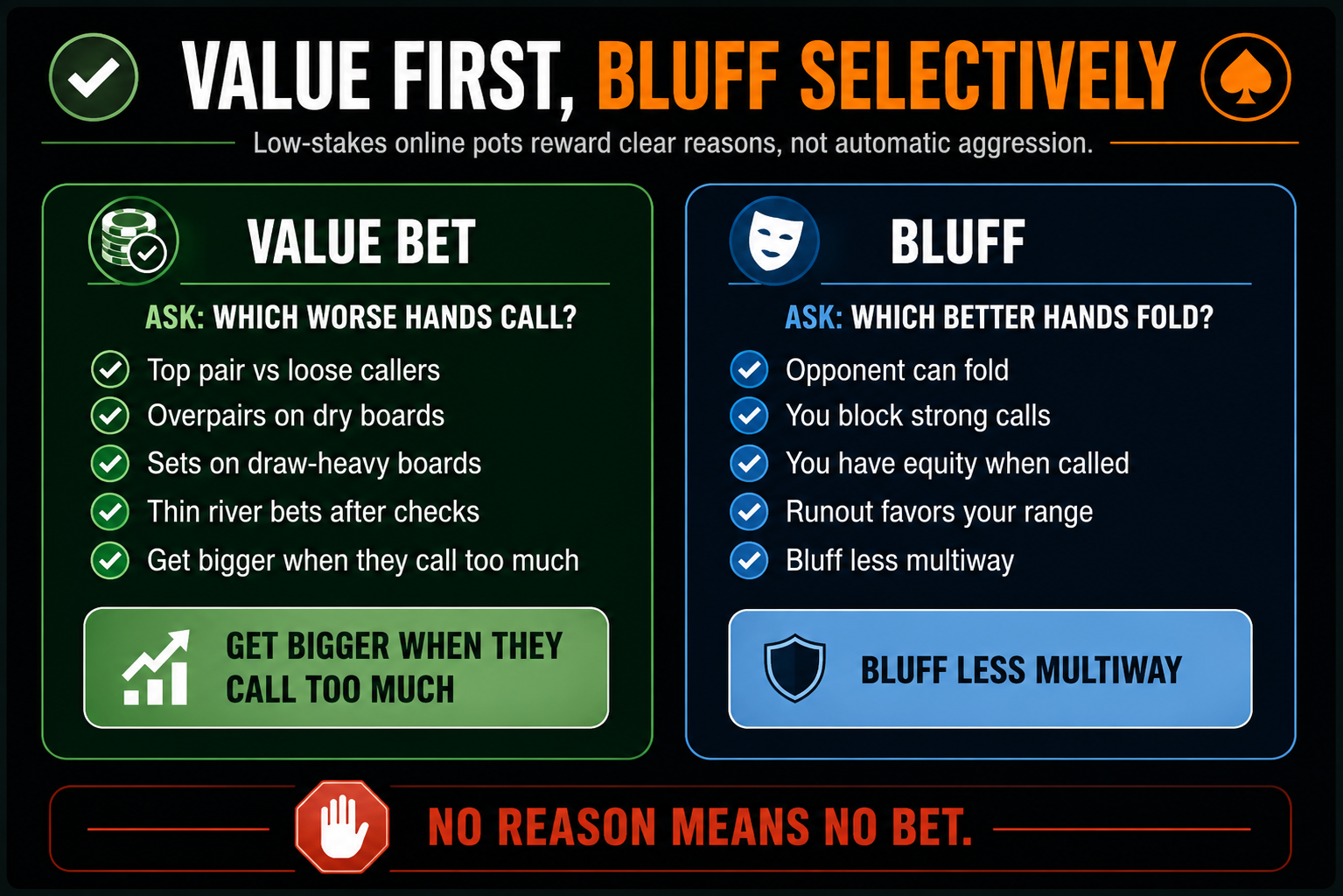
Ask one question before every value bet: which worse hands call?
If the answer is clear, bet. If you have AK on A74 rainbow against a loose big blind, worse aces, pocket pairs, and some floats can continue. If you have QQ on K83 against a tight caller, worse hands may not call multiple streets, so checking can make more sense.
The best beginner value bets are not thin hero plays. They are obvious spots you stop missing:
- Top pair top kicker against loose callers.
- Overpairs on dry boards.
- Sets and two pair on draw-heavy boards.
- Strong top pair after missed draws brick.
- Second pair in checked-down pots when ranges are weak.
Bet Sizing for Value
Use sizing that matches the target. Against a calling station, a half-pot bet with a strong hand may leave money behind. If they call 75 percent pot with worse top pair or a draw, charge them.
Against tighter opponents, smaller bets may get paid by worse hands that fold to large bets. You do not need one size for every spot.
Here is a practical sizing framework:
- Small bets, around 25-33 percent pot, work well when you have range advantage on dry boards.
- Medium bets, around 50-66 percent pot, work well for clear value and protection.
- Large bets, around 75 percent pot or more, work well when your opponent has many worse hands that will call or when your value range is very strong.
Do not hide behind "standard" sizing. Low-stakes players reveal what they will tolerate. If someone calls too much, value bet larger. If someone overfolds, bluff smaller and more often in the right spots.
Bluff Less Often, But Choose Better Bluffing Spots
You still need to bluff. If you never bluff, observant opponents can overfold when you bet. But beginners usually bluff in the wrong places: multiway pots, calling-station rivers, boards that smash the caller, and hands with no blockers or equity.
A good low-stakes bluff has at least one of these features:
- Your opponent can fold.
- Your range has the strongest hands.
- Your hand blocks strong calls.
- Your hand has equity when called.
- The runout is bad for your opponent's range.
Example: You raise from the button with As5s. The big blind calls. The flop is Ks7s2d. You continuation bet and get called. The turn is Qh. This can be a reasonable barrel against a player who folds too much because you have the nut-flush draw, an overcard blocker to some strong ace-high floats, and a board that favors your button range.
Now compare that to bluffing 9h8h on AcJc7d4s2c after a loose player check-calls twice. You block very little, missed draws arrived, and a calling station is not looking for reasons to fold ace-x. That river bluff burns money.
Bluffing is not about courage. It is about fold equity and range interaction.
Stop Bluffing Multiway by Default
Multiway pots are different. When two or more players continue to the flop, the chance that someone connected with the board rises, and the ranges that continue against bets become stronger. Your one-pair hands also shrink in value.
In heads-up pots, a continuation bet on A72 rainbow may print against a big blind who misses often. In a four-way pot, someone has an ace, a set, or a sticky pair much more often. You should check more, bluff less, and value bet with clearer equity.
This one adjustment saves beginners a lot of money. If you are unsure in a multiway pot, default to tighter betting ranges and smaller pots. Let other players make the first big mistake.
Continuation Bet With a Plan
A continuation bet is not automatic. Beginners learn that the preflop raiser can bet many flops, then they overuse the idea. The better approach is to classify the board.
Good boards for frequent c-bets:
- A-high or K-high dry boards when you raised preflop.
- Paired dry boards where callers miss often.
- Disconnected boards where your overpairs and top pairs are strong.
Boards that require caution:
- Low connected boards like 987 two-tone.
- Monotone boards when you lack a strong suit.
- Multiway flops.
- Boards that heavily favor the big blind's calling range.
Example: You raise from the cutoff with AdQd, and the big blind calls. The flop is Kh7c2s. This is a good small c-bet candidate. Your range has many strong kings, and the big blind misses often.
Now you raise AhQh and the big blind calls. The flop is 9s8s7d. Your overcards have some equity, but the big blind has many pairs, straights, two pairs, and draws. Betting automatically is much worse.
Before you c-bet, ask:
- Who has more strong hands?
- Which worse hands call?
- Which better hands fold?
- What turns can I barrel?
- What will I do if raised?
If you cannot answer, checking is allowed. Poker does not pay extra for clicking buttons quickly.
River Decisions: Stop Paying Off Obvious Strength
Low-stakes online players often underbluff big river raises and big river bets, especially after passive lines. That does not mean every large bet is the nuts. It means your default bluff-catching standards should be higher until a player proves they are capable.
The classic beginner mistake is "I know I am beat, but I have to call." You usually do not.
Suppose you open KcKd, the big blind calls, and the board runs Qd8d4s2cAd. You bet flop and turn. The river completes the flush and brings an ace. Your opponent leads pot. Against a passive player, this is a poor bluff-catching spot. The river improved many hands, and the population may not find enough bluffs.
Better bluff catches have specific reasons:
- You unblock missed draws.
- Your opponent is aggressive enough to bluff.
- Their value range is narrow.
- Their line is inconsistent.
- Your hand beats some value bets.
If those reasons are missing, fold. Folding strong-looking hands is part of winning poker. A realistic beginner strategy should include permission to make disciplined folds without feeling exploited.
Bankroll Management for Low-Stakes Online Cash Games
Bankroll management will not make bad strategy profitable, but it keeps normal variance from ending your progress. Cash games have lower variance than large-field tournaments, yet downswings still happen. Online players also see hands quickly, so downswings can arrive fast.
A practical beginner bankroll plan:
- Keep poker money separate from life money.
- Use at least 30 full buy-ins for the stake if you are learning.
- Use 40-50 buy-ins if you tilt easily or play tougher pools.
- Move down when you fall below your stop-loss threshold.
- Take shots only with a defined number of buy-ins and a move-down rule.
For example, if you play 10NL with a 100bb buy-in, one full buy-in is $10. A 30-buy-in bankroll is $300. A 50-buy-in bankroll is $500. If that feels too large, play 5NL until the numbers feel boring.
[INTERNAL: poker bankroll management for cash games]
The point is not to be overly conservative forever. The point is to avoid making strategic decisions under financial stress. If losing two buy-ins makes you scared, angry, or desperate to recover, you are playing too high.
Use HUD Stats and Notes the Right Way
Where HUDs are allowed, they can help you spot player types. Where they are not allowed, manual notes and population reads still matter. Either way, stats are tools, not commands.
The most useful beginner stats are simple:
- VPIP: how often a player voluntarily puts money in preflop.
- PFR: how often a player raises preflop.
- 3-bet: how often a player reraises preflop when given the chance.
- Fold to c-bet: how often a player folds against flop continuation bets.
- Hands: the sample size behind the numbers.
The sample size matters. If someone has played 12 hands and VPIP is 50, you do not know they are a maniac. They may have been dealt playable hands. If someone has played 600 hands with VPIP 45 and PFR 8, you have a much stronger read: loose-passive.
Notes should be specific and action-based:
- "Called 3-bet OOP with KJo."
- "Check-raised river with nut flush only."
- "Bet one-third pot with missed draw on river."
- "Limp-called 6bb with Q8s."
Avoid vague notes like "bad" or "fish." They do not help you make decisions. A good note tells you what adjustment to make later.
Build a Simple Study Routine
You do not need to study six hours a day to beat low stakes, but you do need a feedback loop. Playing without review turns leaks into habits.
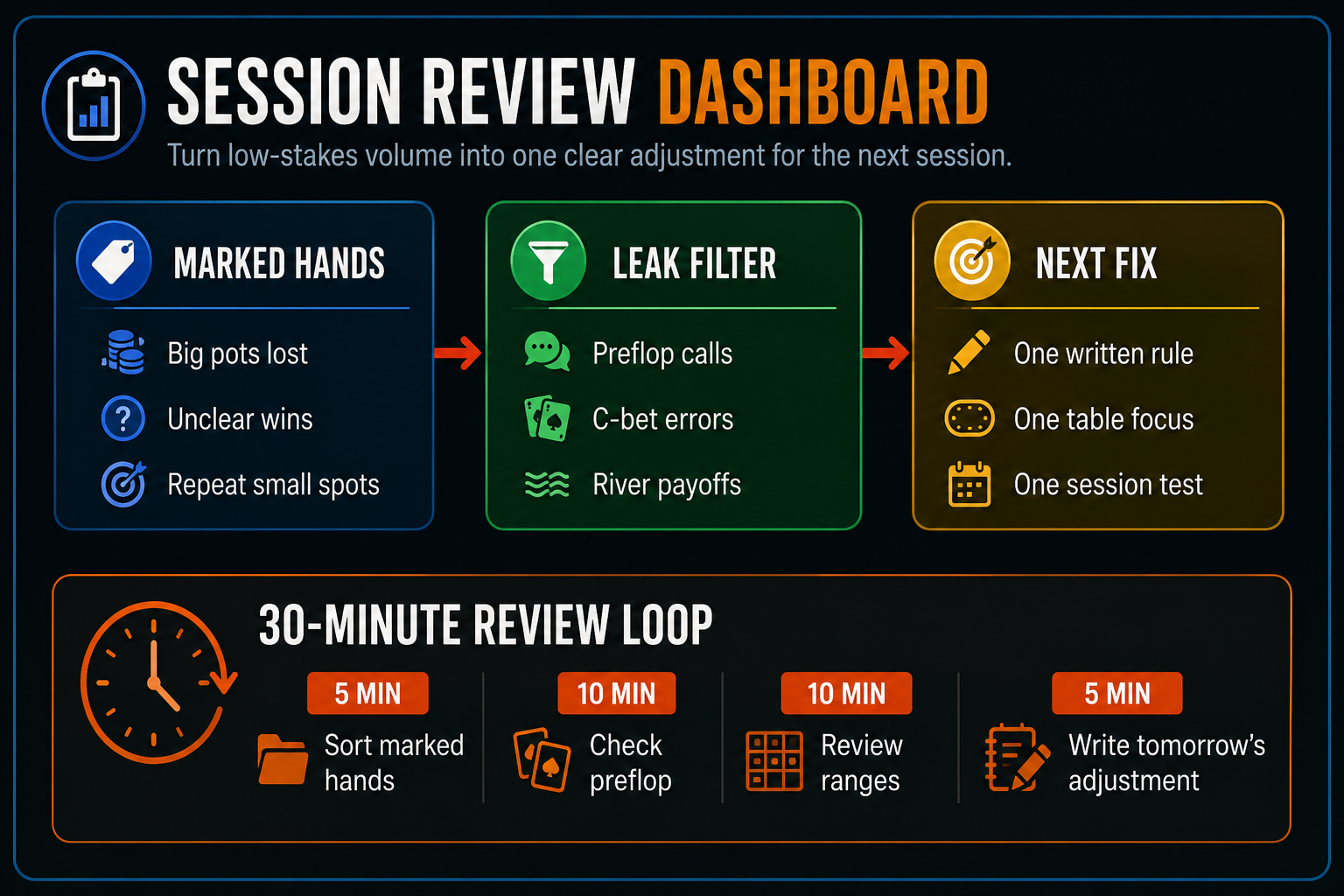
After each session, mark three types of hands:
- Big pots you lost.
- Big pots you won but felt unsure about.
- Small pots where you faced a recurring decision.
The third category is underrated. If you face button versus big blind c-bet spots 40 times per week, improving that node may be worth more than obsessing over one all-in cooler.
A 30-Minute Review Process
Use this review structure:
- Spend five minutes filtering your marked hands.
- Spend ten minutes checking preflop decisions against your chart.
- Spend ten minutes reviewing flop and turn decisions by range advantage.
- Spend five minutes writing one adjustment for the next session.
Your adjustment should be concrete:
- "Fold AJo versus tight button 3-bets when out of position."
- "Value bet larger against loose-passive players."
- "Stop c-betting low connected boards without equity."
- "Tag river raises from passive players and review them."
[INTERNAL: hand history review process]
This is how you turn study into money. You identify a pattern, choose a fix, and test it in the next session.
A Complete Example Hand
Here is how a realistic low-stakes decision process looks.
You are playing 10NL 6-max with $10 effective stacks. A loose-passive player with 52 VPIP and 12 PFR limps under the gun. You are on the button with AhQh. The blinds look tight.
Preflop: Raise to 5bb. You are ahead of the limper's range, in position, and want to isolate. Calling invites the blinds and misses value. Raising too small gives everyone a cheap flop.
The limper calls. The pot is about 11.5bb after rake considerations vary by site. The flop is Qs8h4h.
Flop: Bet about 75 percent pot. You have top pair top kicker plus the nut-flush draw. The opponent can call with worse queens, eights, pocket pairs, straight draws, worse flush draws, and random floats. This is a value bet, not a bluff.
The opponent calls. The turn is 2c.
Turn: Bet large again, around 70-80 percent pot. The turn does not change much. Worse made hands and draws can still call. Checking gives free equity and misses value.
The opponent calls. The river is Jd. The flush misses. The opponent checks.
River: Value bet, but choose a size worse hands can call. Against this player, half pot may get called by Qx, stubborn 8x, or pocket pairs. Shoving may fold too many worse hands unless you have seen this player call huge river bets light.
Notice the theme. You did not win because of a fancy line. You won because you isolated a weak range, made top pair with strong equity, and charged worse hands.
Now change the river. Suppose the river is 7h, completing your nut flush. If checked to, bet large. This player has many worse flushes, queens, and two-pair hands. Beginners often bet too small when they finally get there. Do not be afraid to build the pot when worse hands can call.
Common Beginner Leaks That Kill Win Rate
The biggest low-stakes leaks are usually boring. That is good news because boring leaks are fixable.
First, cold-calling too much. When you call raises behind the opener, you invite squeezes and play capped ranges. Prefer 3-betting or folding in many seats, while preserving some calls on the button and big blind.
Second, defending the small blind too wide. The small blind is a trap because you already have money invested but still play out of position. Completing or calling weak hands creates difficult spots.
Third, overvaluing one pair in multiway pots. Top pair is strong heads-up. It is much less comfortable against three players who continue.
Fourth, bluffing calling stations. If a player hates folding, stop trying to make them fold. Value bet them.
Fifth, slow-playing strong hands on wet boards. When the board has flush draws, straight draws, and many worse made hands, bet. You are not protecting your hand only from bad cards; you are extracting value from worse hands that will call now.
Sixth, ignoring rake. Small speculative calls become worse in high-rake environments. If a hand barely looks playable, folding is often the higher-profit beginner choice.
Seventh, playing too long while tilted. Online poker makes it easy to instantly reload and continue. Use session stop-losses and time limits. A tired C-game can erase a week of solid A-game.
When to Move Up in Stakes
Move up when three things are true: your bankroll supports it, your sample is meaningful, and your decisions feel stable under pressure.
Do not move up because you won five buy-ins today. Do not refuse to move down because you think lower stakes are beneath you. Stakes are tools. You use the one that lets you make good decisions and keep learning.
A practical shot-taking plan:
- Build at least 40 buy-ins for your current stake.
- Take a two- or three-buy-in shot at the next stake.
- Move down immediately if the shot fails.
- Review hands from the higher stake before trying again.
The higher you go, the less you can rely on obvious mistakes. Players defend better, bluff better, and value bet thinner. That is fine. Your low-stakes foundation should prepare you for that by teaching clean ranges, disciplined folds, and structured review.
Frequently Asked Questions
Can beginners really win at low-stakes online poker?
Yes, but not by playing randomly or chasing every draw. Beginners can win if they choose good games, use disciplined preflop ranges, value bet well, avoid large low-confidence calls, and review hands consistently. The edge is usually small at first, so bankroll management matters.
What is the best low-stakes online poker format to start with?
Regular 6-max cash games are a strong learning format because stacks are often 100bb, decisions repeat often, and hand histories are easy to review. Fast-fold games can be convenient, but they remove table selection and may be tougher for beginners.
Should I use GTO charts at low stakes?
Use charts as a baseline, not a prison. GTO-inspired ranges help you avoid major structural mistakes, but low-stakes profit often comes from exploitative adjustments: value betting calling stations, folding more versus underbluffed lines, and attacking players who overfold.
How many buy-ins do I need for low-stakes cash games?
A beginner should consider at least 30 full buy-ins, with 40-50 buy-ins being more comfortable for tougher games, aggressive shot-taking, or tilt control. If you cannot lose a few buy-ins without emotional pressure, play lower.
What is the fastest way to improve?
Play fewer tables, mark hands during sessions, and review one recurring spot each day. Preflop discipline, c-bet selection, river bluff-catching, and value bet sizing will usually produce faster gains than studying rare solver nodes.
Take Action Now
The best Low Stakes Poker Strategy is practical: sit in beatable games, play strong preflop ranges, isolate weak players, value bet relentlessly, bluff with reasons, and review the spots that repeat. Start with one session today where your only goal is clean decisions. Mark five hands, write one leak, and make that leak smaller tomorrow.