How to Study Poker Without Wasting Time: A Weekly Plan for Low-Stakes Players
How to Study Poker Without Wasting Time: A Weekly Plan for Low-Stakes Players
Learning How to Study Poker is not about collecting more videos, buying every tool, or building a 40-hour routine you will quit after two weeks. If you play low stakes, your edge usually comes from doing a few boring things consistently: reviewing real hands, fixing one leak at a time, drilling preflop until it is automatic, and turning study notes into table decisions.
Most players waste study time because they start too broad. They watch one c-bet video, open a solver spot, skim a Discord hand, check a chart, and end the hour with no specific change to make in their next session. That feels productive, but it does not compound.
This weekly plan is built for low-stakes cash game and tournament players who have limited time. It assumes you can study three to five hours per week and play enough hands to bring back real spots. The goal is simple: every study block should produce one decision you can execute at the table.
Why Low-Stakes Players Waste Study Time
The first leak is passive study. Upswing Poker's study guide warns that many players misuse training videos by watching them like entertainment instead of pausing, taking notes, and applying the concept to future sessions. That is especially expensive at low stakes because you probably do not have unlimited study hours.
The second leak is studying hands you will barely see. If you play $25NL online or $1/$2 live, do not spend your best hour building a river overbet range for a rare four-bet pot unless that spot keeps appearing in your database. Start with repeated spots: blind defense, single-raised pots, c-betting, facing c-bets, turn barrels, river calls, and obvious preflop confusion.
The third leak is outcome-based review. You lose a stack with top pair, feel annoyed, and review only that hand. Sometimes that is useful. Often, the better hand to review is the quiet 18 big blind pot where you checked back too much equity, missed a value bet, or called preflop with a hand that never performs well from that position.
Your plan needs friction. Not emotional friction, but structure. You should know what to study before the session starts, how many hands to review, what question you are answering, and what your next-session focus will be. Without that structure, poker study expands to fill the time and leaves no trace.
How to Study Poker With a Weekly Loop
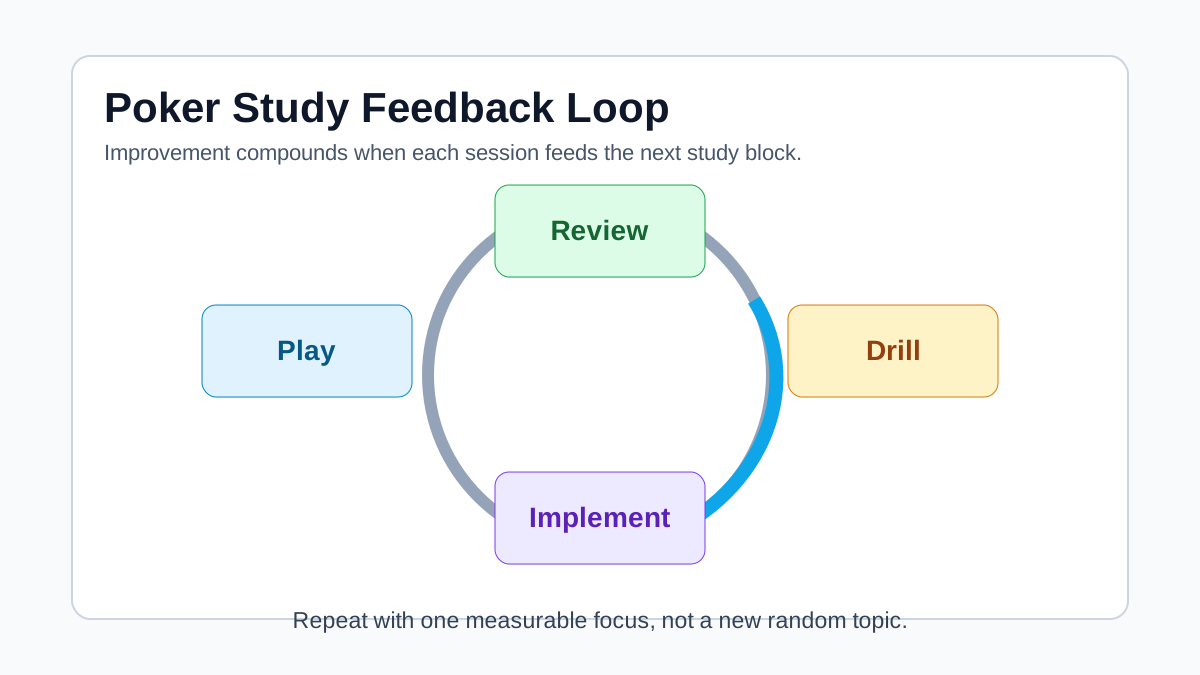
The best low-stakes study plan is a loop, not a content playlist. Play creates hands. Hands reveal leaks. Leaks define study topics. Study creates a focus. The next session tests the focus. Then the loop repeats.
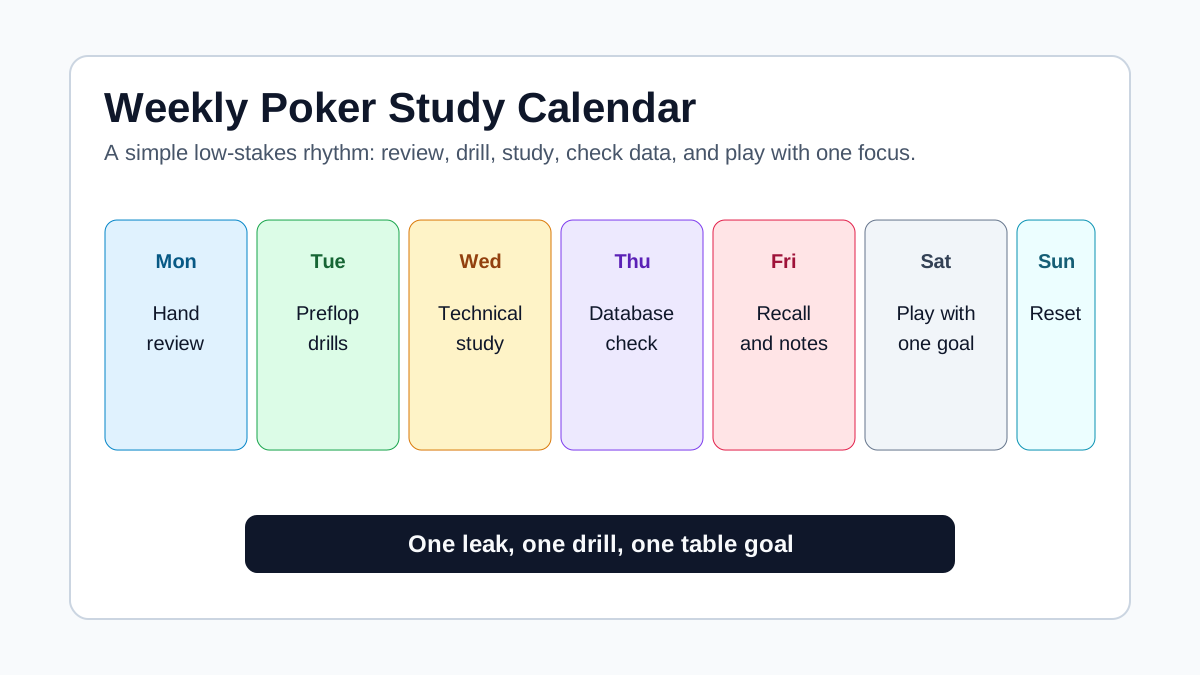
Use this weekly rhythm:
- One review block for tagged hands.
- One technical block for the week's main topic.
- One drilling block for preflop or a repeated postflop decision.
- One short database or session review.
- One implementation note before your next session.
PokerCoaching's study plan advice is useful here: pick one specific topic, study with purpose, do active work, and set a goal for implementation. That order matters. If you start with "I should get better at postflop," the topic is too large. If you start with "I am losing money after defending the big blind and facing a small flop c-bet," you have something you can study.
Keep a study log with four columns:
| Date | Topic | Finding | Next-session focus |
|---|---|---|---|
| June 2 | BB vs BTN c-bet | Overfolding ace-high backdoors on small bets | Defend more hands with backdoor equity |
| June 4 | CO open range | Opening too many weak offsuit broadways | Use chart before session |
| June 6 | River calls | Calling too wide after passive lines | Ask what worse hands villain value bets |
The log prevents circular study. If the same topic appears every week with no implementation note, you are not done studying it. You are avoiding the hard part.
Monday: Review Your Last Session in 30 Minutes
Monday is not for watching content. It is for finding the highest-value leak from your own hands.
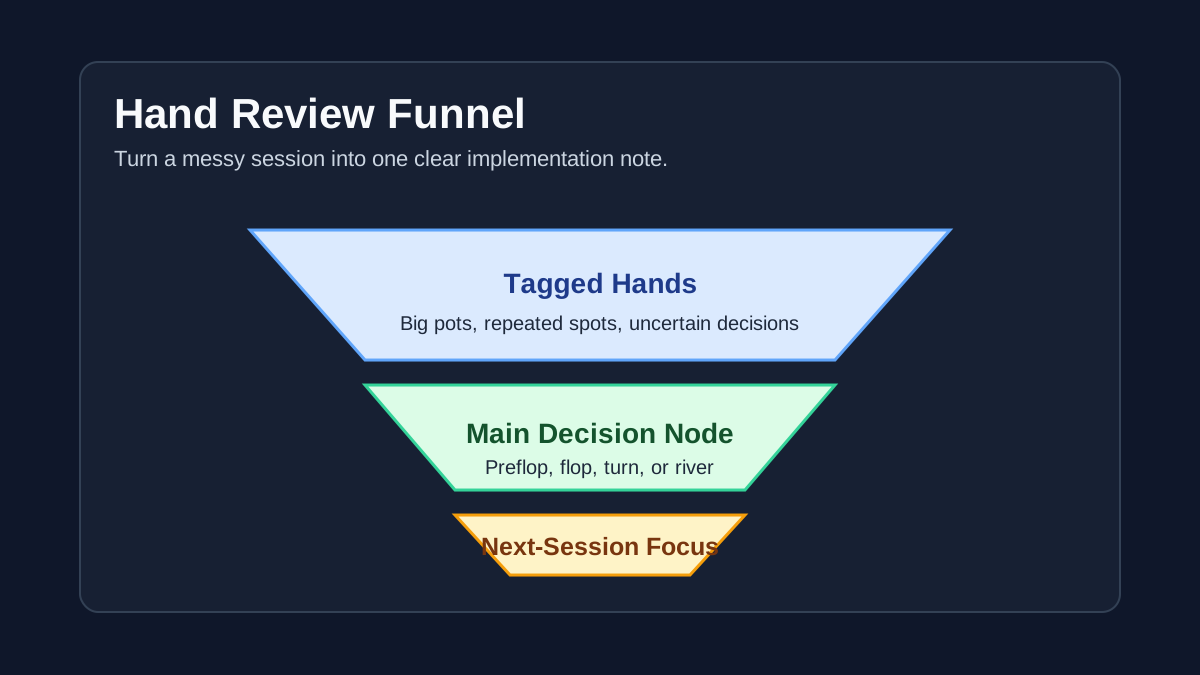
If you play online, tag hands during the session. Use three tags: unsure, big pot, and repeat spot. If you play live, write notes immediately after the hand. You do not need perfect suit accuracy for every folded card. You need stack depth, position, preflop action, board, bet sizes, and the decision that mattered.
Review five hands only. That limit keeps you honest. Pick the hands most connected to decisions you will see again, not the ones that hurt the most.
For each hand, write:
- What range did I start the street with?
- What range does villain likely have after taking this action?
- What hands am I value betting or calling with?
- What better hands fold if I bluff?
- What worse hands call if I value bet?
- What would I do differently next time?
Upswing's hand analysis routine starts with recording hands, preparing the hand history, and identifying the tough spot. That is the part most low-stakes players skip. They ask, "Should I call river?" without first defining the preflop ranges and how the turn action shaped the river.
Example: A Fast Monday Review
You open AQs from the cutoff to 2.5 big blinds. The button calls. The flop is Qh 8s 4s. You bet one-third pot, button calls. Turn is 2c. You bet two-thirds pot, button calls. River is 9s. You check, button bets 75% pot, and you call. Button shows Js Ts.
Do not write "unlucky river." Write the real study question: when the front-door flush completes after you bet twice, which worse hands does a low-stakes button bluff often enough? Then check whether your turn size forced you into too many thin river bluff-catches. That one hand becomes a river defense study topic, not a bad beat story.
Tuesday: Drill Preflop Until It Stops Leaking
Preflop study is not glamorous, but it is the fastest way to stop wasting money. A low-stakes player with sloppy preflop ranges creates hard postflop spots on purpose. You call too wide in the small blind, miss too many flops out of position, then tell yourself you need more solver work.
Spend Tuesday on one preflop node:
- RFI from early position, cutoff, button, small blind.
- Big blind defense versus button opens.
- Small blind three-bet or fold strategy.
- Calling versus three-bets in position.
- Short-stack tournament opens and reshoves.
Do not drill every chart. Pick one. For cash games, a useful first month is:
| Week | Preflop focus | Why it matters |
|---|---|---|
| 1 | Cutoff and button opens | You play these spots constantly and profit from position. |
| 2 | Big blind defense vs button | Small mistakes repeat at high volume. |
| 3 | Small blind strategy | Calling too much out of position burns EV. |
| 4 | Versus three-bets | Low-stakes players often overfold or defend dominated hands. |
Use charts as guardrails, not as a personality test. If a hand is a pure fold in your chart, folding it is not "nitty." It is removing a low-return decision from your game. If a hand mixes in a solver solution, choose the action that is easier to execute well at your stakes.
Before your next session, write one sentence: "This week I will stop flatting weak offsuit broadways in the small blind." That is a study output. Watching a two-hour preflop course and making no table change is not.
Wednesday: Learn One Postflop Pattern
Wednesday is your technical study block. This is where you use training content, solver outputs, articles, or quizzes. The rule is that the topic must come from your hands.
Good Wednesday topics are narrow:
- Button versus big blind, single-raised pot, dry ace-high boards.
- Big blind check-raise range on low connected flops.
- Turn barreling after c-betting flop and picking up equity.
- Facing delayed c-bets after flop checks through.
- River value betting when draws miss.
Bad Wednesday topics are huge:
- Learn GTO.
- Study postflop.
- Get better at bluffing.
- Understand solvers.
GTO Wizard's solver education is helpful because it frames solvers as tools for understanding incentives, not memorizing every mixed action. Their work on solver study and multiple sizings repeatedly points toward the same practical lesson: ask why a strategy exists. Which range has the nut advantage? Which player has more equity? Which hands benefit from denial? Which hands want to build the pot?
The Three-Question Solver Filter
When you open a solver spot, answer three questions before looking at every combo:
- Who has the range advantage?
- Who has the nut advantage?
- Which hand classes want to bet, check, call, or raise?
Suppose you study button versus big blind on K72 rainbow after the big blind checks. The button often has more strong Kx and overpairs, while the big blind has more weak pairs and air. A small c-bet can pressure the big blind's missed hands while getting value from worse pairs. You do not need to memorize the exact mixed frequency of every backdoor hand. You need to understand why a range bet might work and when it stops working.
End Wednesday with a rule of thumb you can test: "On disconnected high-card boards where I have range advantage, I can simplify to small bets with most of my range, then slow down on turns that improve the big blind's calling range."
Thursday: Run a Small Database or Pool Review
Thursday is for patterns. You are not trying to solve your entire game. You are looking for one repeated decision that deserves next week's study time.
If you use PokerTracker, Hold'em Manager, or another database, filter spots by position and action. Upswing's study article recommends player-pool review for low-stakes environments because huge pools make individual opponent samples less reliable. That is a practical distinction: at low stakes, you usually learn more from population tendencies than from overfitting to one opponent with 86 hands.
Start with simple filters:
- Win rate by position.
- VPIP and PFR gap by position.
- Fold to flop c-bet after calling preflop.
- Turn c-bet frequency after betting flop.
- River call efficiency or big river call outcomes.
- Three-bet percentage by position.
Do not obsess over tiny samples. If you have 600 hands in a spot, treat it as a clue, not a verdict. If you have 20,000 hands and the same leak appears across months, take it seriously.
For live players, your "database" can be a session spreadsheet. Track hours, game type, biggest decision, emotional state, and one hand category. After ten sessions, you may notice that your worst decisions come after long card-dead stretches or in straddled pots. That is study data.
The output of Thursday is a ranked leak list:
| Rank | Leak candidate | Evidence | Next step |
|---|---|---|---|
| 1 | Calling too wide in small blind | Losing heavily, many dominated hands | Tuesday preflop drill |
| 2 | Overfolding flop vs small c-bets | Database fold rate high | Wednesday BB defense study |
| 3 | Missing river value | Notes show repeated check-backs | Monday hand review theme |
The list should be short. If you find 17 leaks, you found noise. Pick the one that costs the most and appears the most often.
Friday: Use Quizzes or Study Groups the Right Way
Friday is the best day for active recall. Use quizzes, a study partner, or a small group, but keep the format strict.
PokerCoaching emphasizes quizzes because they force you to pause, decide, and compare your thought process to a coach's answer. Pokercode similarly recommends using hands you have played, tools that speed up review, and similar spots so you learn how board dynamics change frequencies. Both ideas beat passive viewing.
Run this 45-minute format:
- 5 minutes: choose one topic from the week.
- 15 minutes: answer three quiz hands or review three tagged hands without looking at results.
- 15 minutes: compare answers to a coach, solver, chart, or trusted player.
- 10 minutes: write one adjustment and one question.
If you study with a group, ban vague feedback. "I probably call" is not enough. Ask for ranges and thresholds. What worse hands value bet? What bluffs exist? What size would villain use with value? What hands block the value range?
Study groups can waste time when they become social hand-history theater. They become valuable when everyone shows their work. A strong player saying "fold" is less useful than an improving player explaining a range clearly and discovering where the range is wrong.
Saturday: Play With One Implementation Goal
Saturday is the bridge between study and results. You are not trying to remember everything you learned. You are trying to execute one adjustment.
Examples:
- "I will not cold call from the small blind except in the exact profitable cases I studied."
- "I will tag every turn barrel spot where I pick up equity."
- "I will value bet thinner on rivers where missed draws can call with pairs."
- "I will defend big blind more carefully versus small button c-bets."
- "I will take 10 seconds before river bluff-catching and list villain's value hands."
Keep the goal visible. Put it on a sticky note, session note, or warm-up page. If you multi-table online, keep it even simpler. One goal is enough.
After the session, grade the process, not the result. Did you execute the adjustment? Did you tag relevant hands? Did you avoid the old leak? If you lost money while making better decisions, the study still worked. If you won money while ignoring the goal, the study did not get tested.
This is where low-stakes players need discipline. The pool will give you strange lines, odd bet sizes, and emotional spots. Your weekly plan is not meant to make poker feel clean. It is meant to give you a stable decision process while the game stays messy.
Sunday: Reset the Plan and Protect Your Energy
Sunday is a short reset. Do not turn it into a second job.
Spend 20 minutes answering:
- What was the week's main study topic?
- What did I implement?
- Which spots still felt unclear?
- Which leak appears most expensive now?
- What is next week's single focus?
Then stop. Burnout makes study worse. Low-stakes players often have jobs, school, families, and limited mental bandwidth. You do not need to mimic a high-stakes pro's schedule. You need a repeatable routine that you can follow for six months.
Jonathan Little's PokerCoaching habit article makes a practical point for recreational players: limited study time has to be prepared in advance. If you spend the first 10 minutes deciding what to study, your best attention is already leaking away.
Create next week's plan before the week begins:
| Day | Time | Task | Output |
|---|---|---|---|
| Monday | 30 min | Review five tagged hands | One leak candidate |
| Tuesday | 30 min | Drill one preflop node | One range adjustment |
| Wednesday | 60 min | Study one postflop pattern | One heuristic |
| Thursday | 30 min | Database or session review | Ranked leak list |
| Friday | 45 min | Quiz or group review | One tested decision |
| Saturday | Play session | Implement one focus | Tagged hands |
| Sunday | 20 min | Reset | Next week's focus |
How to Study Poker When You Only Have Three Hours
If you have three study hours per week, do not divide them evenly across everything. Use a 60/30/10 split.
Spend 60% of your time on your own hands. That means tagged hands, database review, and live session notes. Your hands show what you actually misunderstand.
Spend 30% on structured learning. That can be a course, article, quiz, solver spot, or coaching video. The key is that it must connect to your hand review. If your review shows blind defense problems, study blind defense. Do not watch a final table ICM video because it looks interesting.
Spend 10% on planning. That sounds small, but it is the difference between a pile of notes and a training system. Decide the next topic, write the next implementation goal, and pick the next hands to review.
For example:
- 70 minutes: review seven hands from the week.
- 50 minutes: study one training source on the main leak.
- 30 minutes: drill a chart or quiz.
- 20 minutes: database check or live-session spreadsheet.
- 10 minutes: write next-session focus.
If you have five study hours, add more hand review and one group session. Do not add four new topics.
The Low-Stakes Study Priorities That Pay First
Not every topic has the same return. For most low-stakes players, the best first priorities are:
- Preflop discipline by position.
- Big blind defense versus common open sizes.
- C-betting in single-raised pots.
- Facing flop c-bets after calling preflop.
- Turn barreling with equity.
- River value betting and bluff-catching.
- Tilt triggers and session length.
That list is intentionally ordinary. You make money by making better repeat decisions, not by knowing a rare solver trick.
A useful leak test is volume times severity. A small mistake that happens 300 times per month may matter more than a huge mistake that happened once. Calling one extra big blind too often from the small blind can quietly cost more than one dramatic river hero call.
Use [INTERNAL: poker preflop strategy by position] when you need a range baseline. Use [INTERNAL: hand history review process] when your notes are messy. Use [INTERNAL: bankroll management for poker] to keep study and shot-taking decisions connected.
Common Study Mistakes to Avoid
The most common mistake is confusing collection with improvement. A folder full of saved videos is not a study plan. A solver subscription is not a study plan. A chart pack is not a study plan. The plan is the behavior that changes after you use those resources.
The second mistake is jumping stakes in your study. If you play loose-passive live $1/$2 games, you still need sound fundamentals, but you should also study population exploits: bigger value bets, fewer low-equity bluffs, and disciplined folds when passive players wake up. If you play online pools with aggressive regulars, you need more work on three-bet pots, c-bet defense, and river bluff-catching.
The third mistake is reviewing only losing hands. Winning hands hide leaks too. You may win a pot after making a bad turn call because villain checked river. You may stack someone with a set after choosing a preflop size that makes your range obvious. Review decisions, not outcomes.
The fourth mistake is studying too long without playing. Poker knowledge decays when it never gets tested. After every technical block, schedule a session focus. You are training decisions, not building trivia.
Frequently Asked Questions
How many hours should a low-stakes player study poker each week?
Three to five focused hours is enough for most low-stakes players if the work is structured. Start with your own hands, study one topic, drill one repeated decision, and write one implementation goal. More hours help only if they stay focused.
Should I use a solver to study low-stakes poker?
Yes, but use it to learn principles, not to memorize mixed frequencies. Ask why the solver bets, checks, raises, or calls. Then simplify the answer into a strategy you can execute against your player pool.
What should I study first if I am losing at low stakes?
Start with preflop ranges by position, then review big blind defense and small blind mistakes. Preflop leaks repeat constantly and make every postflop decision harder.
Is watching poker videos a good way to study?
It can be, but only if you pause, predict actions, take notes, and connect the lesson to hands you have played. Passive video watching is one of the easiest ways to feel productive without improving.
How do I know if my poker study is working?
Look for cleaner decisions before you look for short-term results. You should see fewer repeated mistakes, clearer hand notes, better preflop discipline, and more specific questions after sessions. Results matter over time, but process improves first.
Take Action Now
The best answer to How to Study Poker is not "study more." It is "study the next decision that will show up again." Review your hands, pick one leak, learn one pattern, drill one node, and test one adjustment in your next session.
Do that every week and your study stops being random. It becomes a feedback loop. Low-stakes poker rewards players who remove repeated mistakes, value bet clearly, fold disciplined hands, and keep improving while the rest of the table stays comfortable.
Start this week with Monday's five-hand review. Choose one leak, write one next-session focus, and make How to Study Poker a practical routine instead of another tab you meant to read.