Poker Hand Analysis: How to Review Your Poker Hands Like a Pro
Poker Hand Analysis: How to Review Your Poker Hands Like a Pro
Poker Hand Analysis is where real improvement happens after the session ends. You can watch strategy videos for months, but if you never review your own decisions, you will keep repeating the same leaks with different cards.
The problem is that most players review hands backward. They start with the result. They ask, "Should I have folded?" after seeing the river. They blame bad beats, search for the one solver answer, or ask a group chat whether the hand was "standard." That is not professional review. That is emotional damage control.
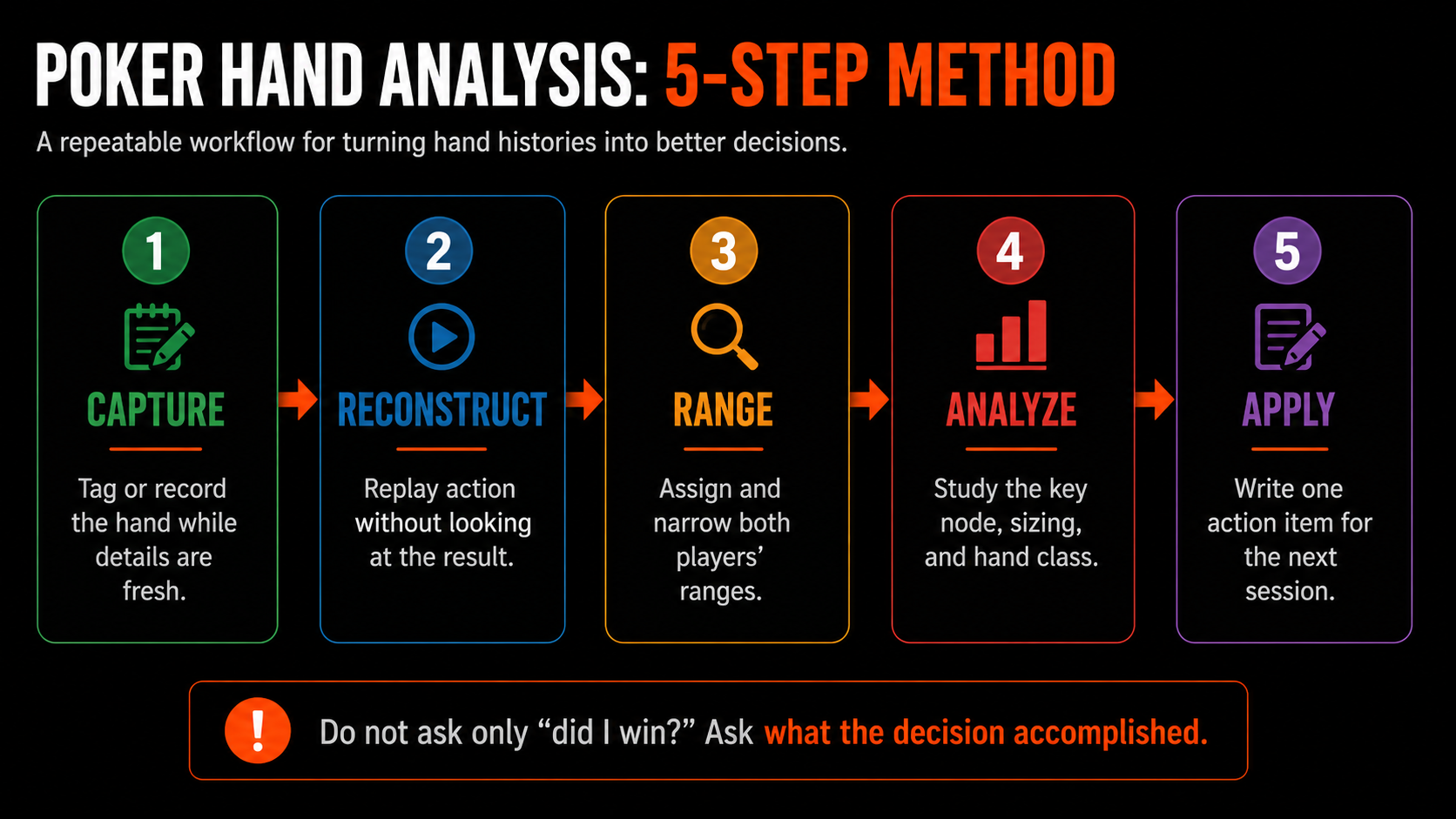
A better process is structured. You capture the hand while the details are fresh. You rebuild the action without the result bias. You assign ranges street by street. You analyze the most important decision node. Then you turn the answer into one adjustment you can actually use in your next session.
This guide gives you a five-step hand history method for cash games and tournaments. You can use it with PokerTracker, Holdem Manager, a site hand history file, a solver, a trainer, or a plain notebook. The tool matters less than the process. A weak process with expensive software still produces vague conclusions. A strong process with simple notes can fix leaks quickly.
Why Poker Hand Analysis Beats Passive Study
Passive study is easy. You watch a coach analyze a hand, nod when the explanation makes sense, and feel like you learned something. That has value, but it does not automatically change your decisions under pressure.
Poker Hand Analysis is different because it starts with your actual game. Your open sizes, your position, your stack depth, your river calls, your missed value bets, your fear of check-raises, your opponent pool. The hand history shows where theory met reality.
Professionals review hands because memory is unreliable. During a session, you may remember the pain of losing a big pot but forget the exact stack-to-pot ratio, bet size, or action sequence. You may remember that the opponent "always bluffs," even though the hand history shows they used a line that is underbluffed in your pool.
Tracking tools help here. PokerTracker's replayer guide describes replaying hands from reports and using replayer controls, notes, tags, stack display options, and equity calculator integration. Holdem Manager's hand views documentation describes selecting hands, replaying or viewing them, filtering tagged hands, and right-click options for tagging and exporting. Those features are useful because they let you isolate decisions instead of relying on memory.
But software is only a container. The review method is the engine. You need a repeatable way to answer five questions:
- What exactly happened?
- What were the ranges before the key decision?
- Which street mattered most?
- What did my hand want to accomplish?
- What adjustment should I make next time?
That structure keeps your study practical. You are not trying to solve poker in one hand. You are using one hand to improve one decision pattern.
Step 1: Capture the Hand Before Bias Takes Over
The first step is capture. You need enough information to review the hand accurately later.
If you play online, tag hands during the session. Do not wait until the next morning and hope you remember which river spot felt close. Holdem Manager hand views include tagged-hand filtering, and PokerTracker's replayer interface supports tags and notes for the current hand. Use those features aggressively.
Tag three types of hands:
- Big pots where you were unsure.
- Medium pots where the decision repeated a common pattern.
- Small pots that reveal a leak, such as overfolding big blind or c-betting the wrong board.
Do not tag only the hands you lost. Winning hands can hide bad decisions. If you 3-bet too large with A-A, got called by worse, and won anyway, the result does not prove the sizing was best. If you triple-barreled into a calling station and got lucky when they folded bottom pair, the win may be a leak in disguise.
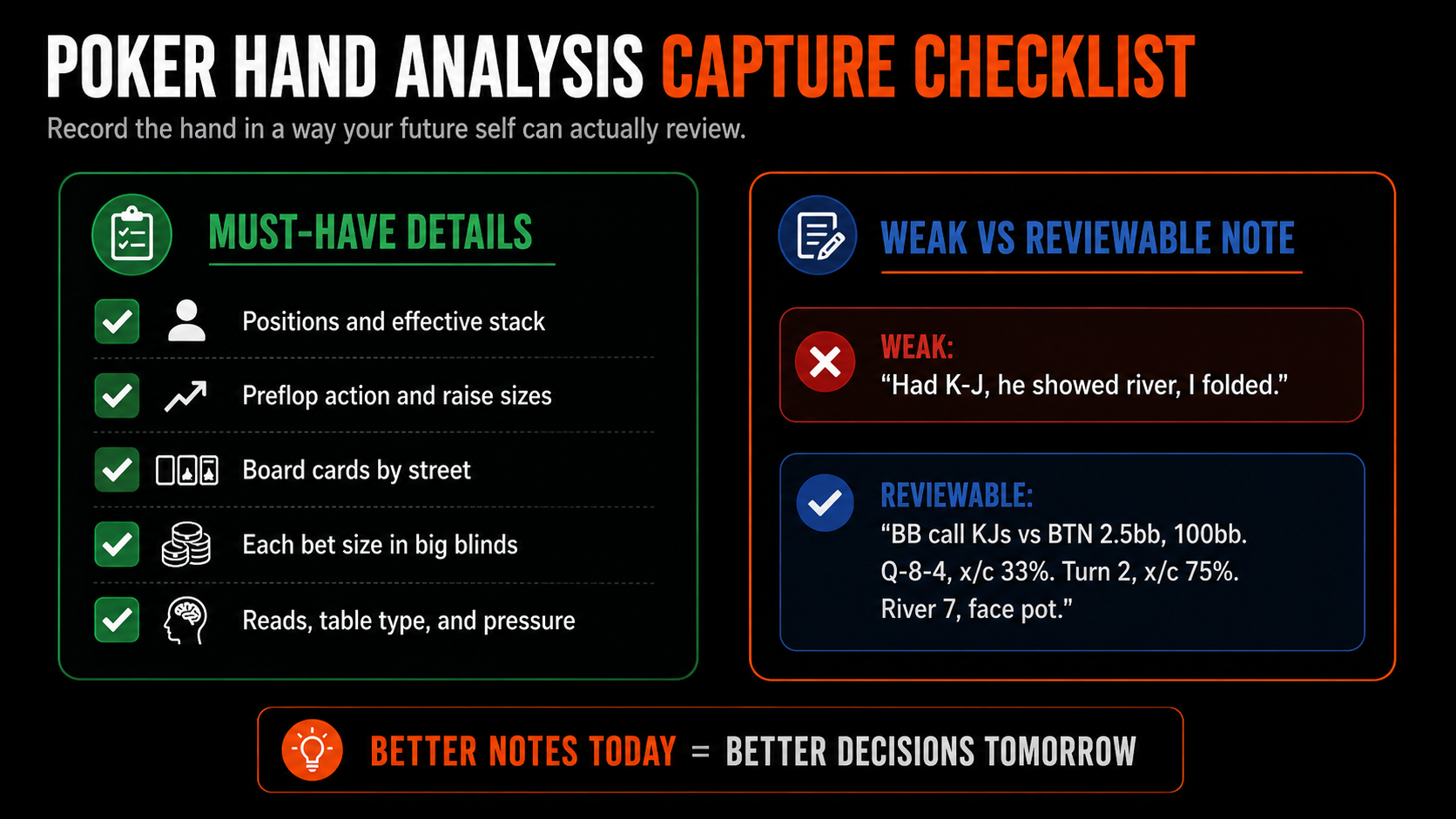
If you play live, capture the hand immediately after it ends. Write it in big blinds, not dollars, so it transfers across stakes. Record position, effective stack, preflop action, board, bet sizes, reads, and your emotional state if it affected the decision.
A useful live note looks like this:
Button opens 2.5bb, I call BB with KJs, 100bb effective. Flop K-8-4 rainbow, check, button bets 33%, I call. Turn 2, check, button bets 75%, I call. River Q, I check, button jams 1.4x pot. Villain is active but no shown river bluffs. I folded.
That note is reviewable. "Had K-J, he shoved river, I folded" is not.
Step 2: Reconstruct the Hand Without Looking at the Result
The second step is reconstruction. Before you open the showdown, rebuild the hand from preflop to the key decision.
This is where many players fail. They see the villain had a bluff, then decide their call was obvious. Or they see the villain had the nuts, then decide their fold should have been easy. Both reactions are result-oriented. A professional review asks what decision was best with the information available at the time.
Start with the preflop setup:
- Game type: cash, MTT, sit and go, or bounty tournament.
- Stack depth: effective stack in big blinds.
- Positions: hero, opener, callers, blinds.
- Rake or tournament pressure: high-rake cash game, bubble, pay jump, final table, bounty.
- Reads: loose-passive, tight-aggressive, unknown, strong regular, short-stacked recreational player.
Then write the action in one clean sequence. Do not add judgment yet. Avoid phrases like "bad call" or "obvious bluff." Keep it factual.
Next, identify the decision nodes. A hand may contain several, but one usually matters most. Maybe preflop was a clear call, flop was standard, turn was close, and river was the real decision. Or maybe the river was forced because your turn sizing created a bad stack-to-pot ratio.
This is why reconstruction matters. A river mistake often starts on the flop. If you c-bet too large on a board where your range should check often, your turn and river options become distorted. If you flat-call a 3-bet out of position with a dominated hand, the postflop pain is not the root problem.
In your review notes, mark the main node:
- Preflop continue or fold.
- Flop c-bet or check.
- Turn barrel or give up.
- River value bet or check.
- River call or fold.
- Raise size or all-in threshold.
Once the main node is clear, you can review with purpose instead of wandering through the whole hand.
Step 3: Build Ranges Before You Analyze Your Exact Hand
The third step is range work. This is the heart of Poker Hand Analysis.
Upswing Poker's hand-reading material makes a beginner-friendly point that serious players use constantly: do not put an opponent on one exact hand. Put them on a range of possible hands, then narrow that range as actions happen. BBZ Poker's range material makes the same core point in modern terms: every action removes some hands from the set a player can reasonably hold.
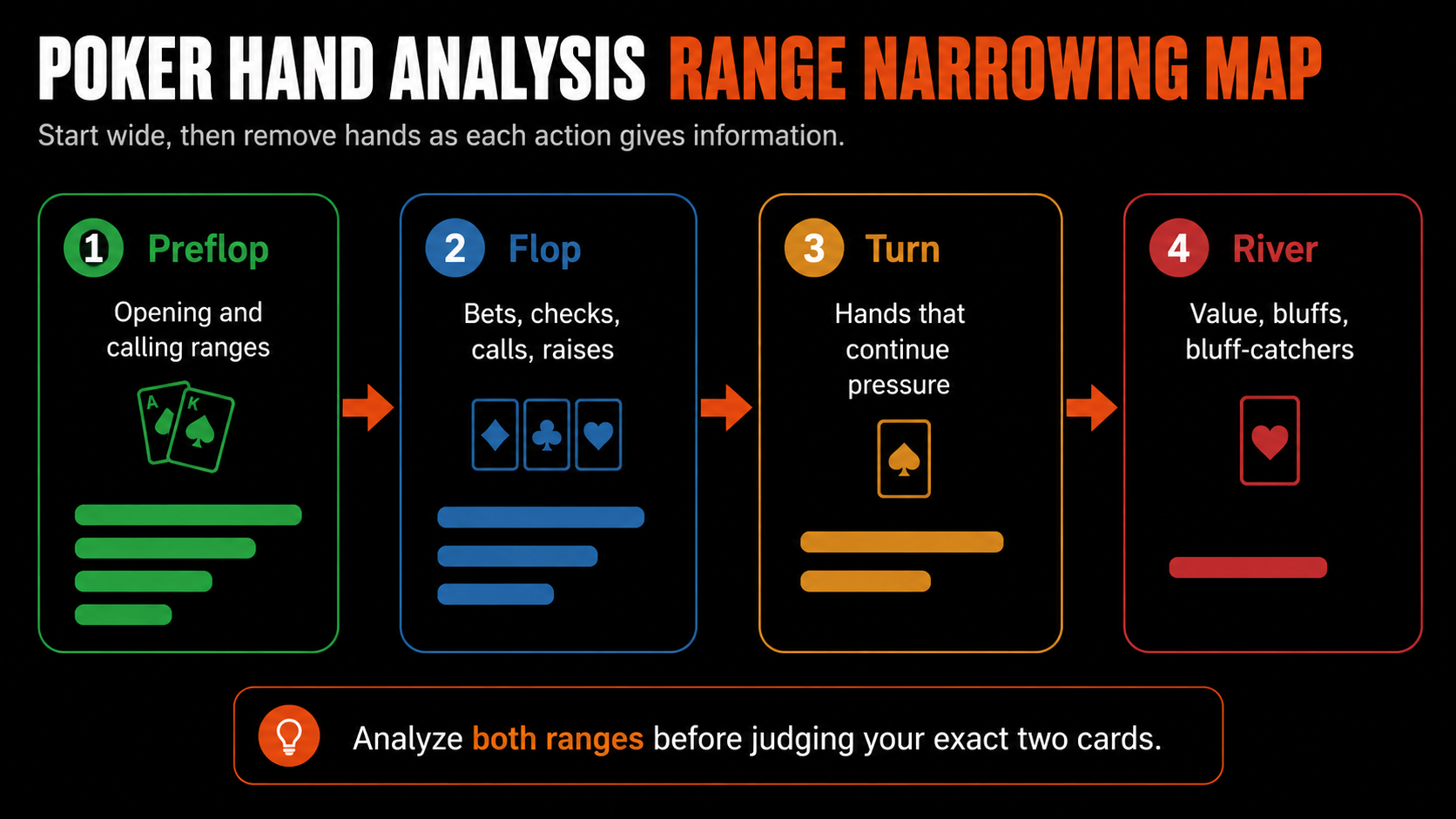
Start preflop. What hands does the opener raise from that position? What hands does the caller flat? What hands does the big blind defend? You do not need a perfect chart. You need a reasonable starting shape.
Then narrow ranges by street:
- Which hands bet this flop?
- Which hands check back?
- Which hands call your bet?
- Which hands raise?
- Which hands continue on this turn card?
- Which hands reach the river after this line?
Do this for both players, not only villain. Many beginners analyze opponent range but ignore their own. Your range matters because it determines whether a bet tells a credible story. If your line has too few value hands, your bluff may fail against attentive opponents. If your range contains many strong hands, you may be allowed to apply more pressure.
Example: River Call With Top Pair
Suppose you defend the big blind with Q-J suited against a cutoff open. Effective stacks are 100bb. The flop is Q-8-4 rainbow. You check-call 33%. The turn is 2. You check-call 75%. The river is 7. You check and villain bets pot.
Bad review: "I had top pair. Do I call?"
Better review:
- Preflop cutoff range is wide but not random.
- Flop c-bet range includes top pairs, overpairs, some ace-high bluffs, and small pairs betting for protection.
- Turn large bet filters out some weak stabs.
- River pot bet likely polarizes to strong queens, overpairs, sets, and bluffs.
- My Q-J blocks some worse queen value and loses to A-Q, K-Q, Q-8, sets, and overpairs.
- Villain profile matters: balanced regular, population underbluffer, or aggressive overbluffer?
Now the question is not "top pair good?" The question is whether your specific hand belongs in the defending part of your range against that opponent and sizing.
Use Solvers for Patterns, Not Just Answers
GTO Wizard's article on outlier hands warns against using a tool only to line-check whether one specific hand was optimal. The deeper value is understanding range behavior and why certain hands stand out. That is exactly how beginners should use solvers.
When you compare a hand to a solution, ask:
- Which player has range advantage?
- Which player has nut advantage?
- Does the strategy prefer small bets, large bets, checks, or mixed actions?
- Which hands are pure value?
- Which hands become bluffs because of blockers?
- Which hands check because they have showdown value?
If your exact hand was mixed, do not stop at "solver mixes." Ask what makes it indifferent. Often the answer is that the hand has enough equity to continue but not enough value to push hard. That concept is more useful than memorizing a frequency.
Step 4: Analyze the Key Node With a Decision Template
The fourth step is to analyze the key node. This is where your review becomes specific enough to change behavior.
Use the same template every time:
- What is my range at this node?
- What is villain's range at this node?
- What is my hand class: value, bluff, bluff-catcher, draw, or showdown value?
- What does my action accomplish?
- What better hands fold or worse hands call?
- What sizing makes sense?
- What exploit changes the answer?
This template stops vague thinking. If you cannot name worse hands that call your river value bet, the bet may be too thin. If you cannot name better hands that fold to your bluff, the bluff may be pointless. If your hand has showdown value and your bluff folds only worse hands, checking may be better.
Example: Missed Turn Barrel
You raise button with A-5 suited. Big blind calls. Flop is K-7-2 with two spades. You have the nut flush draw. Big blind checks, you bet small, big blind calls. Turn is Q offsuit. Big blind checks.
The lazy review asks, "Should I barrel?"
The node template asks more:
- Your range has many K-x, Q-x, sets, and strong draws.
- Big blind has some K-x, 7-x, pocket pairs, flush draws, and floats.
- A-5 suited with nut flush draw is a semi-bluff.
- Betting can fold out 7-x, small pairs, and some better ace-high hands.
- Betting builds a pot when you improve to the nut flush.
- Checking realizes equity and avoids a check-raise.
- Against a player who overfolds turns, betting gains value.
- Against a sticky player who check-raises aggressively, checking may perform better.
The best answer depends on board texture, ranges, sizing, and opponent. But the analysis is now professional because it explains the job of the bet.
Example: Thin River Value Bet
You raise cutoff with A-J suited. Big blind calls. Board runs J-8-3-4-2 with no flush. You bet flop and turn; villain calls twice and checks river.
If villain is a loose caller, your hand may still value bet. Worse J-x, 8-x that does not believe you, and stubborn pocket pairs can call. If villain is a strong regular who reaches river with fewer weak pairs, checking may be better.
The key is naming the target. "I bet because I have top pair" is incomplete. "I bet half pot because this opponent calls too many pairs and I target J-T, J-9, T-8, 9-8, 7-7, and 6-6" is real Poker Hand Analysis.
Step 5: Turn the Review Into One Action Item
The fifth step is the most important and most ignored: write one action item.
A hand review that ends with "interesting spot" is not finished. You need a behavior change.
Good action items are specific:
- "In single-raised pots as the big blind, check more often on low connected boards after defending."
- "Do not call large river bets with one-pair hands against passive players unless I block value or have evidence of bluffs."
- "When isolating loose limpers in position, size larger with value and avoid weak suited junk."
- "Tag every 3-bet pot where I call out of position and review whether preflop was the leak."
- "Use a smaller flop c-bet size on dry ace-high boards where my range wants high frequency."
Bad action items are vague:
- "Play better rivers."
- "Be less spewy."
- "Study more."
- "Trust my gut."
Your action item should be something you can check next session. If you cannot observe whether you did it, rewrite it.
[INTERNAL: poker tracking software setup]
The 5-Step Poker Hand Analysis Checklist
Use this checklist after every session. It works whether you review one hand or twenty.
1. Capture
Tag or write down hands while details are fresh. Include position, stack depth, bet sizes, action, board cards, reads, and your emotional state if relevant.
2. Reconstruct
Replay the hand without looking at the result first. Identify the main decision node and any earlier decision that created the difficult spot.
3. Range
Assign preflop ranges, then narrow them street by street. Review your own range and villain's range. Do not jump straight to your exact two cards.
4. Analyze
Use the node template: hand class, range advantage, action purpose, sizing, better hands that fold, worse hands that call, and exploitative reads.
5. Apply
Write one action item. Add it to your next-session focus list. If possible, create a saved filter or tag category so you can find similar hands later.
Holdem Manager's report filter guide is relevant here because filters can isolate exact situations, and saved filters can make repeated study faster. The same idea applies in any tracker: once you find a leak, build a way to revisit that spot.
Which Hands Should You Review First?
Do not review every hand equally. Time is limited, and not every hand teaches the same amount.
Start with expensive uncertain decisions. These are hands where a mistake costs many big blinds: river calls, turn jams, 3-bet pots, 4-bet pots, and large multiway pots.
Next, review repeated small leaks. A single blind-defense fold is not exciting, but if you overfold the big blind for 20 sessions, the leak becomes expensive. Filter for common spots: button open versus big blind, small blind versus button, flop c-bet after raising preflop, turn barrel after c-bet gets called, and river call facing large size.
Then review hands where your plan changed. Maybe you bet flop intending to barrel but froze on the turn. Maybe you called preflop with a suited connector but had no plan when you flopped middle pair. These hands reveal process leaks.
Finally, review hands you won but felt uncomfortable about. Winning masks errors. If you got paid by worse, ask whether your sizing was best. If your bluff worked, ask whether it had good blockers and whether better hands actually folded.
Common Poker Hand Analysis Mistakes
The first mistake is reviewing only results. If the river call wins, you call it good. If it loses, you call it bad. That is not analysis. Poker is a decision game with incomplete information.
The second mistake is asking for feedback without context. If you post a hand and leave out positions, stack depth, bet sizes, reads, and tournament stage, serious players cannot give serious answers.
The third mistake is solver shopping. You run the hand, see a mixed output, change ranges or sizings until the solver validates what you did, and learn nothing. Use tools to challenge your assumptions, not defend them.
The fourth mistake is ignoring earlier streets. You may face a river spot with no good option because you used the wrong preflop call, flop size, or turn barrel. Review the whole path.
The fifth mistake is creating too many action items. If one session produces twelve "must fix" notes, you will fix none of them. Pick the highest-value leak and work on it until it changes.
[INTERNAL: solver study for beginners]
A Weekly Review Routine That Actually Works
Here is a simple weekly routine for low-stakes online players.
After each session, tag 5 to 10 hands. Do not judge them yet. Just tag uncertain, expensive, or repeated spots.
The next day, pick three hands. Review them when you are calm. For each hand, complete the five-step method. Do not spend 90 minutes on one spot unless it is a major pattern.
Once per week, run one filter. Examples:
- Called river bet and lost.
- Faced turn check-raise.
- 3-bet pot as caller out of position.
- Button open, big blind defended, flop c-bet.
- Hands tagged "value bet?"
Look for patterns. Are you calling too many rivers against passive lines? Are you c-betting low connected boards too often? Are you losing money in 3-bet pots because you call dominated hands preflop?
Then choose one weekly focus. Write it before your next session:
"This week I will slow down on low connected boards as preflop raiser."
That is actionable. It gives your session a study target without overwhelming your game.
Live players can use the same routine with fewer hands. Capture two hands per session in detail. Review them the next day. Once per month, look across your notes for repeated spots.
Take Action Now
Poker Hand Analysis should make your next decision better, not just make yesterday's hand feel resolved. Use the five-step method: capture the hand, reconstruct it without result bias, build ranges, analyze the key node, and write one action item.
Start with three hands from your last session. Do not ask whether you won or lost. Ask what your range was, what villain's range was, what your action accomplished, and what you will do differently next time. That is how Poker Hand Analysis becomes a repeatable edge.
[INTERNAL: hand reading and ranges guide]
Frequently Asked Questions
How many poker hands should I review after each session?
Review 3 to 10 hands depending on session length. Quality matters more than volume. A focused review of three important hands is better than skimming 50 hands with no action items.
Should I review hands right after playing?
Tag hands right away, but do the deepest review when you are calm. Immediate notes preserve details. Delayed review reduces tilt and result bias.
Do I need PokerTracker or Holdem Manager for Poker Hand Analysis?
No, but tracking software makes review faster because you can tag hands, replay action, build filters, and find repeated spots. Live players can still use the method with detailed written notes.
Should beginners use a solver for hand history review?
Yes, but only after reconstructing the hand and assigning ranges first. If you jump straight to a solver answer, you may learn less. Use solver output to understand patterns, not just to grade one click.
What is the biggest mistake in hand history review?
The biggest mistake is result-oriented thinking. Winning the pot does not prove the play was good, and losing the pot does not prove it was bad. Review the decision with the information available before showdown.