GTO Poker vs Exploitative Poker: Which Strategy Should Beginners Actually Use?
GTO Poker vs Exploitative Poker: Which Strategy Should Beginners Actually Use?
GTO Poker sounds like the modern answer to everything. Exploitative poker sounds like the old-school way to print money from bad players. If you are new, that creates a real problem: should you study balanced solver strategy, or should you just watch opponents and adjust?
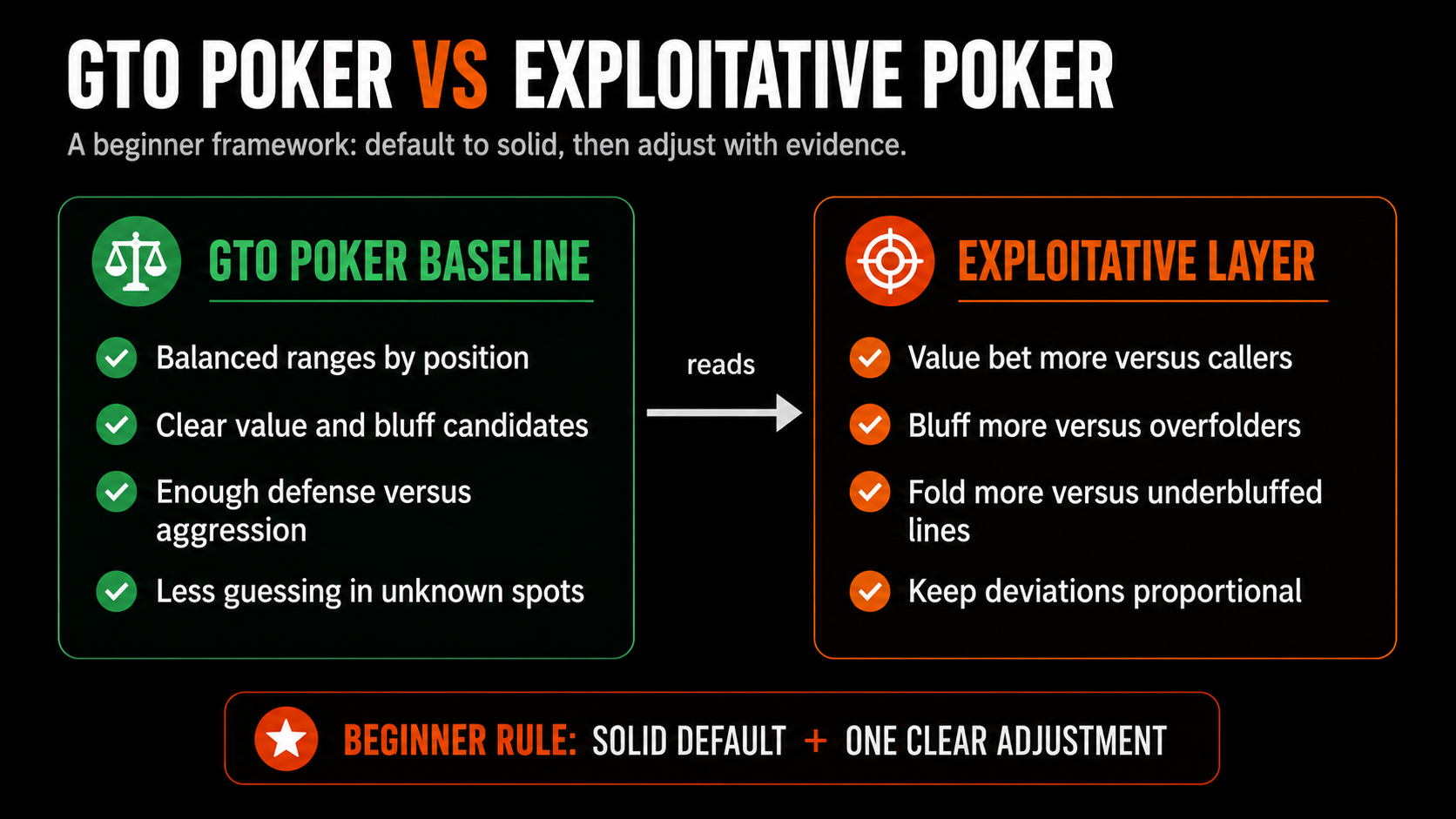
The practical answer is simple but not lazy: beginners should use GTO Poker as their default map, then make small exploitative adjustments when the opponent gives clear evidence. You do not need to copy every solver mix. You also should not ignore obvious mistakes just because a chart says one hand is mixed at equilibrium.
Think of GTO as your baseline. It tells you what a reasonable range looks like, which hands can bet for value, which hands can bluff, and how often a line should exist in theory. Think of exploitative poker as your adjustment layer. It tells you what to change when a real opponent folds too much, calls too much, bluffs too little, or uses sizing tells.
This distinction matters because beginners usually make two opposite mistakes. Some try to play "pure GTO" without understanding ranges, pot odds, or position. Others try to exploit every opponent with no baseline, which often turns into guessing. The winning beginner approach is tighter: learn the baseline, observe the mistake, make one clear adjustment, then check whether it keeps working.
What GTO Poker Actually Means
GTO stands for Game Theory Optimal. In poker conversation, it usually means a balanced strategy that is difficult or impossible for opponents to exploit when executed correctly. GTO Wizard defines the idea around game theory and equilibrium: if both players are at equilibrium, one player cannot simply change strategy and gain extra expected value.
That does not mean a beginner must memorize a solver output. Real no-limit hold'em has too many stack depths, positions, bet sizes, board textures, and opponent types for that to be realistic. For your purposes, GTO Poker is a way to understand what a solid default strategy is trying to protect.
A GTO-inspired strategy asks questions like:
- What hands are in my range after I take this line?
- Which strong hands do I bet, check, raise, or call?
- Which weak hands make the best bluffs?
- Which medium-strength hands should avoid building the pot?
- How often should I fold so opponents cannot profit by bluffing any two cards?
That last question is important. If you fold every time you face pressure, opponents can bluff too much. If you call every time, opponents can stop bluffing and value bet you relentlessly. GTO thinking helps you avoid those extreme leaks.
The beginner version is not about randomizing perfectly between bet and check with A-Q suited on a specific turn. It is about building reliable habits. Open reasonable hands by position. 3-bet strong hands and selected bluffs. Continuation bet more on boards that favor your range. Defend enough against common aggression. Avoid calling down just because you hate folding.
GTO Poker also gives you a language for study. Instead of saying, "I felt like he had it," you can ask whether your range needed to defend, whether your blockers mattered, whether your hand was too strong to fold, and whether the opponent's line was likely underbluffed.
What Exploitative Poker Means
Exploitative poker means changing your strategy to attack a specific opponent mistake. PokerCoaching describes exploitative play as using a GTO range or baseline, then adjusting based on what you observe. That order matters. You start with a reasonable default, then move away from it because you have a reason.
Examples are everywhere in low-stakes games:
- A player folds to every flop c-bet unless they have top pair or better.
- A loose caller refuses to fold any pair to a small or medium bet.
- A tight player opens under the gun once per hour and always has a premium.
- A recreational player min-raises the river only with the nuts.
- A frustrated regular 3-bets too wide from the blinds after losing a pot.
Against those opponents, balance is not always the highest-profit response. If someone never bluffs the river, you should fold more marginal bluff-catchers than a solver would. If someone calls any pair, you should value bet thinner and bluff less. If someone overfolds to 3-bets, you can 3-bet more hands that are slightly too weak in theory.
Exploitative poker is not "play however you feel." It is targeted. You identify a leak, choose the adjustment that attacks that leak, and keep the adjustment proportional to your confidence.
GTO Wizard's exploitative-dynamics framework is useful for beginners because it separates the process into clear steps: know the equilibrium shape, make a read, identify the exploit, and decide how far to deviate. You can simplify that at the table:
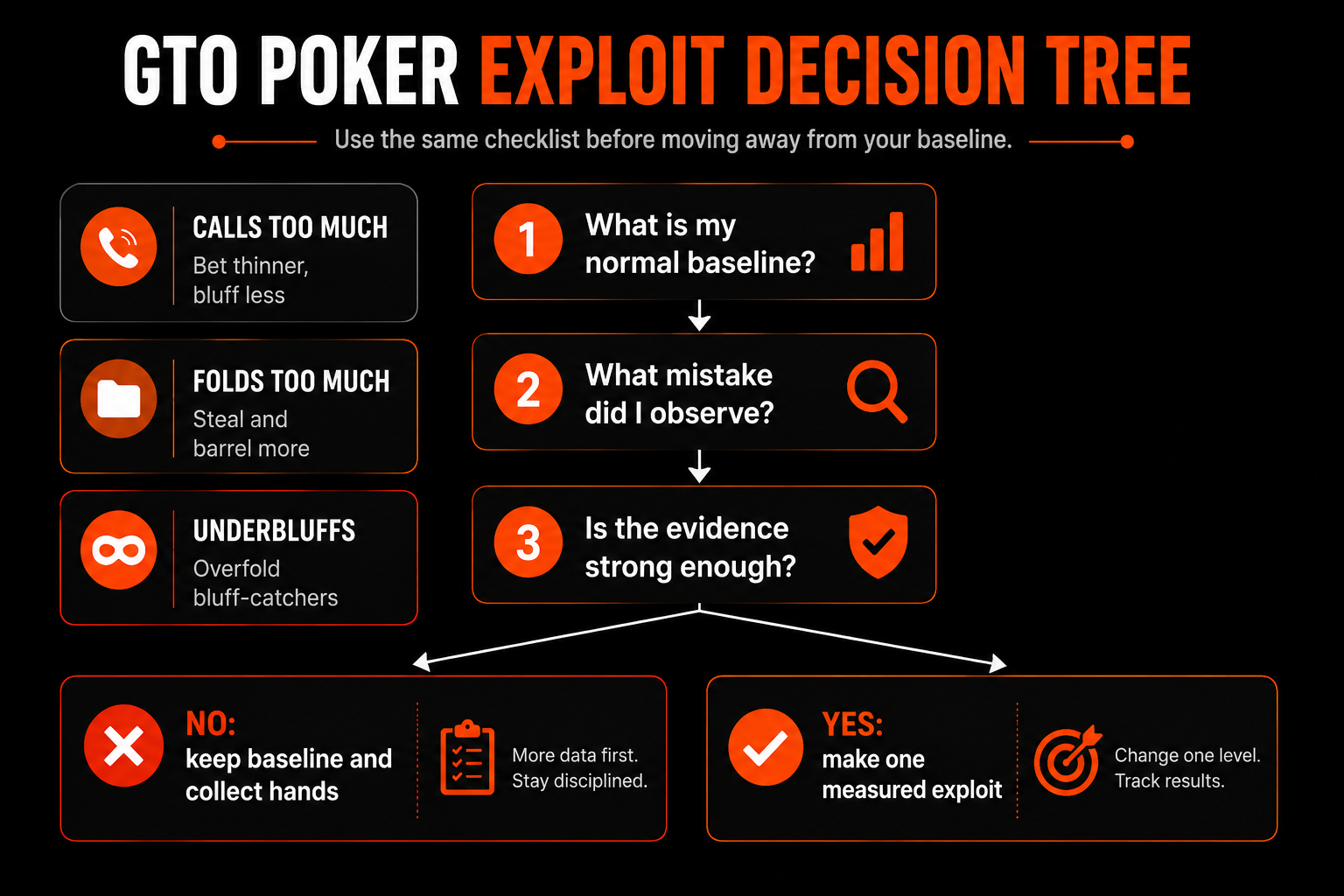
- What would my normal strategy do?
- What is this opponent doing wrong?
- What adjustment profits from that mistake?
- How sure am I?
The fourth question prevents disaster. A one-hand read is not enough to rebuild your whole strategy. If a player folds once to a river overbet, that does not prove they overfold rivers. If they fold five similar river spots and complain about "always being beat," now you have evidence.
The Beginner Answer: Use GTO Poker as Your Baseline
Beginners should not choose between GTO Poker and exploitative poker as if they are separate identities. Your best default is a simplified GTO-inspired strategy, with exploitative changes layered on top.
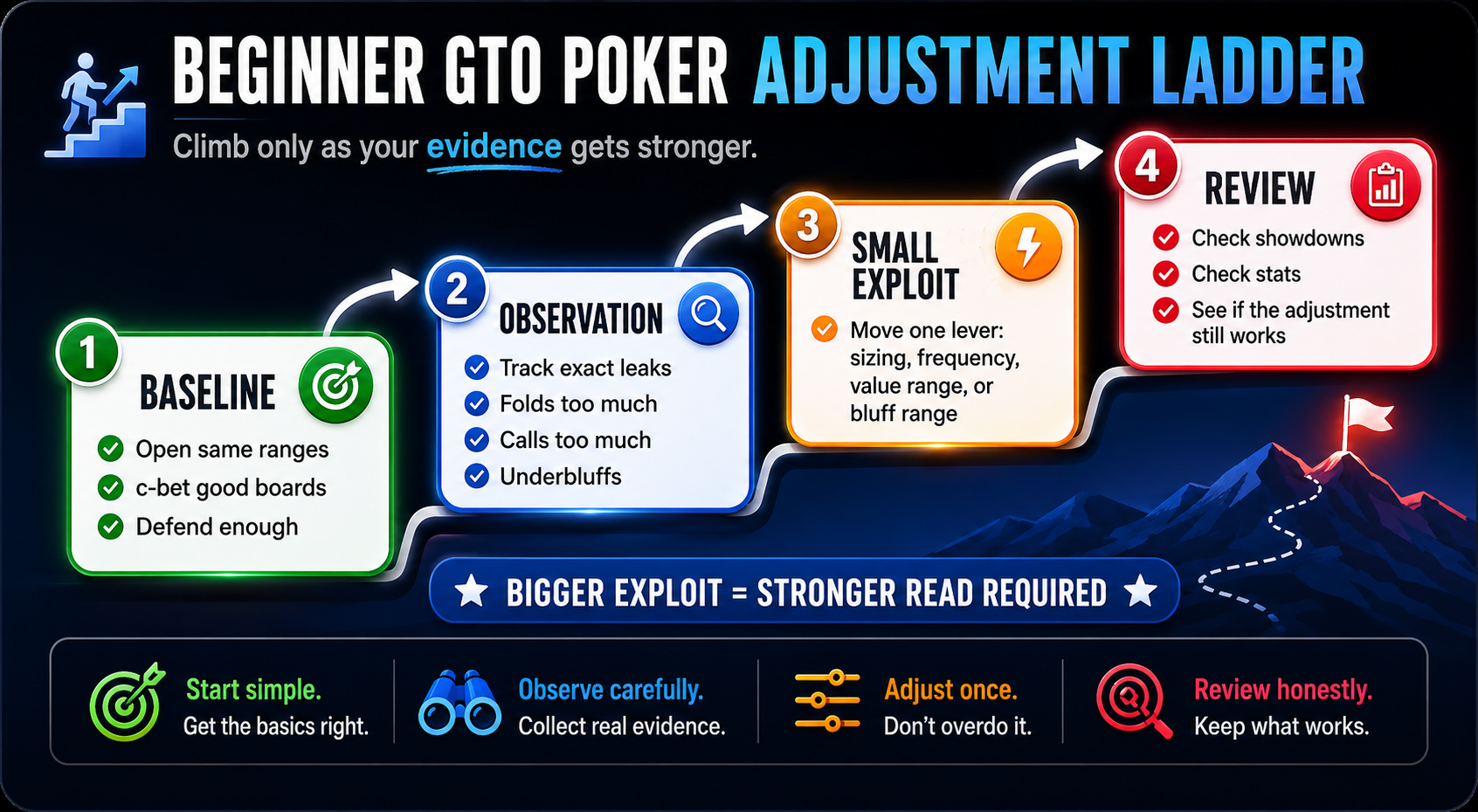
This baseline protects you from the biggest beginner leaks. You stop opening random hands from early position. You stop calling too many 3-bets out of position. You stop bluffing rivers with hands that block folds and unblock calls. You stop folding every medium-strength hand because a confident opponent bet big.
Then, once you see a real mistake, you adjust. Not with a wild personality change, but with one lever at a time.
If the big blind overfolds to button opens, open the button wider. If the big blind calls too much and plays fit-or-fold after the flop, open a strong value-heavy range and c-bet good boards. If a player never folds to flop c-bets, stop auto-c-betting weak air and start betting more thin value.
This approach works because low-stakes opponents are rarely balanced. Upswing Poker makes the point that a true GTO approach can pass up maximum value when opponents have major leaks. That is especially relevant at beginner stakes, where players overcall, underbluff, limp too often, size bets by hand strength, and fail to protect checking ranges.
Still, the baseline is not optional. Without it, your "exploit" may just be another leak. For example, suppose you decide a player "folds too much," so you start bluffing every river. If the board and line heavily favor their range, or if your own range has too few value hands, you may be lighting money on fire. A GTO Poker baseline tells you which bluff candidates are reasonable before you increase frequency.
The beginner rule is this: default to solid, then deviate with evidence.
Why Pure GTO Poker Is Too Much for Most Beginners
Pure GTO Poker is not a realistic beginner goal. Even strong players do not reproduce full solver outputs perfectly in live hands. Solvers use exact ranges, exact bet sizes, exact stack depths, and exact node assumptions. Your opponents limp, overcall, misclick, talk, tilt, and use sizes no preflop chart expected.
The first beginner problem is cognitive load. If you try to remember every mixed strategy, you will miss the basics. You might know that a solver sometimes checks top pair on a dry board, but still open K-9 offsuit under the gun. That is backwards. Preflop discipline, position, value betting, and pot control matter more at the start.
The second problem is false precision. A solver output is only as good as the game tree and ranges you give it. If the solution assumes a competent opponent with a reasonable big blind defense range, it may not fit a player who calls every suited hand and never check-raises without two pair. Treating that spot as "GTO says" can hide a missed exploit.
The third problem is implementation. GTO often uses mixed actions: bet one size with part of a hand class, check another fraction, and raise specific combos. Beginners who copy the surface of this strategy often randomize in spots where they do not understand why the actions mix. You need the principle first. Is the hand pure value? Is it a bluff? Is it a bluff-catcher? Does it need protection? Does it block the opponent's folds?
The fourth problem is table selection. At micro-stakes, low-stakes live games, beginner tournaments, and casual home games, many opponents make large mistakes. Playing a balanced strategy will usually do fine, but it may leave value behind. If a player calls too many river bets, the profitable adjustment is not to maintain a perfect bluffing ratio. It is to value bet more hands and reduce bluffs.
So study GTO Poker, but do not worship the output. Use it to understand ranges, thresholds, and incentives. Then make practical decisions against the people actually in the pot.
Why Pure Exploitative Poker Gets Beginners in Trouble
Pure exploitative poker has the opposite danger. It feels practical, but without a baseline it can become guesswork dressed up as confidence.
A beginner may say, "This player is loose, so I should bluff more." That is often wrong. Loose players usually call too much, which means you should bluff less and value bet more. Another beginner may say, "This player is tight, so I should never pay them off." That can be correct against a true underbluffer, but it can be expensive if the tight player is capable of selecting natural bluffs.
The risk is that every adjustment opens you up to counter-adjustment. If you overfold because someone "always has it," a thinking opponent can start bluffing you. If you 3-bet too wide because a player folded twice, they can 4-bet you or call in position and punish weak ranges. If you value bet thinly into a player who is not actually a station, you turn medium-strength hands into donations.
Exploitative poker also requires accurate observation. Live reads can be noisy. Online HUD stats need sample size. A player with a 75 percent fold-to-c-bet stat over four opportunities has not proved much. A player with the same pattern over 80 relevant spots is different. PokerTracker's HUD documentation is useful here because it shows how tracking software turns observed hands into statistics, but those statistics still require interpretation.
Beginners should avoid broad labels. "Fish," "nit," "maniac," and "reg" are too vague. Better notes are specific:
- "Called flop and turn with second pair versus large bets."
- "Checked back top pair on wet flop in position."
- "River raise shown down as two pair or better twice."
- "Folded big blind to button steal five of last six opportunities."
- "C-bets small almost every flop, then gives up turn."
Specific notes create specific exploits. Vague labels create ego-driven mistakes.
GTO Poker Spots Beginners Should Learn First
You do not need to solve every node. Start with the spots that appear constantly and create the most expensive beginner errors.
Preflop ranges by position
Preflop is the cleanest place to use GTO Poker as a baseline. Learn which hands open from early position, hijack, cutoff, button, small blind, and big blind. Then learn how those ranges change facing a raise or 3-bet.
You do not need 20 charts at once. Start with a conservative open-raise chart and a simple 3-bet plan. Your early-position range should be tight. Your button range can be wider. Your small blind should not complete random trash just because it is cheap.
The exploitative layer is easy. If the blinds fold too much, widen late-position opens. If players behind 3-bet aggressively, tighten the weakest opens and prepare more 4-bet responses. If a tight opener raises under the gun, do not defend the same range you would defend against a button steal.
Flop continuation betting
Flop c-betting is where many beginners burn money. A GTO-inspired baseline asks whether the board favors your range, whether you have a nut advantage, and whether your hand benefits from betting.
On A-K-4 rainbow after you raise from early position and the big blind calls, your range has many strong ace and king hands. Betting small often makes sense with a high frequency. On 9-8-7 two-tone, the big blind has many more connected hands, two pairs, straights, and draws. You should check more often and be careful with overpairs.
The exploit is opponent-dependent. Against fit-or-fold players, c-bet more often on boards where they miss. Against calling stations, bluff less and value bet hands like top pair, overpairs, and strong draws more aggressively. Against check-raise-heavy players, check back medium hands and build a better continue range.
River bluff-catching
River decisions are expensive because no more cards are coming. GTO Poker helps you understand minimum defense, blockers, and range strength. If you fold too much, bluffs print. If you call too much, value bets print.
For beginners, the main exploit is population-based: many low-stakes players underbluff large river bets, especially after passive lines. That does not mean fold every time. It means you should be cautious with bluff-catchers that do not block value or unblock bluffs.
For example, you call a raise in the big blind with Q-J suited. The board runs Q-8-4-2-7. You check-call flop and turn. A passive opponent overbets river. In theory, top pair may sometimes defend depending on ranges, suits, and blockers. Exploitatively, against a player who has not shown big bluffs and uses large river bets only with strong hands, folding can be the best beginner adjustment.
Exploitative Adjustments Beginners Should Actually Make
The best beginner exploits are simple, common, and low-risk. They do not require guessing at complex solver branches.
First, value bet more against callers. If an opponent hates folding pairs, stop trying to make them fold. Bet top pair for value. Bet overpairs. Bet good second pairs in clean spots. Choose sizes they will call. If they call any pair for half pot but fold weak hands to an overbet, your exploit may be betting medium size more often, not always going huge.
Second, bluff less against calling stations. This sounds obvious, but many beginners cannot resist telling the story. The story does not matter if the opponent does not listen. If they call flop with bottom pair, call turn with bottom pair, and sigh-call river with bottom pair, do not fire three barrels with ace-high just because your range can have overpairs.
Third, fold more against underbluffed lines. At many low-stakes tables, river raises are too value-heavy. Limp-reraises are too value-heavy. Turn check-raises from passive players are too value-heavy. When the pool is not finding enough bluffs, you can overfold your weakest bluff-catchers.
Fourth, steal more against overfolders. If the blinds give up too easily, button and cutoff opens become more profitable. If a player folds too much to 3-bets, add more suited wheel aces, suited broadways, or blocker-heavy hands as bluffs. Keep it measured. You are widening, not declaring war.
Fifth, isolate limpers with hands that dominate their range. If a player limps too many weak hands and calls raises, raise larger with value and strong playable hands. Do not isolate with junk just because they are weak. Your edge comes from playing better hands in position against worse hands, not from building bloated pots with 8-3 suited.
Sixth, respect tight aggression. If a player has been passive for two hours and suddenly raises turn on a dry board, you do not need a heroic call with one pair. Your baseline may defend some bluff-catchers against a balanced opponent. Your exploit can fold more when this specific opponent is unlikely to bluff.
A Hand Example: Baseline First, Exploit Second
Suppose you are playing $1/$2 live cash, $300 effective. A loose-passive player limps under the gun, two players fold, and you are in the cutoff with A-Q offsuit.
Your GTO Poker baseline says this hand is far ahead of a limp range and wants to raise for value. You make it $15 because live limpers call too much and smaller raises invite multiple callers. The button folds, blinds fold, and the limper calls.
The flop is Q-7-3 rainbow. Pot is $33. Villain checks.
Baseline: you have top pair top kicker on a dry board against a wide range. Betting for value is clear. You do not need to slow-play. You bet $20. Villain calls.
The turn is 9, adding a backdoor flush draw. Pot is $73. Villain checks.
Baseline: A-Q is still a strong value hand. Some worse queens, 9-x floats, 7-x, pocket pairs, and draws can call. You bet $50. Villain calls again.
The river is 2. Pot is $173. Villain checks.
Now use the exploit. Against a balanced opponent, you would consider your value threshold and sizing carefully. Against this specific loose-passive player, the read is that they call too much and rarely check-raise bluff. You can value bet. A smaller size may get paid by Q-J, Q-T, 7-x, 9-x, or stubborn pocket pairs. You bet $75.
If villain check-raises all-in, the exploit changes. Loose-passive players do not usually turn worse pairs into river bluffs after check-calling twice. Your top pair top kicker becomes a hand that can bet-fold. That is the full beginner framework in one hand: baseline for the normal line, exploit for the opponent's mistake, discipline when new information arrives.
How to Study GTO Poker Without Getting Lost
A beginner study routine should connect solver concepts to hands you actually play. Do not spend your first month memorizing rare river overbet nodes. Spend it building a repeatable study loop.
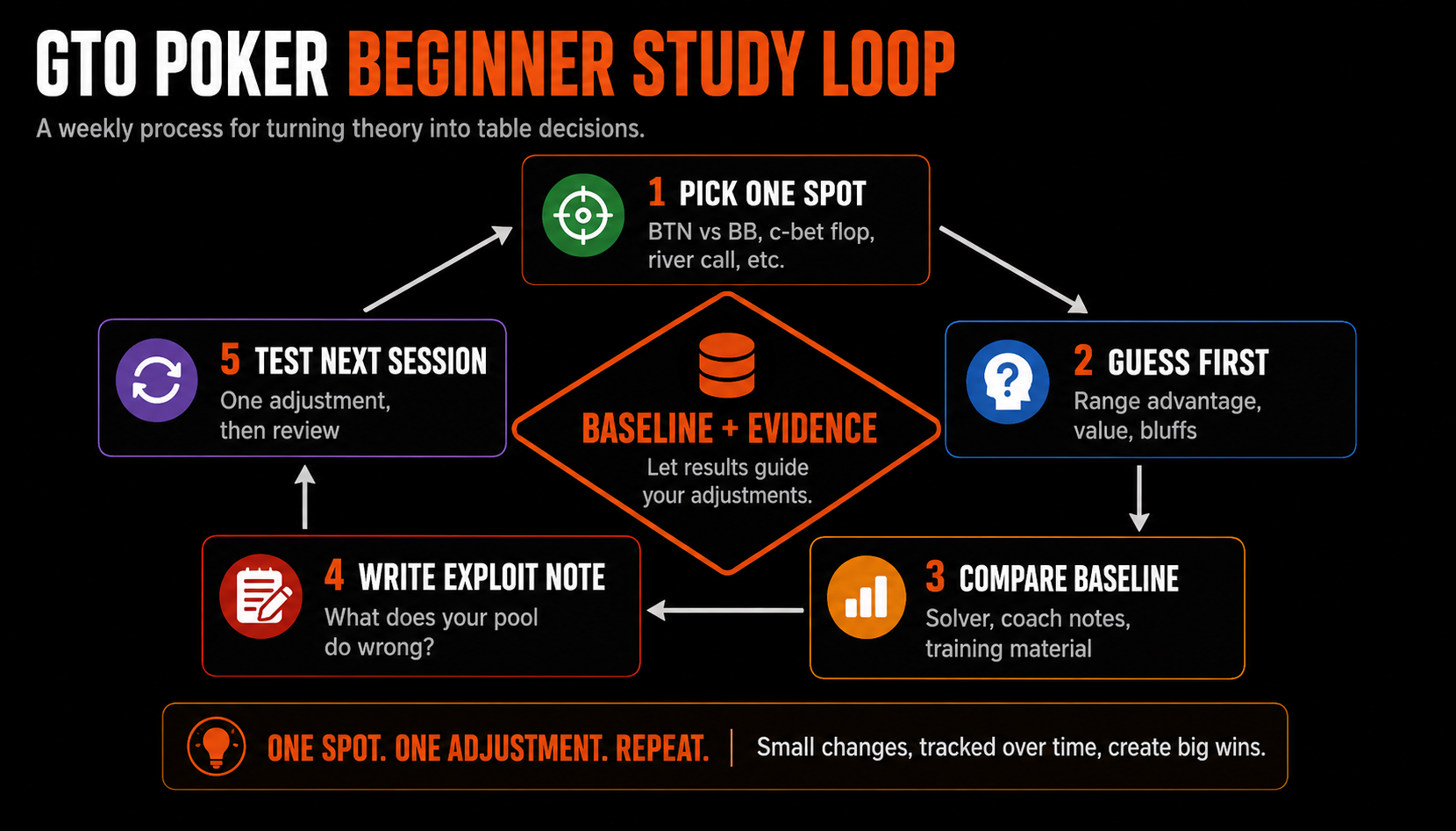
Start with one common spot each week. For example:
- Button open versus big blind call, single-raised pot.
- Big blind defense versus cutoff open.
- Flop c-bet as preflop raiser on ace-high boards.
- Turn barrel decisions after flop c-bet gets called.
- River bluff-catching versus large bet.
Review five to ten hands from that spot. Before checking a solver or training tool, write your guess:
- Which range has the advantage?
- Which hands are clear value bets?
- Which hands are natural bluffs?
- Which hands prefer checking?
- What does the opponent pool usually do wrong?
Then compare your answer to a GTO solution or high-quality training material. You are not looking only for the exact action. You are looking for the reason. If the solver bets range for small size on one board but checks often on another, ask what changed. High-card boards, paired boards, monotone boards, and connected low boards distribute equity differently.
Finally, write one exploit note. For example: "Population overfolds to turn barrel on A-high dry boards after calling flop too wide." Or: "Pool underbluffs river check-raise line." These notes turn GTO Poker from theory into table decisions.
[INTERNAL: solver study for beginners]
Online Database Review: When Exploits Become Evidence
If you play online and use tracking software where allowed, your database can help separate real exploits from stories. PokerTracker's official HUD guide explains that a HUD displays statistics based on imported hand histories. That can include common stats such as VPIP, preflop raise, aggression, and many custom stats depending on configuration.
For beginners, keep your review simple. Look for stats and filters that answer direct strategic questions:
- Are you opening too loose from early position?
- Are you folding the big blind too much against button opens?
- Are opponents folding too much to your flop c-bets?
- Are you losing too much when calling river bets?
- Are specific players overfolding to 3-bets or calling them too often?
Sample size matters. VPIP and PFR become useful faster because they occur preflop every hand. River raise bluff frequency takes far longer because the spot happens rarely. Do not make a massive exploit from a tiny sample.
A good beginner database workflow is:
- Pick one stat or line.
- Filter for hands where it happened.
- Review showdowns and bet sizes.
- Compare to your baseline.
- Make one adjustment for the next session.
For example, suppose your database shows a regular folds to flop c-bets 62 percent across a meaningful sample, but folds to turn barrels only 32 percent after calling flop. Your exploit is not "triple barrel constantly." It may be c-bet more one-and-done bluffs on favorable flops, then slow down when called unless you improve or have excellent blockers.
The same logic applies to your own leaks. If you are calling too many river bets and losing, do not simply become a nit. Review which lines are underbluffed, which hands had bad blockers, and whether you arrived at the river with too many weak hands in the first place.
[INTERNAL: hand history review process]
Live Poker Reads: Useful, But Keep Them Specific
Live poker gives you information that online stats do not. You can see who watches hands, who protects their cards, who talks when strong, who freezes when bluffing, who buys in short, who splashes chips, and who seems emotionally attached to pots. But beginners often overrate these reads.
The safest live reads are betting-pattern reads and showdown reads. If a player shows down a weird hand, write down the line. Did they limp-call K-4 suited under the gun? Did they call a pot-sized turn bet with bottom pair? Did they check back the nut flush on a scary river? Did they raise small with a set on a wet board?
Those details are more useful than "he looked nervous." Physical tells can matter, but they are unreliable until you have a baseline for that person. Betting lines are more repeatable.
Here are practical live exploits:
- Against players who limp-call too much, raise bigger for value in position.
- Against players who continuation bet once and give up, call more flops in position with hands that can take the pot away on turns.
- Against players who never bluff river, fold marginal bluff-catchers.
- Against players who bet tiny with weak pairs, raise more value and selected bluffs on boards where they cannot continue.
- Against players who overvalue top pair, stop slow-playing strong hands.
Use GTO Poker to keep yourself honest. If your live read tells you to make a huge fold, ask whether the line is truly underbluffed and whether your hand blocks value or bluffs. If your live read tells you to bluff, ask what better hands fold and whether your story contains enough value hands.
Beginner Mistakes in the GTO vs Exploitative Debate
The first mistake is using "GTO" as a synonym for good. A play can be solver-approved in one configuration and bad in your game. Stack depth, rake, positions, antes, bet sizes, and ranges all matter.
The second mistake is copying outputs instead of learning concepts. If you know a solver mixes a hand but do not know whether it is value, bluff, protection, or showdown value, you have not learned the spot yet.
The third mistake is over-adjusting from weak evidence. One showdown can create a hypothesis. It should not create a permanent player profile unless the action is extreme. If someone calls too loose once, watch for repetition before making big deviations.
The fourth mistake is making exploits that contradict the read. If the opponent calls too much, bluff less. If the opponent folds too much, bluff more. If the opponent underbluffs, fold more. If the opponent overbluffs, call more. Keep the relationship clean.
The fifth mistake is failing to notice counter-adjustments. If you steal every button because the blinds are tight, they may start defending. If you keep folding river, a capable opponent may bluff more. If you keep betting thin, observant players may check-raise more. Low-stakes players adjust slowly, but some do adjust.
The sixth mistake is forgetting rake. In high-rake games, marginal calls and tiny edges shrink. A solver solution for one rake environment may not transfer cleanly to another. Beginners should generally avoid loose, marginal, out-of-position calls unless there is a strong exploitative reason.
A Practical Session Plan for Beginners
Before your next session, choose one GTO Poker baseline and one exploit you are allowed to make.
For example:
- Baseline: open tighter from early position and wider from the button.
- Exploit: if the blinds overfold, widen button opens by one hand class.
Or:
- Baseline: c-bet less often on low connected boards.
- Exploit: if a player folds too much to small flop bets, c-bet more frequently heads up in position.
Or:
- Baseline: value bet top pair and better against loose ranges.
- Exploit: against calling stations, add thin river value and remove most bluffs.
This keeps your learning focused. You are not trying to become a solver in one night. You are building a baseline, testing one read, and reviewing results.
After the session, write down three hands:
- One hand where you followed the baseline.
- One hand where you made an exploit.
- One hand where you were unsure.
For each hand, ask what you knew and what you guessed. The goal is not to prove you were right. The goal is to make your future decisions more structured.
[INTERNAL: bankroll and study plan for low stakes]
Take Action Now
If you are a beginner, do not frame GTO Poker and exploitative poker as rivals. Build your default strategy from GTO Poker principles, then attack clear opponent mistakes with simple, measured exploits. That combination gives you a stable floor and still lets you win extra money from players who call too much, fold too much, bluff too little, or play face-up lines.
Start with one spot this week. Learn the baseline. Watch for one common population mistake. Make one adjustment. Review the hand afterward. That is how GTO Poker becomes a practical strategy instead of a buzzword.
Frequently Asked Questions
Should beginners learn GTO Poker first?
Yes, but beginners should learn simplified GTO Poker concepts first, not full solver trees. Start with position, preflop ranges, range advantage, value thresholds, bluff selection, and river defense. Those ideas create a stable baseline for every exploit you make later.
Is exploitative poker better at low stakes?
Exploitative poker often makes more money at low stakes when opponents have clear leaks. The catch is that you need a baseline to know what you are deviating from. Without that baseline, exploitative poker can become guessing.
Can I beat beginners by playing only GTO Poker?
You can often do well with a solid GTO-inspired strategy because many opponents make mistakes against balanced ranges. But if someone is obviously calling too much or bluffing too little, refusing to adjust leaves money on the table.
How do I know when my read is strong enough to exploit?
Look for repeated evidence from similar spots. Three to five consistent observations can justify a small adjustment. Larger deviations need stronger evidence, better sample size, or a very clear showdown pattern.
What is the easiest exploit for a beginner to use?
The easiest exploit is value betting more against players who call too much and bluffing less against them. It is simple, common, and low-risk. You still need hand-reading discipline, but you do not need advanced solver work to apply it.