Continuation Bet Poker: C-Betting Explained, When to Bet the Flop, and When to Check Back
Continuation Bet Poker: C-Betting Explained, When to Bet the Flop, and When to Check Back
Continuation Bet Poker strategy starts with a simple idea: if you raised before the flop, you often get the first chance to keep telling that story on the flop. The hard part is knowing when that story is believable, profitable, and protected. A good c-bet is not a reflex. It is a bet that uses your range, position, hand class, board texture, and opponent tendencies to make the next decision easier.
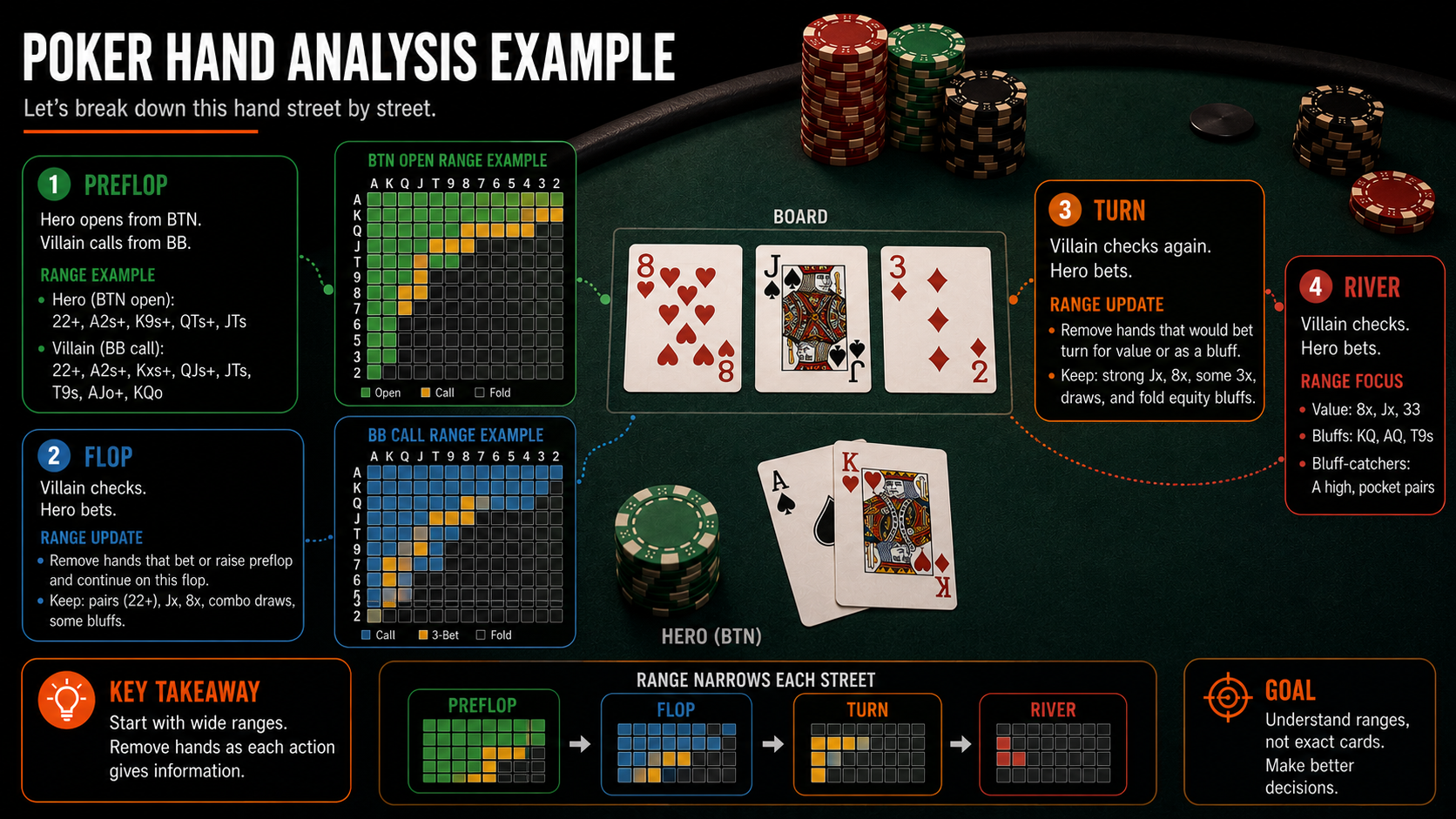
Most players learn c-betting backwards. They ask, "Did I hit the flop?" That question matters, but it is too narrow. You can miss the flop and still have a profitable bluff. You can flop top pair and still check because your hand performs better as a protected check-back. You can have ace-high and bet a dry king-high board because your range crushes the caller. You can have an overpair on a low connected board and still slow down because the caller has more two pair, sets, straights, and strong draws than you want to face.
This guide gives you a practical framework for flop c-bets in No-Limit Hold'em single-raised pots. The goal is not to memorize solver frequencies. The goal is to make cleaner decisions in the spots that come up every session: button versus big blind, cutoff versus button, early position versus big blind, and the awkward out-of-position pots where automatic c-betting burns money.
Continuation Bet Poker Basics: What a C-Bet Is Actually Trying to Do
A continuation bet is a bet made by the preflop aggressor on the next street, most commonly when the raiser bets the flop after getting called preflop. That definition is useful, but it does not explain why the bet wins money. A c-bet works when it pressures the hands your opponent must fold, gets value from worse hands, denies equity to hands that can improve, or sets up profitable turn and river barrels.
Think of every flop bet as having at least one primary job. With KQo on K-7-3 rainbow after you open the button and the big blind calls, the job is value and protection. You expect worse kings, sevens, pocket pairs, ace-high floats, and backdoor hands to continue often enough. With A5s on K-8-2 rainbow in the same formation, the job is fold equity and range pressure. Your exact hand may not be strong, but your range contains more strong king-x and premium pairs than the big blind's defending range.
The mistake is forcing every hand into "value" or "bluff" without considering the whole range. Some bets are thin value plus equity denial. Some checks are not give-ups; they are pot control, bluff-catching setup, or range protection. When you check back AQs on J-7-4 rainbow, you may be preserving showdown value and keeping weaker ace-high hands in the pot. When you check back top pair on a dynamic board, you may be preventing a check-raise from turning your hand into a guessing game.
The best c-bet decisions answer four questions before chips go in:
- Who has the range advantage?
- Who has the nut advantage?
- Who benefits from position?
- Which hands need to bet, and which hands prefer to realize equity?
If those questions point in the same direction, your decision becomes straightforward. If they conflict, you need a more selective strategy.
Range Advantage and Board Texture Drive the Flop Decision
Range advantage means one player's entire range has more equity or more strong hands on a board. Nut advantage means one player has more of the very strongest hands: sets, two pair, straights, and premium overpairs. You can have a range advantage without a nut advantage, and that difference matters.
Suppose you open the button and the big blind calls. The flop is K-8-2 rainbow. You have more Kx, AA, QQ, JJ, and broadway strength. The big blind has some strong hands, but a lot of their range is weak pairs, suited connectors, suited gappers, and offsuit hands that defended because of pot odds. This is the classic small c-bet spot. A one-third-pot bet applies pressure to many weak hands while risking little.
Now change the flop to 7-6-5 with two suits. You still have overpairs and some strong hands, but the big blind has more 87, 76, 65, 54, sets, open-ended straight draws, pair-plus-draw hands, and suited combinations that connect hard. Your preflop aggression no longer gives you permission to bet everything. If you c-bet range here, you expose yourself to check-raises and calls from hands with plenty of equity.

Dry, high-card boards usually reward frequent small bets by the preflop raiser. Low, wet, connected boards usually require more checking, especially when the caller's range contains many suited and connected hands. Paired boards can go either way. A72 rainbow, KK4, and 883 are often good for small bets because the caller has trouble connecting strongly, but you still need to account for who has more trips, sets, and sticky pairs.
Board texture also changes how your hand class performs. A hand like AQ with no pair is a strong candidate to bet on K-7-2 rainbow because it blocks strong continues and has overcard equity. The same AQ on 9-8-7 two-tone is a poor automatic c-bet because it has little equity, poor blockers, and limited barrel potential. JTs with a backdoor flush draw may be a better bluff than ace-high on some boards because it can turn more profitable semi-bluff cards.
Use this shortcut in real time: if your opponent's calling range contains many hands that now have pair-plus-draw, two pair, sets, or strong draws, reduce your c-bet frequency. If your range contains most of the overpairs, top pairs, and high-card pressure while villain has many misses, bet more often and usually smaller.
Continuation Bet Poker in Position: When You Can Bet More Often
Position lets you see what your opponent does before you act on later streets. That information edge makes your flop c-bets more powerful. When you are in position as the preflop raiser, you can often bet a wider range, control pot size more easily, and check back hands that want to reach turns.
Button versus big blind is the clearest example. You open the button, the big blind calls, and the flop comes Q-6-2 rainbow. You can usually apply pressure with a small bet at high frequency. Your range has the premium pairs, many queens, and broadway overcards. The big blind has plenty of hands that missed or made weak one-pair holdings. A small c-bet forces those hands to continue wide or surrender immediate equity.
But "bet more often in position" does not mean "bet every hand in position." The best in-position c-bet strategy still separates hands into useful groups.
Hands That Usually Want to Bet
Strong value hands want to build the pot. Top pair good kicker, overpairs, sets, two pair, and strong draws usually benefit from betting. On Q-9-4 with a flush draw, KQ, AQ, QQ, 99, 44, JT, T8s, and nut flush draws are natural betting candidates. They can get called by worse or continue profitably when raised.
Good bluffs usually have equity, blockers, or barrel potential. A5s on K-8-2 rainbow blocks some ace-high continues and can turn wheel equity. JTs on Q-7-3 with a backdoor flush draw can turn straight or flush possibilities. These hands are better than random air because they give you profitable turn cards.
Hands That Often Prefer to Check Back
Medium-strength hands often make more money by checking. Second pair, weak top pair, underpairs, ace-high with showdown value, and hands that cannot handle a check-raise are frequent check-back candidates. If you bet J9 on J-8-5 two-tone and face a check-raise, your hand is suddenly uncomfortable. Checking protects your equity and keeps your opponent's worse hands in.
Checking back also strengthens your future range. If you only check with garbage, alert opponents can attack turns whenever you decline to c-bet. If your check-back range includes hands like second pair, some top pair, ace-high, slowplayed overpairs, and occasional traps, your opponent cannot automatically probe every turn.
The practical in-position rule is this: bet often on boards that favor your range, but do not bet hands that are mostly trying to realize equity and avoid a bloated pot. A protected check-back range is not weakness. It is how you prevent your flop strategy from becoming transparent.
When to Check Back Instead of C-Bet
Checking back is correct more often than many aggressive players want to admit. You check back when betting accomplishes too little, when your hand realizes equity well, when the board favors the caller, when your opponent check-raises too often, or when your range needs protection.
Start with medium showdown value. If you open the cutoff with AJs, the big blind calls, and the flop is T-7-4 rainbow, your ace-high may be too strong to bluff and too weak to value bet. Betting may fold out worse hands and get called by better hands. Checking back keeps dominated ace-highs, king-highs, and weak draws in the pot while letting you realize your equity.
Next look at vulnerable but non-premium pairs. You open button with 88, big blind calls, and the flop is J-6-3 rainbow. You can bet small sometimes, but checking back is attractive against opponents who check-raise aggressively or call flop and attack turns. Your hand has showdown value. It does not need to turn into a bluff. It can call many turns after checking back, especially on blanks.
Now consider boards that smash the caller. You open cutoff, the button calls, and the flop is 8-7-6 two-tone. Out of position against the button, you should be careful with much of your range. Even in position against the big blind, this board is not a license to blast every hand. The caller has a lot of suited connectors, two pair, pair-plus-draw, and straights. You can still bet strong value and strong draws, but your weakest hands can simply check.
Checking back also creates delayed c-bet opportunities. If you check flop and your opponent checks turn, many hands that were poor flop bets become profitable turn bets. For example, A5s on T-8-6 may check back flop. If the turn is a king and your opponent checks again, your range picks up stronger perceived hands and your opponent has shown less interest. A delayed c-bet can win the pot without exposing you to a flop check-raise.
The key is not to check only because you are scared. Check because your hand and range benefit from a turn card, because betting isolates you against better hands, or because the board does not support high-frequency pressure.
C-Betting Out of Position Requires a Tighter Plan
Out-of-position c-betting is where many players lose the most. You raise preflop, get called by the button or cutoff, and feel obligated to bet because you "have the initiative." The problem is that initiative does not erase position. When you are out of position, your opponent acts after you on every postflop street, controls more information, and can pressure your checks.
Imagine you open from the hijack with AKo and the button calls. The flop is T-8-5 with two hearts. You missed, the board hits suited and connected calling hands, and your opponent can float or raise profitably with many holdings. A c-bet may still be part of a mixed strategy, especially with backdoor equity, but automatic betting is a leak.
Out of position, you need stronger checking ranges. That means checking some overpairs, top pairs, strong draws, and ace-highs instead of putting every playable hand into the bet range. If your checks are always weak, the in-position caller can stab frequently and make your life miserable. If your checks include AA, top pair, sets at some frequency, and check-raise candidates, your opponent has to slow down.
Small bets can still perform well on boards where you retain a major range advantage. If you raise early position, the button calls, and the flop is A-7-2 rainbow, you have many strong Ax hands and premium pairs. A small c-bet is reasonable. If the flop is 6-5-4 two-tone, your overpairs are not enough to justify reckless betting because the caller has more natural straights, sets, two pair, and draws.
The out-of-position plan should be simpler and more defensive:
- Bet strong value that wants protection and can handle action.
- Bet draws that can continue versus raises or barrel many turns.
- Check medium hands that want showdown.
- Check some strong hands to protect your checking range.
- Give up more often with low-equity air on bad boards.
You do not need to prove you were the preflop raiser. You need to build a range that survives turn and river pressure.
Sizing: Small Range Bets, Larger Polar Bets, and Why One Size Fails
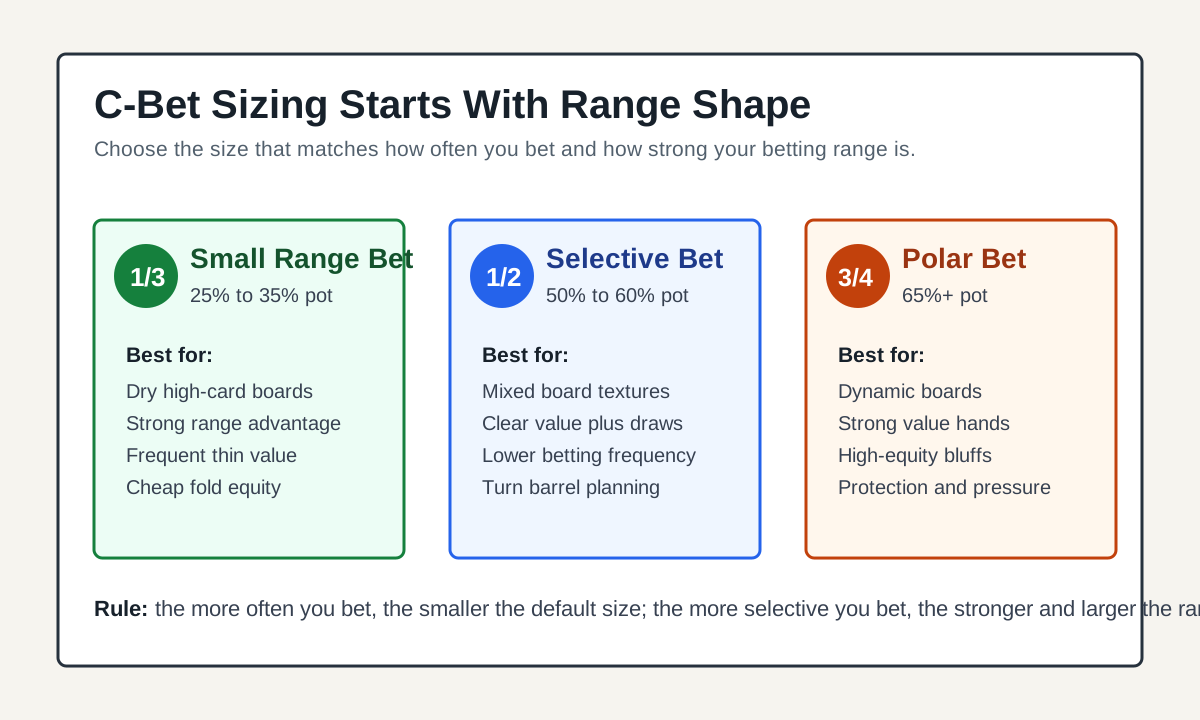
C-bet sizing should match your range and the board. Small bets work when you are betting frequently and your opponent has many weak hands that cannot comfortably continue. Larger bets work when your range is more polarized: strong value hands and bluffs with meaningful equity or blockers.
On K-8-2 rainbow after button opens and big blind calls, a one-third-pot c-bet makes sense. Your range advantage is strong, the board is dry, and you do not need a large bet to pressure 9-high, weak suited hands, and low pocket pairs. Betting small also lets you include more thin value and protection hands without risking too much.
On Q-J-9 two-tone, a small range bet is less appealing. Many hands have equity. The big blind or caller can continue with pairs, straight draws, flush draws, combo draws, and pair-plus-draw hands. If you bet, you may prefer a larger and more selective strategy with hands like sets, two pair, strong top pair, nut draws, and high-equity bluffs.
The sizing mistake at small and low stakes is using the same half-pot bet with everything. Half pot on every board is easy to play against. It gives up value when your strong hands want to punish draws, risks too much when a small bet would accomplish the job, and reveals that you are not thinking about range shape.
Use these sizing defaults as a starting point:
- Bet 25% to 35% pot on dry boards where you can bet frequently.
- Bet 50% to 75% pot when your betting range is stronger and more polarized.
- Bet larger on dynamic boards when value hands need protection and worse hands can still call.
- Check more often instead of forcing a big bet with hands that have medium showdown value.
Sizing is not just about the flop. A small flop bet can set up turn pressure because it keeps weaker hands in. A larger flop bet can reduce your opponent's continuing range and make later streets more polarized. Before you choose a size, ask what turn decisions you are creating.
The Bet or Check-Back Decision Tree
The easiest way to improve your c-bet decisions is to use the same checklist every time. It will not replace study, but it will stop the automatic button-clicking that creates most c-bet leaks.

First, identify the formation. Button versus big blind is not the same as under-the-gun versus button. Blind versus blind is not the same as cutoff versus big blind. Preflop ranges create postflop ranges. If you skip this step, you will misread the board.
Second, decide who has range and nut advantage. If both favor you, bet more often. If range favors you but nuts favor your opponent, use more caution. If both favor your opponent, check more often and protect your range.
Third, classify your exact hand. Strong value, strong draw, thin value, medium showdown, weak draw, or total air. Strong value and strong draws usually bet. Medium showdown often checks. Total air bets only when the board, blockers, and opponent tendencies make the bluff credible.
Fourth, consider opponent tendencies. Against a player who overfolds to flop c-bets, bluff more and value bet thinner. Against a player who never folds flop but overfolds turn, choose hands that can barrel good turns. Against a check-raise-heavy opponent, check back more medium hands and bet hands that can continue. Against a passive caller, bet value relentlessly and reduce low-equity bluffs.
Fifth, plan the turn. If you bet flop with A5s on K-8-2, what turns continue the story? A, 5, 3, 4, Q, and some backdoor flush cards may be good. If every turn feels terrible, your flop bet may be too optimistic.
This process sounds slow, but it becomes fast with repetition. At the table, you can compress it into one sentence: "This board favors my range, my hand benefits from betting, villain folds enough, and I have a turn plan." If you cannot say that, checking may be better.
Common Continuation Bet Poker Leaks to Fix
The first major leak is betting because you raised preflop. Initiative matters, but it is only one input. If you open from early position and the button calls, a low connected board may favor the caller's continuing range enough that checking is mandatory with many hands.
The second leak is c-betting too much multiway. This article focuses on heads-up pots because multiway strategy changes dramatically. When two or more players see the flop, the chance that someone connected increases, your fold equity drops, and your bluffs need to be more selective. A hand that is a profitable heads-up c-bet can become a clear check in a three-way pot.
The third leak is checking only when you miss. If your check-back range is all air, opponents can probe turns aggressively. Add medium pairs, ace-highs, some top pairs, and occasional slowplays to your checks. This makes your turn strategy harder to attack.
The fourth leak is betting medium hands that hate raises. Hands like second pair, weak top pair, and underpairs often perform better as checks. When you bet them and get raised, you either fold too much equity or call into a bad turn situation. Checking lets those hands realize equity and bluff-catch.
The fifth leak is choosing bluffs with no future. A good c-bet bluff can improve, block continues, or barrel useful turns. A random hand like 92s on Q-J-8 two-tone usually has none of that. You do not need to fight for every pot.
The sixth leak is ignoring population tendencies. If your pool overfolds to small flop bets, exploit it. If your pool calls flop too wide and folds turn too much, build a two-street plan. If your pool under-check-raises, value bet thinner. If a specific opponent is sticky and passive, stop firing low-equity bluffs and make them pay with value.
Study Workflow: How to Train Better C-Bets
You can improve c-betting quickly if you review hands by formation instead of by emotional outcome. Do not only mark the big pots. Mark the routine flop spots where you raised preflop, got called, and faced a decision. Those small pots add up.
Start with one common formation: button open versus big blind call. Filter hands where you had the opportunity to c-bet the flop. Sort by board texture: ace-high dry, king-high dry, paired boards, low connected boards, two-tone boards, monotone boards, and broadway connected boards. Look for patterns. Are you betting 80% on boards where you should slow down? Are you checking too much on dry high-card boards?
Next, tag your hand class. Strong value, top pair, second pair, underpair, ace-high, draw, backdoor draw, air. Many players discover they are betting too many medium hands and too few high-equity bluffs. Others find the opposite: they fire every backdoor hand but check too much thin value.
Then compare your decisions to solver outputs or trusted training material, but simplify the lesson. You do not need to copy an exact 63% frequency. You need a usable rule like, "On K-high rainbow boards button versus big blind, I can bet small very often," or, "Out of position on low connected boards versus button, I need a lot more checks."
Finally, build a one-week drill. For the next five sessions, pause on every flop c-bet spot and say the board category before acting. "Dry high card." "Low connected." "Paired disconnected." "Dynamic broadway." This small habit forces you to stop treating every missed flop the same.
For related study, add these internal review paths when the final site links are selected: [INTERNAL: postflop hand review process], [INTERNAL: range advantage in poker], and [INTERNAL: poker bet sizing strategy].
Frequently Asked Questions
What is a continuation bet in poker?
A continuation bet is a bet made by the player who was the aggressor on the previous betting street. In Hold'em, the most common version is when the preflop raiser bets the flop after getting called. The bet can be for value, as a bluff, for equity denial, or to set up later streets.
Should you always c-bet when you miss the flop?
No. You should c-bet some missed hands when the board favors your range, your hand has useful blockers or equity, and your opponent folds enough. You should check many misses on boards that connect with the caller's range, especially when you are out of position or have poor turn barrel options.
What is a good flop c-bet size?
A small size around 25% to 35% pot is common on dry boards where the preflop raiser can bet frequently. Larger sizes are better when your betting range is more polarized or the board is dynamic enough that value hands need protection. The best size depends on range advantage, board texture, position, and opponent tendencies.
When should I check back as the preflop raiser?
Check back when your hand has medium showdown value, when betting folds out worse and gets called by better, when the board favors the caller, or when your range needs protection. Good check-backs include many second pairs, underpairs, ace-highs, weak top pairs, and occasional strong hands that prevent your check range from being too weak.
Is a delayed c-bet a sign of weakness?
No. A delayed c-bet means you checked the flop as the preflop aggressor and bet a later street after your opponent checked again or the turn improved your range. It can be a strong strategic line because flop checks keep weaker hands in and create profitable turn bluff or value opportunities.
Take Action Now
Continuation Bet Poker decisions get easier when you stop asking only whether you hit the flop. Before your next session, choose one formation, one board category, and one leak to track. Bet when your range, hand class, position, and opponent read support the bet. Check back when your hand realizes equity better, protects your range, or avoids a bad check-raise. That discipline turns c-betting from an automatic habit into a repeatable postflop edge.