Best Poker Starting Hands by Position: Beginner-Friendly Preflop Chart
Best Poker Starting Hands by Position: Beginner-Friendly Preflop Chart
Poker Starting Hands are easier to learn when you stop asking, "Is this hand good?" and start asking, "Is this hand good from this position?" Pocket aces are strong anywhere. Ace-nine offsuit can be a raise on the button and a fold under the gun. The cards matter, but your seat matters just as much.
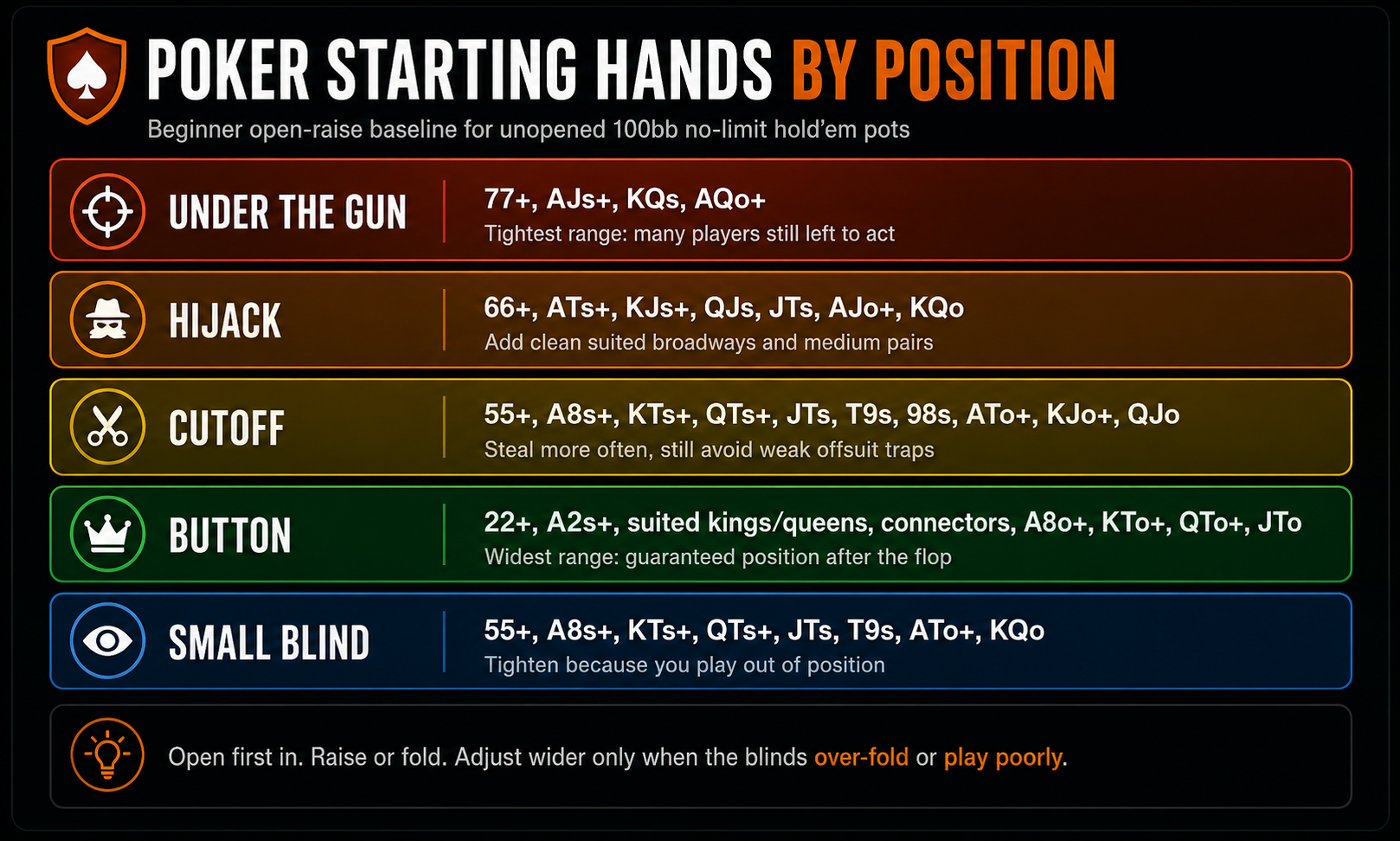
This guide gives you a beginner-friendly preflop chart for no-limit hold'em cash games around 100 big blinds deep. It is not a solver printout and it is not meant to replace judgment. It is a practical baseline you can use while learning which hands to open, which hands to fold, and why late position lets you play more hands.
Why Position Changes Poker Starting Hands
Position is your seat relative to the blinds and button. Early position acts first before the flop and will often act early after the flop. Late position acts after more players and gets more information before making decisions. PokerStars Learn highlights this basic idea in its position lessons: later seats have an informational advantage because more opponents have already acted.
That information changes hand value. A hand like K-J suited is playable from many seats because it can make strong pairs, flushes, and straights. K-J offsuit is different. From early position, it can get called or 3-bet by hands that dominate it: A-K, A-J, K-Q, and better pairs. From the button, after everyone folds, the same hand can attack the blinds profitably because there are only two players left.
Think of position as a permission system. Early position gives you permission to play premiums and clean high-card hands. Middle position adds more suited broadways, medium pairs, and suited aces. The cutoff and button add steal hands because fewer players can wake up with a premium. The small blind is not late position in practice, because you play out of position after the flop.
[INTERNAL: poker positions guide]
The Beginner Chart for Poker Starting Hands by Position
Use this chart for unopened pots when everyone folds to you. "Raise" means open-raise, not limp. Beginners do better with a raise-or-fold strategy because limping invites multiway pots, hides less information, and often leaves you with weak hands out of position.
| Position | Beginner open-raise hands |
|---|---|
| Under the gun | 77+, AJs+, KQs, AQo+ |
| Hijack | 66+, ATs+, KJs+, QJs, JTs, AJo+, KQo |
| Cutoff | 55+, A8s+, KTs+, QTs+, JTs, T9s, 98s, ATo+, KJo+, QJo |
| Button | 22+, A2s+, K8s+, Q9s+, J9s+, T8s+, 98s-65s, A8o+, KTo+, QTo+, JTo |
| Small blind | 55+, A8s+, KTs+, QTs+, JTs, T9s, ATo+, KQo |
| Big blind | Do not open; defend or raise after someone else acts |
This chart is intentionally conservative. It keeps beginners away from the worst dominated offsuit hands while still teaching the real pattern: tighter first, wider later. Upswing Poker's starting-hand and chart resources make the same broad point that starting hands depend heavily on position and context.
Do not treat every listed hand as automatic. If the table is aggressive and players are 3-betting often behind you, tighten the weaker suited connectors and offsuit broadways. If the blinds are folding too much, your cutoff and button can open wider. If the game has high rake and many callers, hands that make weak one-pair holdings lose value.
How to Read the Chart Without Memorizing 169 Squares
A poker starting hand chart is a range. PokerStrategy defines a range as the set of possible hands a player can have, and preflop charts usually compress no-limit hold'em into 169 starting-hand classes: 13 pairs, 78 suited non-pair hands, and 78 offsuit non-pair hands.
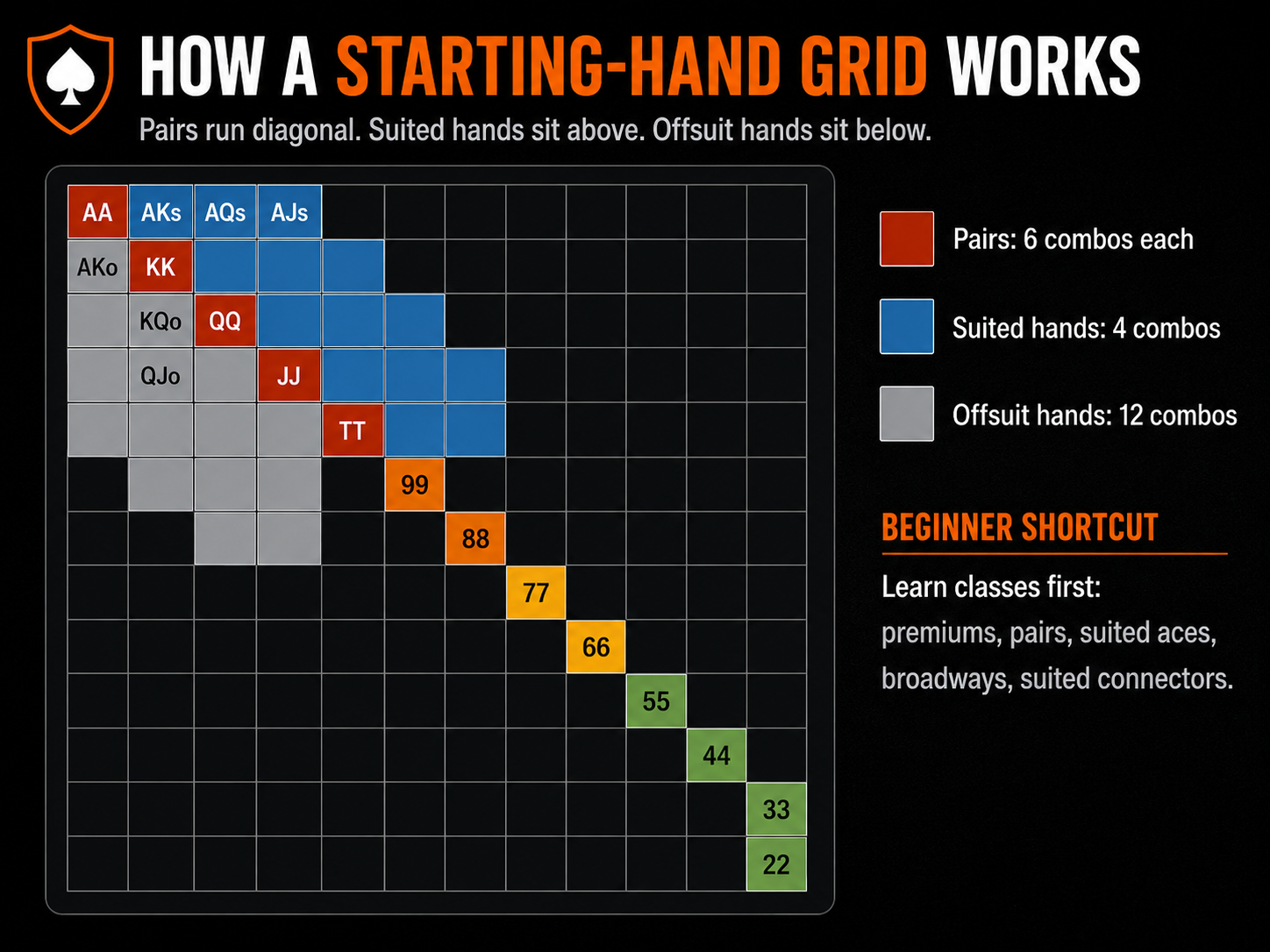
You do not need to memorize all 169 cells at once. Learn hand classes first.
Premium pairs are A-A, K-K, Q-Q, and J-J. These hands are strong from every seat and should usually be raised for value. Strong pairs like T-T through 7-7 are still good opens, but they become more sensitive to position and table aggression. Small pairs can make sets, but they dislike being 3-bet and often miss the flop.
Broadways are hands with two cards ten or higher. A-K, A-Q, and K-Q are the cleanest because they make top pair with strong kickers. Suited broadways are more flexible than offsuit broadways because they can continue on more flops.
Suited aces are valuable because they can make nut flushes and useful semi-bluffs. A-5 suited can also make wheel straights. Offsuit weak aces are dangerous for beginners because they often make top pair with a bad kicker.
Suited connectors like 9-8 suited and 8-7 suited play best in position, with deeper stacks, and against opponents who make postflop mistakes. They are not magic. If you call too many raises with them from the blinds, you will bleed money.
Poker Starting Hands From Early Position
Early position is the tightest part of the chart. In a nine-handed game, under the gun has eight players behind. In six-max, the first player still has five players behind. Either way, you are opening into the whole table.
Start with 77+, A-J suited or better, K-Q suited, A-Q offsuit, and A-K offsuit. If the game is soft and passive, you can add hands like A-T suited or K-J suited. If the table is aggressive, stay tighter until you understand who is attacking too often.
Why so tight? Because early-position mistakes compound. When you open K-T offsuit and get called by the button, you play a dominated hand out of position. When you open A-8 offsuit and get 3-bet, folding feels annoying, calling is often worse, and 4-betting is usually too ambitious for a beginner.
Your early-position goal is boring on purpose: enter pots with hands that can stand pressure. Premium pairs can 4-bet or call 3-bets. A-K and A-Q block strong ace hands and make strong top pair. Suited broadways can flop equity when called.
The beginner leak is trying to "mix it up" too early. You do not need early-position deception if your opponents are not exploiting your folds. You need fewer tough spots with weak kickers.
Poker Starting Hands From Middle Position
Middle position gives you more room. You still have dangerous seats behind, but fewer than under the gun. This is where you can add 66, A-T suited, K-J suited, Q-J suited, J-T suited, A-J offsuit, and K-Q offsuit.
These additions make sense because the risk of running into a premium is lower and you will sometimes win the blinds uncontested. You also start to include more hands that play well as single-raised pots: suited broadways, medium pairs, and connected suited hands.
Be careful with offsuit broadways. K-Q offsuit is a standard open in many middle-position charts, but K-T offsuit and Q-T offsuit are not the same hand. They make dominated top pairs more often and have less flexibility when facing a 3-bet.
If there is a loose caller behind you, lean toward hands that realize equity well: pairs, suited aces, suited broadways, and strong suited connectors. If there is an aggressive 3-bettor behind you, remove the weakest opens and avoid hands that cannot continue.
A simple test helps: if you open this hand and get called by the button, will you be comfortable playing top pair? If the answer is no because your kicker is often dominated, fold the hand from middle position and save it for later seats.
Poker Starting Hands From the Cutoff and Button
The cutoff and button are where beginners should learn controlled aggression. When everyone folds to you in the cutoff, only three players remain. On the button, only the blinds remain and you are guaranteed position after the flop if called.
That is why the chart expands. You can open all pairs, many suited aces, more suited kings and queens, suited connectors, and more offsuit broadways. On the button, hands like A-8 offsuit, K-T offsuit, Q-T offsuit, J-T offsuit, 8-7 suited, and 7-6 suited can become reasonable opens in many games.
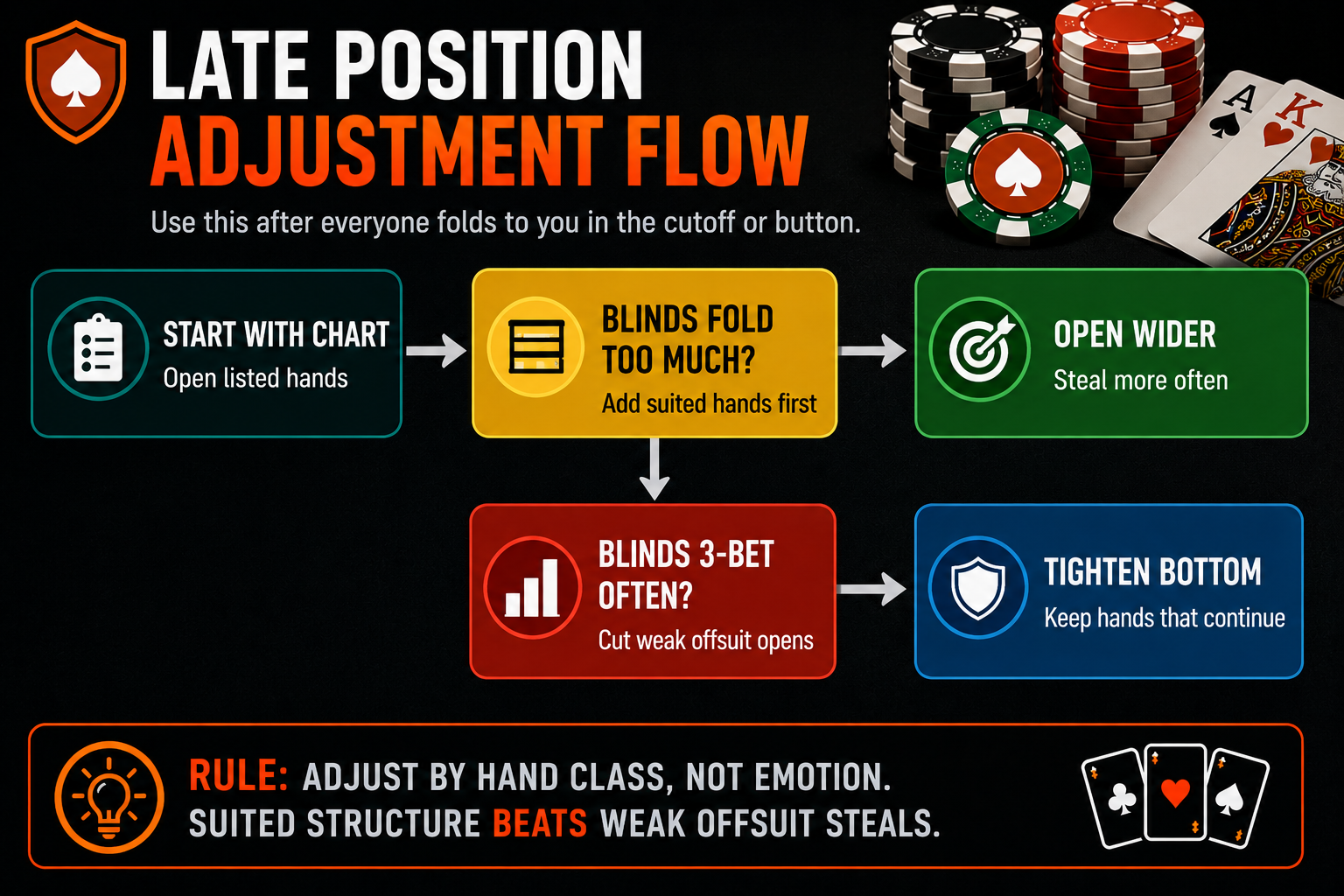
Late-position profit comes from fold equity plus position. Sometimes the blinds fold and you win immediately. Sometimes they call and you play a pot with more information. Sometimes they 3-bet and you fold the bottom of your range without drama.
Do not confuse wider with reckless. Hands such as Q-7 offsuit, J-5 suited, T-6 offsuit, and 9-4 suited still create too many weak pairs and low-equity flops for beginners. Your first job is to open hands that have a clear plan when called.
Against tight blinds, open a little wider. Against loose defenders who never fold postflop, trim the weakest offsuit steals and value-bet more when you connect. Against strong players who 3-bet aggressively, keep your button range wide enough to steal but not so wide that you fold everything to pressure.
[INTERNAL: blind stealing strategy]
Poker Starting Hands in the Blinds
The blinds are special because you already have money in the pot, but you also play out of position. Many beginners misunderstand this. They defend too wide because they are "getting a discount," then lose more after the flop.
The small blind is the toughest seat. If everyone folds to you, you can raise a range similar to the cutoff in some games, but beginners should start tighter because the big blind has position postflop. Avoid completing with random hands just because it is cheap. Raise hands that can win the pot or play reasonably when called.
The big blind does not open because it is last preflop only after others act. Your decision is usually defend, 3-bet, or fold. You can call wider against a small button raise than against a large under-the-gun raise because the price and opponent's range are different.
Use this beginner defense rule: defend hands that are suited, connected, paired, or high-card enough to make strong top pair. Fold offsuit trash even when it feels cheap. J-4 offsuit, T-3 offsuit, and 8-2 suited do not become profitable just because you posted a blind.
When you 3-bet from the blinds, start value-heavy: A-A through T-T, A-K, A-Q suited, and some A-Q offsuit or suited wheel aces as you improve. Do not build a fancy bluffing range before you can identify who actually folds to 3-bets.
Raise, Call, or Fold With Poker Starting Hands
Most beginner preflop mistakes come from calling too much. Calling feels safe because you are not risking a bigger raise, but it often puts you in pots without initiative. Raising gives you two ways to win: opponents can fold now, or you can continue with the betting lead after the flop.
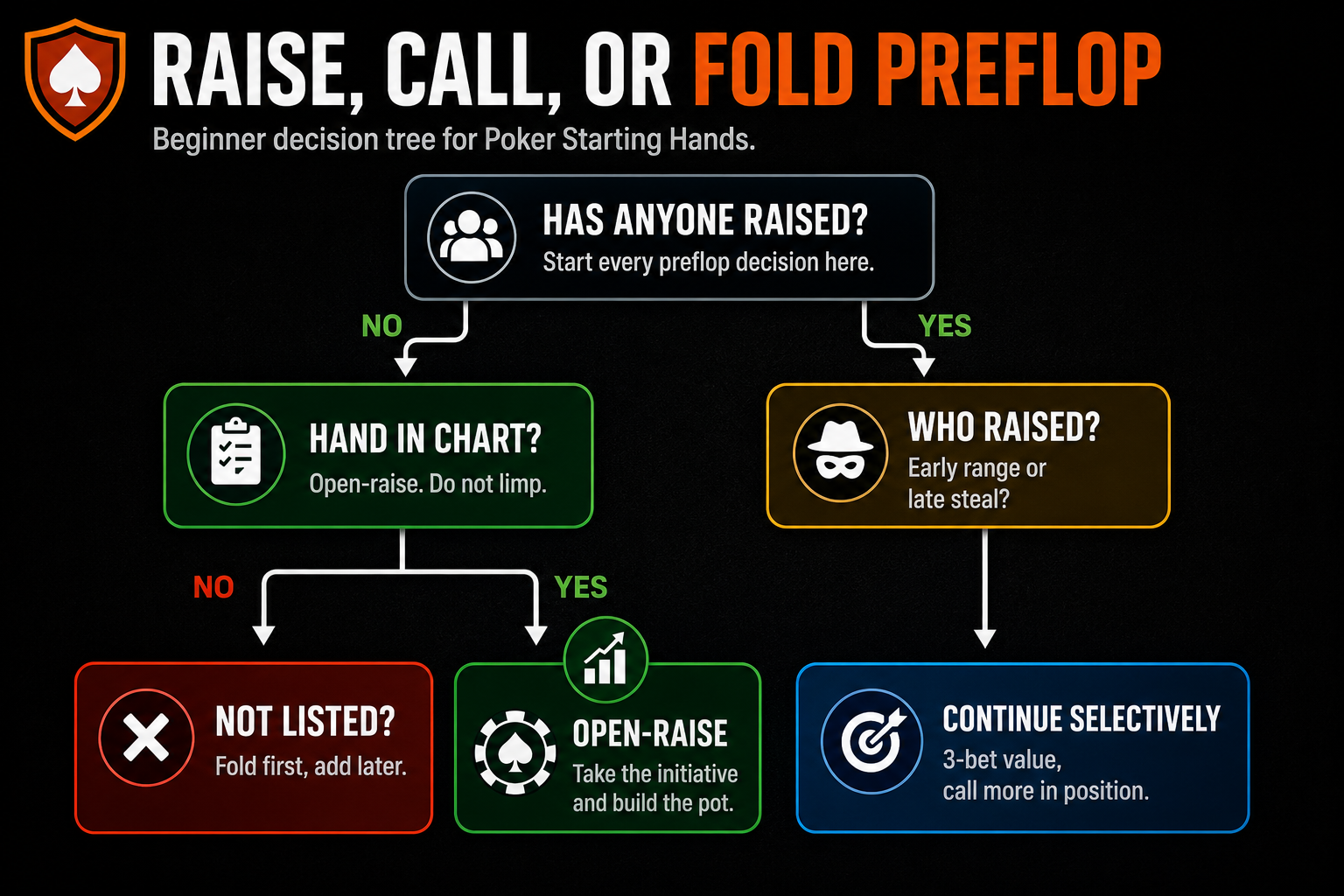
If everyone folds to you and your hand is in the chart, open-raise. If your hand is not in the chart, fold until you have a clear exploitative reason to add it. If someone already raised, the chart changes. You should not flat-call every hand you would have opened.
Against an early-position raise, continue tightly. Hands like A-Q, J-J, T-T, and suited broadways can be playable, but weak offsuit broadways shrink in value. Against a button raise, you can defend or 3-bet more from the blinds because the button range is wider.
Use calling ranges with care. Calling on the button with a suited connector can be fine against a loose opener and passive blinds. Calling in the small blind with the same hand is much worse because you invite the big blind in and play out of position.
The clean beginner framework is:
- Open-raise first in.
- 3-bet strong hands for value.
- Call more in position than out of position.
- Fold dominated offsuit hands without regret.
- Add bluffs only against opponents who can fold.
When to Tighten or Loosen Your Preflop Chart
GTO Wizard's work on preflop range morphology emphasizes that ranges change with incentives such as position, stack depth, rake, antes, and prior action. A chart is a starting point, not a law.
Tighten when the game has high rake, players behind you 3-bet often, stacks are short, or the opener is strong and early. High rake punishes marginal small pots. Short stacks reduce implied odds for small pairs and suited connectors. Aggressive players behind make weak opens less attractive.
Loosen when the blinds over-fold, stacks are deep, antes are in play, or opponents call too wide and play poorly after the flop. Deep stacks increase the value of hands that can make hidden strong hands, especially in position. Antes create more dead money, which rewards stealing.
Adjust by hand class, not by random mood. If you want to open wider on the button, add suited hands before weak offsuit hands. If you want to tighten under the gun, remove A-T suited and K-J suited before removing A-K or Q-Q. If you face more 3-bets, keep hands that can continue and cut hands that fold too often.
PokerCoaching.com's preflop strategy material also reinforces a practical beginner point: enter pots with purpose. Know whether you are raising for value, stealing, isolating a weak player, calling with position, or folding because your hand is dominated.
Adjust the Chart for 6-Max, 9-Max, and Tournaments
The chart above works best as a beginner cash-game baseline. For 6-max, remove the earliest full-ring seats and expect everyone to reach late-position ranges more often. Upswing's 6-max strategy material frames short-handed poker as naturally more aggressive because fewer players are dealt in.
In 9-max live games, early position matters more. If you are first in from under the gun at a full table, keep the tightest range. Many low-stakes live games are also multiway, which means offsuit broadways lose value and hands that make strong disguised hands can improve in position.
Tournaments require stack-depth adjustments. At 15 to 25 big blinds, small pairs and suited connectors lose some implied-odds value, while hands that can raise-call or shove profitably become more important. Antes also make stealing more attractive, especially from the cutoff, button, and small blind.
Do not use one cash-game chart blindly in every tournament spot. ICM pressure, payouts, stack distribution, and opponent stack sizes matter. As a beginner, the safest adjustment is simple: play tight from early position, attack late position when stacks and opponents allow it, and avoid calling off with pretty hands that cannot handle all-in pressure.
[INTERNAL: tournament preflop ranges]
Common Beginner Mistakes With Poker Starting Hands
The first mistake is overvaluing any ace. A-9 offsuit looks strong because it has an ace, but when it makes top pair against A-Q or A-K, you lose a bigger pot. Weak suited aces are more playable than weak offsuit aces because they can make nut flushes and better semi-bluffs.
The second mistake is calling because a hand is "too good to fold." K-J offsuit may be an open on the button, but that does not mean it is a call against a tight under-the-gun raise. Starting-hand value changes after someone else enters the pot.
The third mistake is opening suited junk. Suitedness helps, but it does not rescue bad structure. K-4 suited, Q-6 suited, and 9-3 suited still make weak pairs. They also miss most flops.
The fourth mistake is ignoring raise size. A hand that defends profitably against a 2.2 big blind button open may be a clear fold against a 5 big blind early-position open. Bigger raises require tighter continues.
The fifth mistake is refusing to update. If the button is folding blinds too often, widen. If the big blind is a strong regular attacking you, tighten or build better 4-bet plans. If a passive player 3-bets, respect it until shown otherwise.
Practice Routine for Learning the Chart
Do not try to memorize every cell in one sitting. Learn one seat at a time.
Start with under the gun and the button because they show the contrast. Under the gun is tight and value-focused. The button is wide and position-driven. Once those are clear, add hijack, cutoff, and small blind.
Review your database or hand histories by position. Look for voluntary put-money-in-pot decisions with hands outside the chart. Sort losing hands by position. You will often find the same leaks: weak offsuit aces from early position, dominated broadways from the blinds, and suited hands that looked prettier than they played.
In live games, keep a simple note after each session. Write down three preflop spots where you were unsure. Later, compare them to the chart and ask one question: was the problem the hand, the position, the prior action, or the opponent?
You can also drill by dealing random hands and naming the earliest position you would open them. A-Q offsuit? Early position. K-J suited? Middle position in many games. 8-7 suited? Cutoff or button. A-6 offsuit? Usually button, sometimes cutoff if the blinds are weak, rarely early.
The goal is not robotic poker. The goal is to build a clean default so your adjustments are intentional.
Take Action Now
Print the chart, save it, or rebuild it in your own words. Then play one session where you make every first-in decision from position before looking for fancy exceptions. If you want to improve your Poker Starting Hands quickly, start by folding the dominated hands that create the hardest postflop spots.
Frequently Asked Questions
What are the best Poker Starting Hands for beginners?
The best beginner hands are premium pairs, strong broadways, and suited hands that make strong top pair or nut draws. Start with A-A through J-J, A-K, A-Q, K-Q suited, medium pairs, suited aces, and suited broadways. Add more speculative hands from later position.
Should beginners limp with small pairs?
Usually no. Open-raising or folding is cleaner when everyone folds to you. Calling with small pairs can be reasonable in position against a raise when stacks are deep and opponents pay off sets, but limping first in creates passive multiway pots and weakens your range.
Why can I play more hands on the button?
You can play more hands on the button because only the blinds remain preflop and you act last after the flop. That extra information lets you realize equity better, bluff more accurately, and control pot size with medium-strength hands.
Are suited connectors good Poker Starting Hands?
Suited connectors are good in the right seats, especially cutoff and button, with deeper stacks and opponents who make postflop mistakes. They are poor automatic calls from the blinds or against large raises because they miss often and can be hard to play out of position.
How often should I change my preflop chart?
Change it when the game changes. Tighten against aggressive players, high rake, short stacks, and strong early-position opens. Loosen against tight blinds, antes, deeper stacks, and weak opponents who fold too much or play poorly after the flop.