Poker Bankroll Management: How Many Buy-Ins Do You Really Need?
Poker Bankroll Management: How Many Buy-Ins Do You Really Need?
Poker Bankroll Management is not about finding the one magic number that keeps every player safe forever. It is about matching your bankroll to the game you actually play, the edge you realistically have, the variance in that format, and how willing you are to move down before a downswing becomes a crisis.
Most players ask, "How many buy-ins do I need?" because they want permission to play a certain stake. A better question is, "How many buy-ins do I need to keep making good decisions after I lose ten, twenty, or fifty of them?" That shift matters. A bankroll is not a scoreboard. It is your operating capital. If it gets too small, you stop choosing the best games and start choosing the games that feel like they can rescue you.
This guide gives you practical buy-in recommendations for cash games, tournaments, and shots at higher stakes. It also explains when you should be strict with those numbers and how to build a move-up plan that does not depend on running hot for two sessions.
Why Poker Bankroll Management Matters More Than Confidence
Confidence helps you pull the trigger on thin value bets and disciplined bluffs. It does not protect you from variance. You can get all in with aces against kings, make a correct river call against a missed draw, or value bet top two pair into a worse hand and still lose the pot. Poker rewards good decisions over large samples, but it punishes players who cannot survive the short term.
That is why bankroll management starts with separation. Your poker bankroll should be money set aside for poker only, not rent money, bill money, or money you need emotionally to feel secure. PokerStrategy defines a buy-in as the amount you pay to enter a game and stresses that bankroll funds should be separate from everyday expenses. That sounds basic, but it changes how you play. When losing two buy-ins affects your life outside poker, you are not just playing a poker hand. You are playing with pressure that should not be in the decision.
Approved training sources also disagree on exact numbers because they are solving different problems. PokerStars Learn gives broad recreational-to-serious guidelines. GTO Wizard frames bankroll management through variance, risk profile, and Kelly-style thinking. Upswing often recommends more conservative numbers for online cash and MTTs because online volume and tournament variance can produce brutal downswings. The lesson is not that one source is "right" and the others are "wrong." The lesson is that your required bankroll changes with format, edge, volume, and risk tolerance.
Use the ranges in this article as a decision framework, not as a badge of toughness. If you are asking whether you can take a shot with 18 buy-ins because the game looks soft, the real answer may be yes, but only if you already know exactly where you move down.
Poker Bankroll Management Buy-In Recommendations by Format
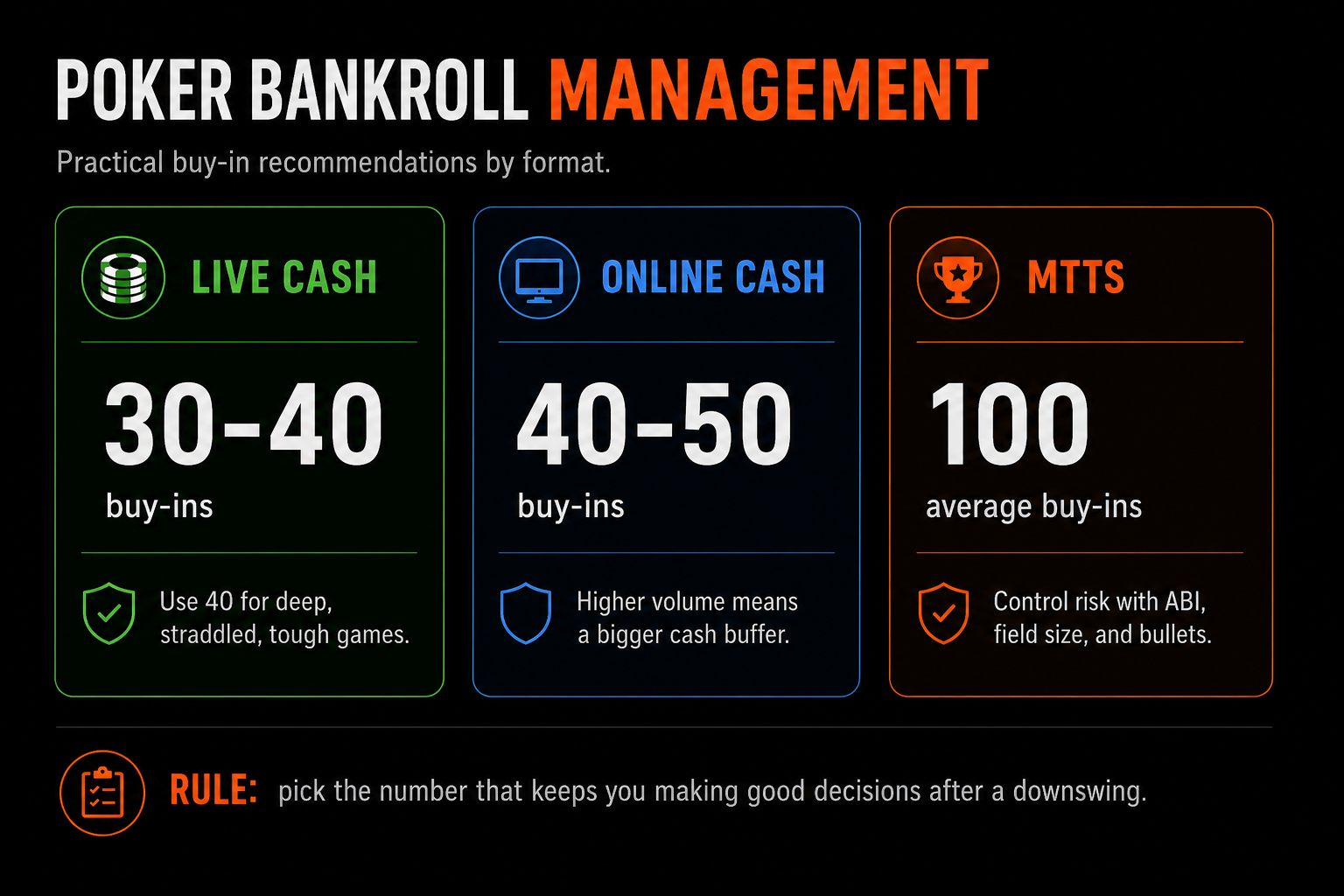
Here is a practical starting point for no-limit hold'em players. These are not laws. They are baseline ranges you can tighten or loosen after you account for your edge, game quality, volume, and ability to reload.
| Format | Recommended bankroll |
|---|---|
| Live cash games | 30-40 buy-ins |
| Online cash games | 40-50 buy-ins |
| MTTs | 100 average buy-ins |
Use the lower end of a cash-game range only when your edge is proven, your life-pressure is low, and you will move down quickly. Use the upper end when your edge is thinner, the games are tougher, or losing affects your decision quality. For MTTs, treat 100 average buy-ins as the baseline and manage risk by controlling your average buy-in, field size, structure, and re-entry habits.
Cash Game Buy-Ins
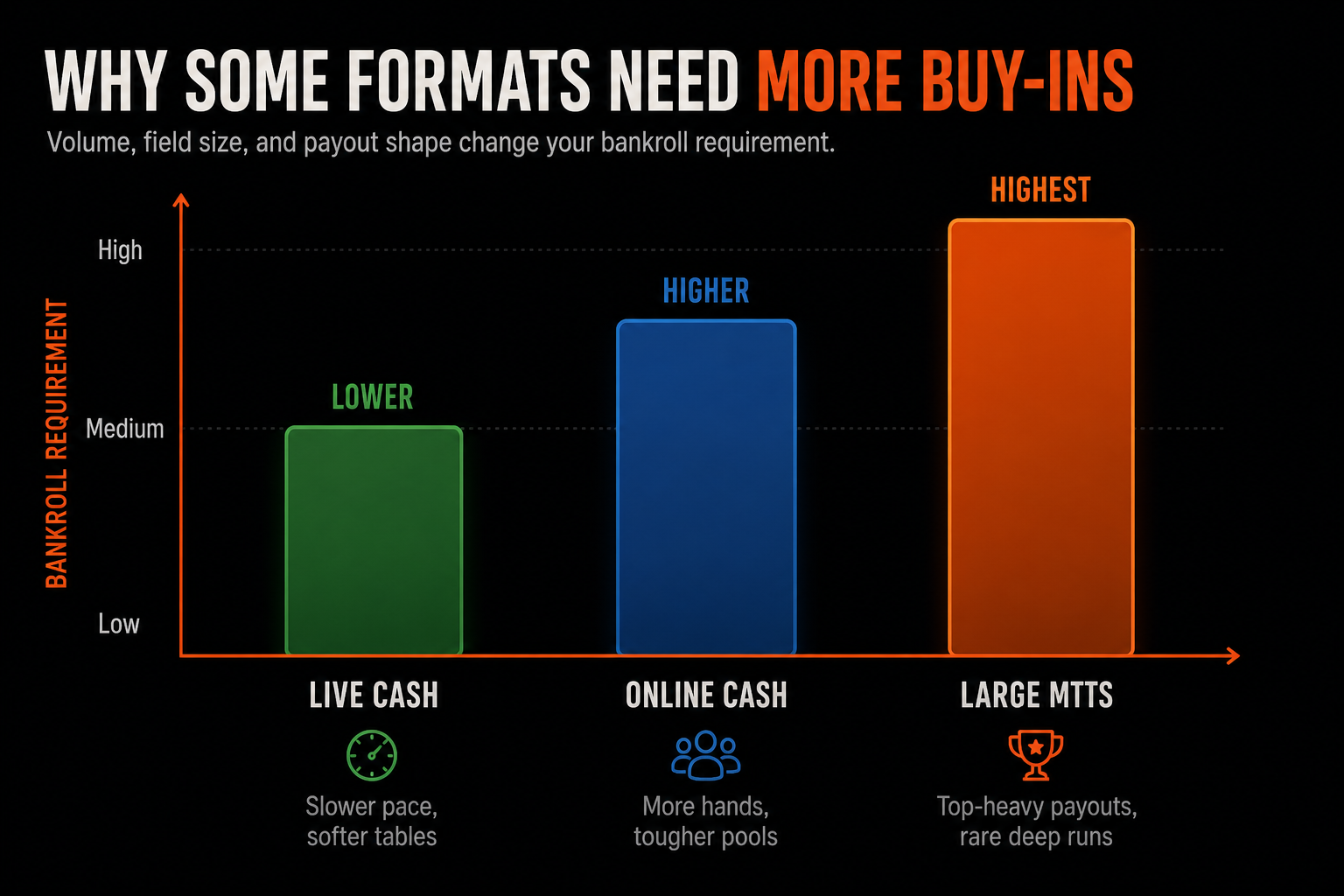
For live cash games, 30 to 40 buy-ins is the practical target because the games are often softer, the pace is slower, and your hourly volume is lower. A $1/$2 player buying in for $200 would treat $6,000 to $8,000 as the working roll. If the room is splashy and you are clearly beating it, the lower end may be reasonable. If the game often plays deep, straddled, and aggressive, stay closer to 40.
Online cash is different. You play more hands per hour, face tougher pools sooner, and see downswings faster. A 10 buy-in losing stretch live may take weeks. Online, it can happen in a few long sessions. That is why a $25NL player using 100 big blind buy-ins should think carefully before treating $750 as a full bankroll. Thirty buy-ins may feel like a lot until a small win rate collides with normal variance. For a serious online cash plan, 40 to 50 buy-ins is the cleaner baseline.
Tournament Buy-Ins
Tournaments require more protection because payouts are top-heavy and deep runs are rare. You can play well for weeks and still have very little to show for it if your strong hands lose before the final three tables. Large-field MTTs, turbo structures, PKOs, and re-entry formats increase variance further because more of your return comes from rare high finishes or high-leverage all-ins.
A $5 average buy-in MTT player with a $500 bankroll has 100 average buy-ins. That is the target. It is stronger if the schedule is mostly small-field $3 to $5 tournaments with slower structures, and it is under more pressure if the schedule is mostly 2,000-player fields, turbos, and multiple bullets. When the schedule gets swingier, the adjustment should be a lower average buy-in, fewer re-entries, or softer fields, not pretending the same event is cheaper than it is.
The Real Factors Behind Your Buy-In Number
The right bankroll is a product of four variables: your win rate, the format's variance, your volume, and your ability to move down. If you ignore any one of those, your buy-in rule becomes a slogan.
Win rate matters because a bigger edge reduces your risk of ruin. A player winning 10 big blinds per 100 hands can handle a smaller roll than a player winning 2 big blinds per 100 hands in the same pool. But most players overestimate their edge, especially after an upswing. Until you have a meaningful sample, assume your edge is smaller than it feels.
Variance matters because some games naturally swing harder. Online six-max cash has more volume and more aggressive pools than a slow live full-ring game. MTTs have more extreme payout distribution than cash games. PKOs add bounty incentives that force wider all-in ranges. Turbos shorten stacks quickly, which turns small edges into frequent all-in decisions.
Volume matters because the more you play, the faster variance arrives. A recreational player who plays one live session per week may experience downswings slowly enough to adjust. A grinder playing 50,000 hands a month needs rules that account for frequent losing stretches. More hands do not make variance disappear. They just reveal it faster.
Move-down discipline matters most because it is the safety valve. A 40 buy-in bankroll with strict move-down rules can be safer than a 70 buy-in bankroll piloted by someone who refuses to leave a game after losing half of it. Your plan has to include the uncomfortable action before you need it.
A Simple Risk Profile Test
Ask yourself these questions before choosing the number:
- Can I replace this bankroll from outside income without stress?
- Am I a proven winner at this stake over a meaningful sample?
- Will I move down immediately when the rule says to?
- Is this game soft enough to justify a thinner roll?
- Does this format have high variance because of field size, structure, or re-entries?
- Will losing ten buy-ins make me chase, play longer, or study less honestly?
If you answer "no" to the first three or "yes" to the last two, choose the conservative side. Bankroll management is partly math, but it is also self-knowledge. Some players can take controlled shots and move down calmly. Others turn a shot into a new default stake because moving down feels like failure. Build rules for the player you are, not the player you imagine you will become during a downswing.
Poker Bankroll Management for Taking Shots
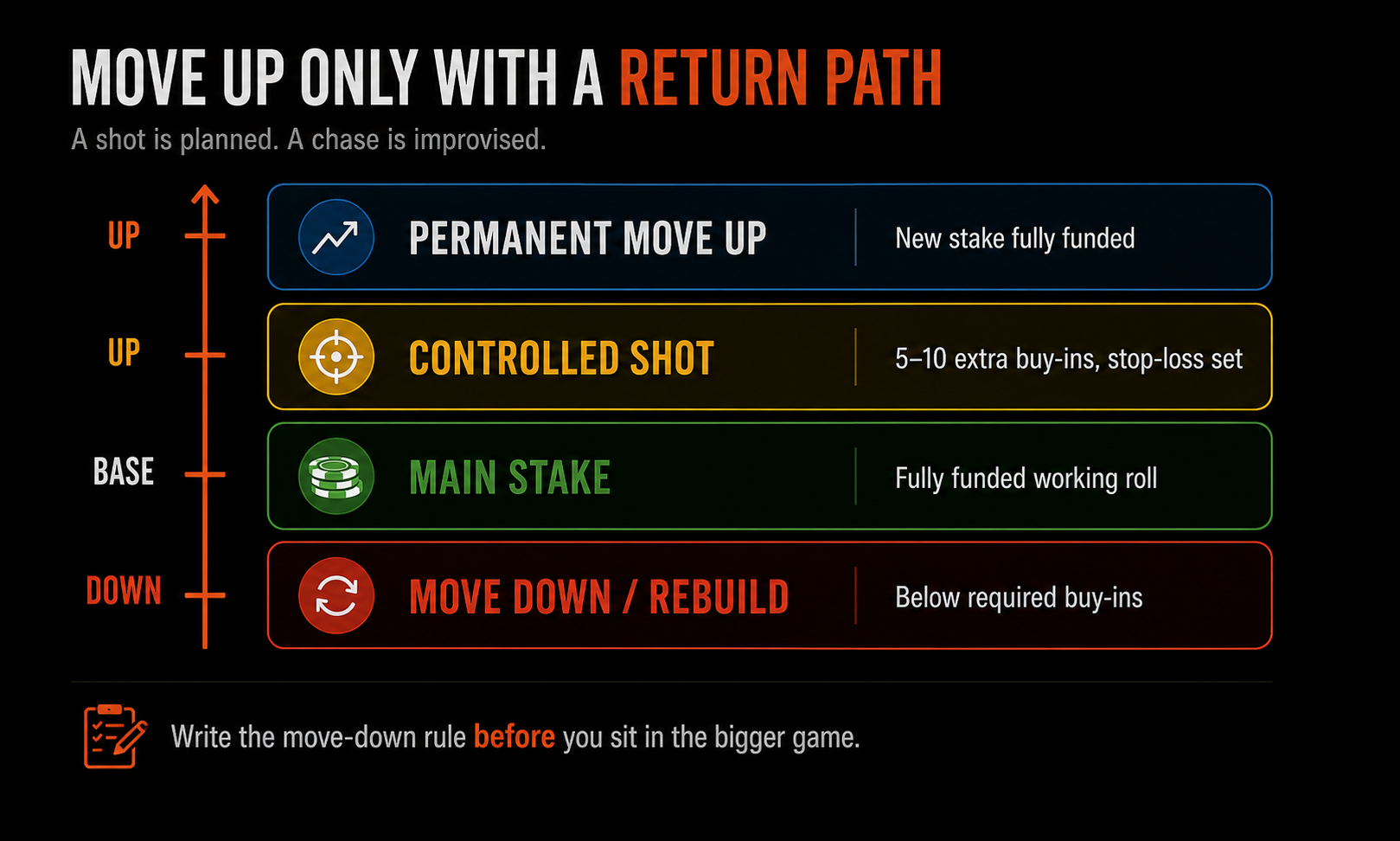
Moving up is not the same as abandoning your current stake. A shot is a planned experiment with a stop-loss, a target, and a return path. Without those three pieces, it is just gambling at a higher price.
For cash games, a clean shot-taking rule looks like this:
- Keep your main stake fully funded.
- Take a shot when you have 5 to 10 extra buy-ins for the next stake.
- Move back down if you lose 3 to 5 shot buy-ins.
- Stay up only after the new stake still leaves you with your required bankroll.
Suppose you play $25NL online and require 50 buy-ins, or $1,250. You want to try $50NL, where one buy-in is $50. Instead of moving up at $1,500 and hoping, you might set $1,750 as the shot point. That gives you your $1,250 base plus ten $50NL shot buy-ins. If you lose $200 to $250, you move back to $25NL with your main bankroll intact. If you win and stabilize above your $50NL requirement, the shot becomes a move.
For live cash, shot-taking can be more flexible because game quality varies. A $1/$2 player may find a $2/$5 table with two deep recreational players and one short waitlist. A controlled shot can be good business. But the rule still needs numbers. "The game was good" is not a stop-loss. Decide before sitting down whether you are risking one buy-in, two buy-ins, or a specific dollar amount.
For tournaments, shots should usually come through schedule mixing rather than one-off ego entries. If your average buy-in target is $11, you can mix in a small number of $22 events while keeping your average under control. PokerStars Learn makes this point with average buy-ins: you do not need every event to be exactly the same price, but your schedule should average to a number your bankroll can support.
When to Move Down Before It Gets Ugly
Moving down is not punishment. It is maintenance. The best bankroll rules tell you what to do when things are going badly, because that is when your judgment is most vulnerable.
For cash games, consider a two-threshold system:
- Warning threshold: when you lose 20% of your bankroll, review hands and reduce table count or game difficulty.
- Move-down threshold: when you fall below your required buy-ins for the current stake, move down immediately.
If you start $50NL with $2,500 using a 50 buy-in rule, your move-down threshold is not "when I feel scared." It is when your bankroll no longer supports the stake. If you fall to $2,000, you now have 40 buy-ins. Depending on your plan, that may trigger a move to $25NL or a temporary reduction in volume while you rebuild.
For tournaments, move-down rules should use average buy-in. If your bankroll falls from $3,000 to $2,000, your $22-heavy schedule may no longer make sense. You can still play poker. You just need a smaller average buy-in, fewer re-entries, more satellites, or more small-field events.
The biggest mistake is treating a downswing as proof you need to play higher to win it back faster. That logic turns variance into bankroll damage. Upswing's downswing guidance emphasizes keeping enough buy-ins, moving down, reviewing hands, and taking breaks when needed. Those steps work because they separate the financial problem from the strategy problem.
Bankroll Management Mistakes That Break Good Players
The first mistake is counting money you cannot actually use. A $5,000 checking account is not a $5,000 poker bankroll if $3,000 is needed for life expenses. Your bankroll is the amount you have ring-fenced for poker.
The second mistake is ignoring rake and expenses. Live players often forget gas, food, hotel costs, tips, and time. Tournament players forget that re-entries turn a "$100 event" into a $200 or $300 exposure very quickly. Online cash players forget that rake at micro and low stakes can turn a small theoretical edge into a much thinner real edge.
The third mistake is mixing formats without adjusting the roll. If you play $1/$2 live cash with a 30 buy-in bankroll, then use that same roll to fire large-field online MTTs, your bankroll plan no longer means what you think it means. The same dollar amount can be conservative for one format and reckless for another.
The fourth mistake is moving up because of a short heater. Winning eight buy-ins does not prove you beat the next stake. It proves you won eight buy-ins. Before moving up, look at your hand histories, showdown lines, red-line leaks, table selection, tilt control, and results over a meaningful sample.
The fifth mistake is refusing to use stop-losses. A stop-loss is not a strategy substitute, and it should not force you out of a great game just because you lost one cooler. But if losing three buy-ins changes your decision quality, you need a rule that protects you from yourself.
Database Review for Online Players
If you play online, use your tracker to connect bankroll decisions to actual performance. Review your win rate by stake, position, table size, time of day, and session length. Look at all-in adjusted results, but do not use them as an excuse to ignore real losses. Check whether your biggest losing sessions came from coolers, over-bluffing, thin calls, fatigue, or poor table selection.
Good database questions include:
- Is my win rate at the current stake clearly positive after rake?
- Do I lose more when playing too many tables?
- Are my biggest losses clustered after long sessions?
- Am I taking marginal river calls because I am stuck?
- Do my shot-taking sessions show different VPIP, PFR, 3-bet, or river call behavior?
This is where solver-aware study helps. You do not need to solve every hand to manage your bankroll, but you do need to know whether your losses come from variance or from repeatable leaks. Mark hands where you were uncertain, compare your line against a solver or trusted training process, and separate "standard losing spot" from "avoidable bankroll leak." [INTERNAL: hand history review process]
A Practical Bankroll Plan You Can Use Today
Start by writing down your poker bankroll, your main format, your current stake, and your average buy-in. Then choose a standard number from the format table and adjust it.
For cash games, use the lower end only if the game is soft, your edge is proven, your bankroll is replaceable, and you have strict move-down rules. Use the upper end if your edge is uncertain, you are playing online, or losing affects your decision quality. For MTTs, keep the bankroll rule at 100 average buy-ins and reduce risk by lowering your average buy-in, avoiding unnecessary re-entries, and choosing better structures.
Next, define your current-stake rule:
- "I play $1/$2 live cash with a $200 buy-in and require 35 buy-ins, so my working bankroll is $7,000."
- "I play $25NL online and require 50 buy-ins, so my working bankroll is $1,250."
- "I play MTTs with an $11 average buy-in and require 100 buy-ins, so my working bankroll is $1,100."
Then define your move-down rule:
- "If my live cash bankroll falls below 25 buy-ins, I move down or stop playing until I rebuild."
- "If my online bankroll falls below 40 buy-ins, I move down one stake."
- "If my MTT bankroll falls below 100 average buy-ins, I cut my average buy-in by at least 30%."
Finally, define your shot rule:
- "I take a cash-game shot only with 5 to 10 extra buy-ins for the next stake."
- "I stop the shot after losing 3 to 5 buy-ins."
- "I do not permanently move up until the higher stake is fully funded by my chosen buy-in rule."
That plan may feel slower than simply jumping into the biggest game you can afford tonight. It is also how you keep playing long enough for skill to matter. [INTERNAL: moving up stakes guide]
How Many Buy-Ins Do You Really Need?
If you want the shortest practical answer, use this:
- Live cash: 30 to 40 buy-ins for most serious recreational players.
- Online cash: 40 to 50 buy-ins for most serious players.
- MTTs: 100 average buy-ins.
If you are a casual player with a separate entertainment budget and no concern about reloading, you can use thinner rules. If you are trying to build a roll, move up stakes, or rely on poker income, you need thicker rules. The more important poker money is to you, the less aggressively you should risk it.
Also remember that a "buy-in" must match the game. In a 100 big blind cash game, one buy-in is usually 100 big blinds. In a deep live game where the real effective stacks are 200 to 300 big blinds, your practical exposure is bigger. In tournaments, your average buy-in should include planned re-entries and add-ons. A $55 event is not really a $55 exposure if you routinely fire three bullets.
Bankroll management is not meant to make poker boring. It is meant to keep your decisions independent. When the bankroll is protected, you can fold without fear, value bet without desperation, quit bad games, and study honestly after losing sessions. [INTERNAL: poker study plan]
Take Action Now
Open your results tracker, spreadsheet, or notes app and write a one-page Poker Bankroll Management policy before your next session. Include your current bankroll, approved stakes, required buy-ins, shot-taking rule, and move-down trigger. If you cannot write those numbers clearly, you are not managing a bankroll yet. You are just hoping variance stays friendly.
Frequently Asked Questions
Is 20 buy-ins enough for poker?
Twenty buy-ins is below the recommended working bankroll. It can be a controlled live-cash shot for a player with a strong edge, soft games, and reload comfort, but the normal live cash target is 30 to 40 buy-ins. It is too thin for online cash and tournament players.
How many buy-ins do I need for online cash games?
Most serious online cash players should use 40 to 50 buy-ins. You can use fewer only if you are taking a controlled shot and will move down quickly. Stay closer to 50 if your win rate is uncertain, your pool is tough, or you play high volume.
How many buy-ins do I need for poker tournaments?
For MTTs, use 100 average buy-ins. Your average buy-in matters more than the single biggest event on your schedule, so include planned re-entries and add-ons when you calculate the number.
Should my bankroll rules change if I play live poker?
Yes. Live cash games can often support thinner bankrolls than online cash because the pace is slower and the games may be softer. However, travel costs, tips, deep stacks, straddles, and limited game selection can push the number back up. Treat expenses as part of the plan.
When should I move down in stakes?
Move down when your bankroll falls below the buy-in requirement you set for your current stake, or sooner if losses are affecting your decisions. The best time to move down is before you feel desperate. Rebuilding at a lower stake is part of disciplined Poker Bankroll Management, not a failure.